



Share information:
Diesel injection system of car Peugeot 306

Diesel fuel injection device
Maintaining cleanliness is a mandatory requirement when performing any work on the diesel fuel injection device. It is necessary to thoroughly clean all union nuts of the injection pipes before unscrewing them. The high...
Maintaining cleanliness is a mandatory requirement when performing any work on the diesel fuel injection device. It is necessary to thoroughly clean all union nuts of the injection pipes before unscrewing them. The high...

Precautions when working with fuel injection devices
When carrying out repair work on the fuel injection device, regardless of its volume, impeccable cleanliness is required. In this regard, it is necessary to strictly adhere to the following rules: All work on the fuel...
When carrying out repair work on the fuel injection device, regardless of its volume, impeccable cleanliness is required. In this regard, it is necessary to strictly adhere to the following rules: All work on the fuel...

Fuel filter
The fuel filter should be replaced after the first 10,000 km as part of the initial scheduled inspection, and then every 30,000 km. Condensed water should be drained from the fuel filter every 10,000 km. Either a...
The fuel filter should be replaced after the first 10,000 km as part of the initial scheduled inspection, and then every 30,000 km. Condensed water should be drained from the fuel filter every 10,000 km. Either a...
High pressure fuel pump
To adjust the high-pressure fuel pump, a special tool is required, that is, it is necessary to have locking rods for adjusting the valve timing mechanism. The following description assumes the existence of such a tool....
To adjust the high-pressure fuel pump, a special tool is required, that is, it is necessary to have locking rods for adjusting the valve timing mechanism. The following description assumes the existence of such a tool....

Removal and installation a Lucas pump
Disconnect the battery. Raise the right front wheel and place the right side of the car on stands. The wheel should sag freely. Remove the plastic fender from the wheel arch. To protect the alternator from diesel fuel,...
Disconnect the battery. Raise the right front wheel and place the right side of the car on stands. The wheel should sag freely. Remove the plastic fender from the wheel arch. To protect the alternator from diesel fuel,...

Removal and installation a Bosch pump
The Bosch pump is removed in the same way as the Lucas pump. However, the injection timing adjustment on both types of pumps is fundamentally different. The Bosch pump is adjusted according to the following...
The Bosch pump is removed in the same way as the Lucas pump. However, the injection timing adjustment on both types of pumps is fundamentally different. The Bosch pump is adjusted according to the following...
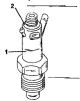
Injectors — checking, removal and installation
Injectors are tested under pressure and repaired in a specialized workshop. These works should never be carried out independently, since in addition to the need for a special tool, there is a risk of injury from the...
Injectors are tested under pressure and repaired in a specialized workshop. These works should never be carried out independently, since in addition to the need for a special tool, there is a risk of injury from the...

Glow plugs
Power is supplied to the glow plugs when the ignition key is turned to the preheat position. The supply voltage is at least 11.5 volts, and the glow plugs heat up to a temperature of approximately 150°C within a few...
Power is supplied to the glow plugs when the ignition key is turned to the preheat position. The supply voltage is at least 11.5 volts, and the glow plugs heat up to a temperature of approximately 150°C within a few...
Adjusting the high-pressure fuel pump
The adjustment of the high-pressure fuel pump in the Lucas injection device and in the Bosch injection device is performed differently. Therefore, before carrying out adjustment work, you should make sure that the...
The adjustment of the high-pressure fuel pump in the Lucas injection device and in the Bosch injection device is performed differently. Therefore, before carrying out adjustment work, you should make sure that the...

Bosch high-pressure fuel pump (except turbodiesel engines)
The adjustment is made using Figure 422. A description of the complete adjustment is given, which, naturally, is not always carried out. Figure 422. Adjusting the Bosch high-pressure fuel pump (conventional diesel...
The adjustment is made using Figure 422. A description of the complete adjustment is given, which, naturally, is not always carried out. Figure 422. Adjusting the Bosch high-pressure fuel pump (conventional diesel...

Bosch high-pressure fuel pump (turbo diesel engine)
Adjustment is made using Figure 425. Figure 425. Adjusting the Bosch high-pressure fuel pump (turbodiesel engine). References to digital designations are given in the text. Idle speed increase device On a cold engine,...
Adjustment is made using Figure 425. Figure 425. Adjusting the Bosch high-pressure fuel pump (turbodiesel engine). References to digital designations are given in the text. Idle speed increase device On a cold engine,...

Lucas high pressure fuel pump
Adjustments are made using Figure 427. Figure 427. Lucas high-pressure fuel pump adjustment. References to numerical and letter designations are given in the text. Adjusting the idle speed increase device - cold engine...
Adjustments are made using Figure 427. Figure 427. Lucas high-pressure fuel pump adjustment. References to numerical and letter designations are given in the text. Adjusting the idle speed increase device - cold engine...

Turbocharger — removal and installation
Figure 429 shows the layout of the turbocharger and air intake system of a turbodiesel engine. The turbocharger is connected to the air filter and charge air cooler and is bolted to the intake manifold pipe at the other...
Figure 429 shows the layout of the turbocharger and air intake system of a turbodiesel engine. The turbocharger is connected to the air filter and charge air cooler and is bolted to the intake manifold pipe at the other...
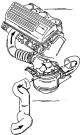
Air filter
Figure 431 shows a typical air cleaner location on a non-turbocharged diesel engine. On an engine running with a catalytic converter, the connection is slightly different, as the hose is connected to the rear of the...
Figure 431 shows a typical air cleaner location on a non-turbocharged diesel engine. On an engine running with a catalytic converter, the connection is slightly different, as the hose is connected to the rear of the...
Turbocharger malfunctions
The engine can develop its full power only when the turbocharger is operating normally. If something is wrong with the engine, you can tell by the engine's smoke signals. In many cases, you can fix the malfunction...
The engine can develop its full power only when the turbocharger is operating normally. If something is wrong with the engine, you can tell by the engine's smoke signals. In many cases, you can fix the malfunction...
Brief information about turbochargers
For beginners who own a turbocharged car for the first time: Basically, the turbocharging system consists of three parts, namely the turbocharger, the relief valve and the charge air cooler. A turbocharger is an add-on...
For beginners who own a turbocharged car for the first time: Basically, the turbocharging system consists of three parts, namely the turbocharger, the relief valve and the charge air cooler. A turbocharger is an add-on...
This section is available on russian, bulgarian, belarusian, ukrainian, serbian, croatian, romanian, polish, slovak, hungarian
See similar information for other Peugeot models
➨ Power unit: Single point fuel injection Peugeot 405 (1987-1997)
➨ Power unit: Fuel injection (petrol) Peugeot 807 (2002-2014)
Link to this section in different formats
TEXTHTMLBB Code
- User manual
- Keys, doors and alarm
- Controls and instruments
- Driving and operation
- Maintenance
- Power unit
- Petrol engines TU3 and TU5
- Petrol engines EW10
- Diesel engines DV10
- Diesel engines DW10
- Transmission
- Clutch and drive shafts
- Mechanical gearbox
- Automatic gearbox
- Chassis, running gear
- Front suspension
- Rear suspension
- Steering
- Brake system
- Body and interior
- Exterior (external elements)
- Interior (internal elements)
- Doors, locks and windows
- Heating and air conditioning
- Electrical equipment
- Equipment and devices
- Power devices
- Airbags
- Electrical circuits
- General information
- Introduction to manual
- Specifications
- Gasoline engine
- Engine repair
- Lubrication system
- Cooling system
- Fuel injection
- Ignition system
- Diesel engine
- Engine repair
- Lubrication system
- Cooling system
- Fuel injection
- Transmission
- Clutch
- Gearbox
- Drive shafts
- Chassis, running gear
- Steering system
- Front suspension
- Rear suspension
- Brake system
- Electrical equipment
- Power devices
- Electrical circuits
- General information
- Maintenance
- Power unit
- Gasoline engines
- Diesel engines
- Cooling system (gasoline)
- Cooling system (diesel)
- Fuel system (gasoline)
- Fuel system (diesel)
- Ignition system
- Transmission
- Clutch
- Mechanical gearbox BB8
- Mechanical gearbox BE1
- Automatic gearbox ZF4
- Shafts, hubs and wheels
- Chassis, running gear
- Brake system
- Car suspension
- Steering
- Body and interior
- Exterior (external elements)
- Interior (internal elements)
- Electrical equipment
- Equipment and devices
- Headlights and lighting
- Power devices
- Electrical circuits
- Wiring diagrams (diesel)