English Русский
Български
Беларускі
Український
Српски
Hrvatski
Română
Polski
Slovenský
Magyar
Bookmark Articles Sitemap Contacts
Company Hyundai Company Opel Company Skoda Company Kia Company Mitsubishi Company LADA Company Audi
PeugeotBook.ru


Series 100   Series 200   Series 300   400-500   Series 600   Crossovers   Others
 
Peugeot 605 (1989-2000)

Description and history of generations of Peugeot 600 series

  • Main
  • 60X
601 ↓ · 604 ↓ · 605 ↓ · 607 ↓

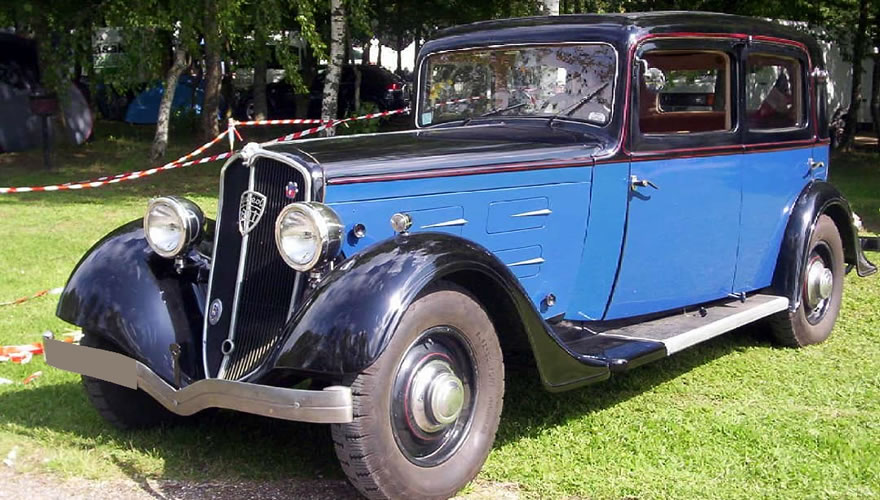
Peugeot 601 (1934-1935)


Peugeot 601, 1934 year, sedan 
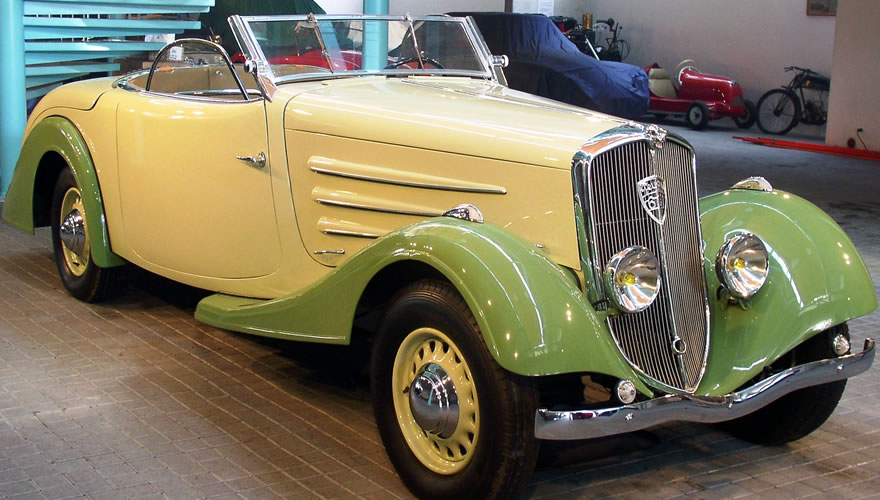
Peugeot 601, 1934 year, sedan
Peugeot 601 — a large passenger car (D-segment) of the French company "Peugeot", produced from May 1934 to October 1935. Replaced the outdated "Type 183", which was produced from 1928 to 1932. Front suspension independent type MacPherson. The body was a four-door sedan or limousine, as well as a two-door convertible, roadster or coupe. There were two wheelbases - the usual "Normale" 2980 mm and extended "Longue" 3200 mm. Depending on the base, the length of the car varied from 4600 to 5080 mm, the width is the same for all bodies 1600 mm.

Peugeot 601 Eclipse, 1934 year 
Peugeot 601 Eclipse, 1934 year
The curb weight was between 1180 and 1400 kg. About 4 thousand cars were produced in 18 months.

The engine was located longitudinally in the front, with rear-wheel drive. The engine was a six-cylinder in-line engine with a volume of 2.2 liters (2148 cm³) and a power of 60 hp. Due to the large weight of the car, the maximum speed was only 105 km/h.

Peugeot 604 (1975-1985)


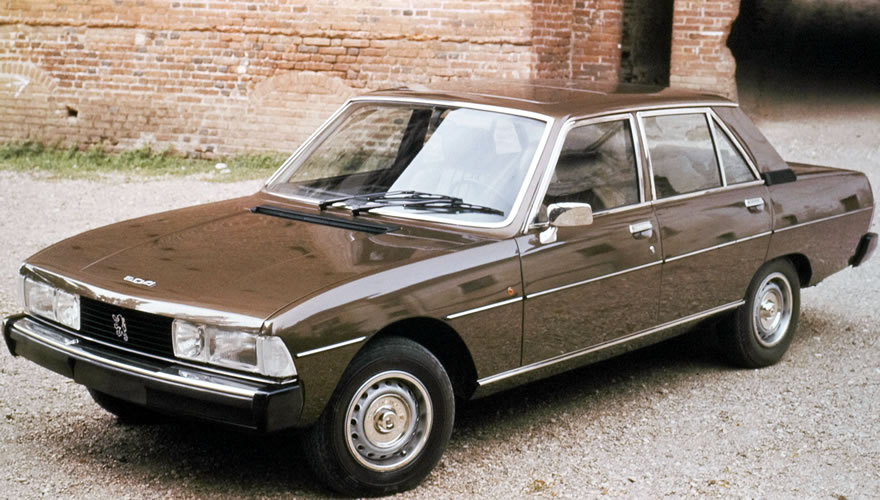
Peugeot 604, 1975 year, sedan 
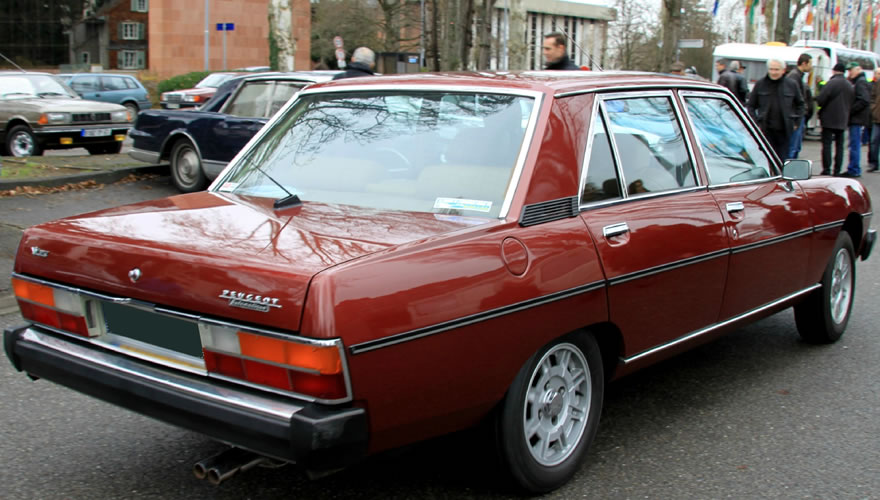
Peugeot 604, 1975 year, sedan
Peugeot 604 — is a representative car (E-segment) of the French company "Peugeot", which was produced from September 1975 to November 1985. It was presented at the Geneva Motor Show in March 1975. The design was developed by the Italian company "Pininfarina". This was the first executive class Peugeot car in over 40 years. The body was only a four-door sedan, 4720 mm long, 1770 mm wide, 1435 mm high, 2800 mm wheelbase and 1450 kg unladen weight. Over the entire period, more than 150 thousand cars were produced.

Peugeot 604, 1975 year, back view 
Peugeot 604, 1975 year, back view
The petrol engines were only six-cylinder V-shaped SOHC with a volume of 2.7 liters (2664 cm³, PRV, 136 hp) and 2.8 liters (2849 cm³, PRV, 150 hp). Diesel engines were four-cylinder turbocharged 2.3-liter (2304 cm³, XD2S, 80 hp) and 2.5 liters (2498 cm³, XD3S/XD3T, 95 hp). The gearbox was a four- or five-speed manual, as well as a three-speed automatic "ZF".

In 1979, some minor changes were made. The fuel filler cap was changed from round to square, a new rear view mirror appeared, a new plastic instrument panel and gear shifter.

Peugeot 605 (1989-1999)


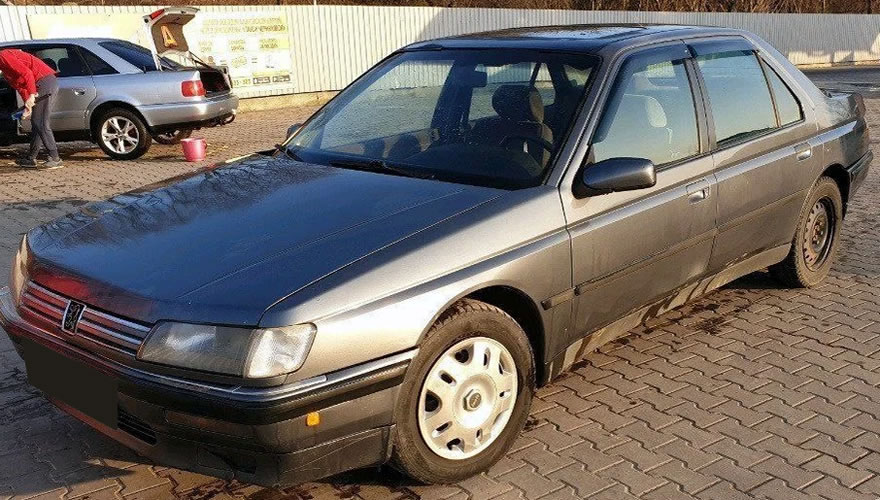
Peugeot 605, 1991 year, sedan 
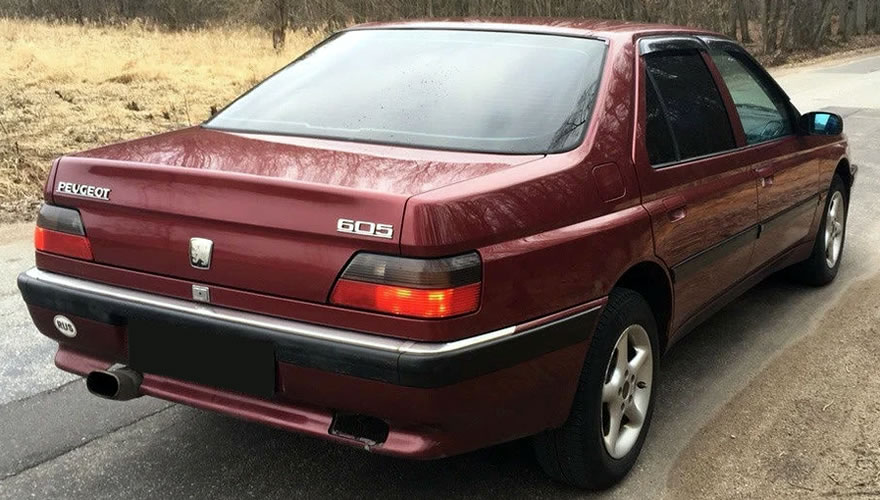
Peugeot 605, 1991 year, sedan
Peugeot 605 — an expensive executive car (E-segment), produced from July 1989 to September 1999 by the French company "Peugeot". It is the successor to the "604", which showed itself well in operation, but sold slowly. The design was done by the Italians from the company "Pininfarina". Based on the same platform as "Citroën XM". The body is only a four-door sedan, 4763 mm long, 1798 mm wide, 1419 mm high and has a curb weight of 1500 kg. More than 250 thousand cars were produced. The luxurious interior, smooth ride and excellent handling were the strong points of the "605", but there were a number of reliability problems, especially the complex electrics that often failed. Malfunctions seriously damaged the reputation of the car.

Peugeot 605, 1998 year, back view 
Peugeot 605, 1998 year, back view
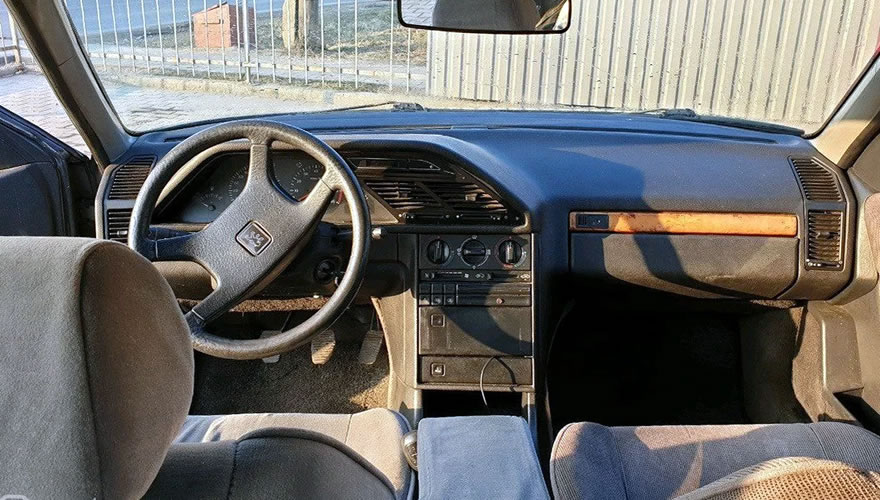
In 1995, the company tried to fix the problems by releasing a heavily updated "605". It received exterior design changes and the interior was significantly improved with more ergonomic instruments and a fresh look. Performance and handling were also improved, and many of the reliability issues were fixed, side airbags were installed, but sales were still low. After the model was released "Peugeot 406" sales of the 605 dropped to almost zero.

Peugeot 605, 1991 year, interior 
Peugeot 605, 1991 year, interior
Over the 10 years of production, the car was equipped with the following petrol engines:
  • 2.0 liters (1998 cm³, XU10, I4, 112 hp)
  • 2.0 liters (1998 cm³, XU10 J4R, I4, 132 hp)
  • 2.0 liters (1998 cm³, XU10 J2TE, I4, turbocharged, 145 hp)
  • 3.0 liters (2963 cm³, ZPJ S6A, V6, 170 hp)
  • 3.0 liters (2975 cm³, ZPJ4 SKZ, V6, 200 hp)
  • 2.9 liters (2946 cm³, ES9 J4, V6, 194 hp)

Diesel engines were all four-cylinder in-line engines with the following volumes: 2.1 liters (2088 cm³, XUD11 BTE, turbocharged, 108 hp), 2.1 liters (2138 cm³, XUD11 A, 82 hp) and 2.5 liters (2446 cm³, DK5ATE, turbocharged, 130 hp). The gearbox was either a five-speed manual or a four-speed automatic.

Peugeot 607 (1999-2010)
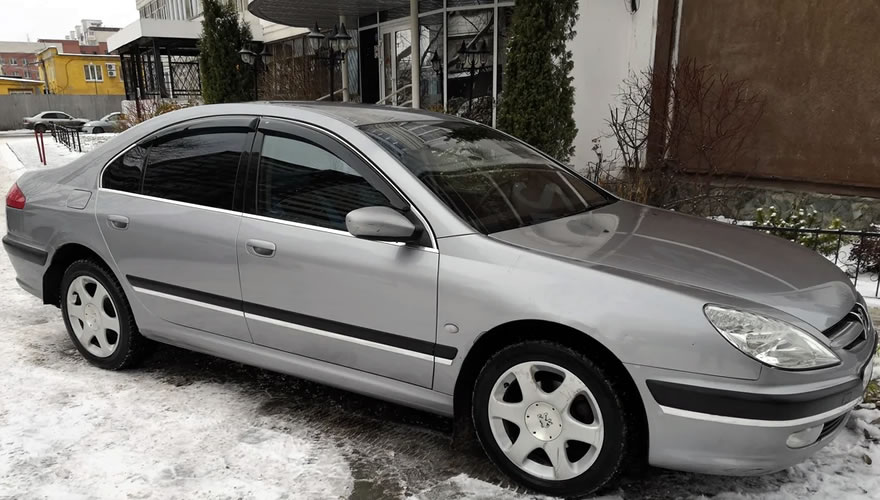


Peugeot 607, 2000 year, sedan 
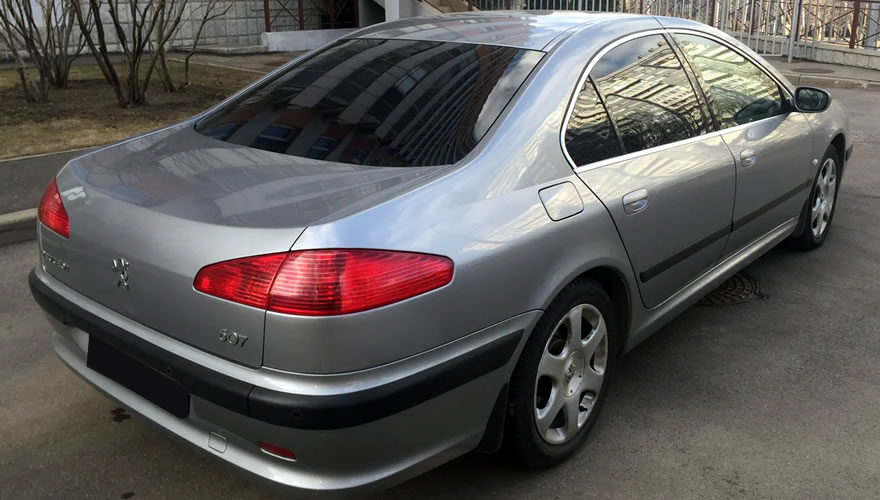
Peugeot 607, 2000 year, sedan
Peugeot 607 — French business-class sedan (E-segment), produced from September 1999 to June 2010 by Peugeot. Based on the same platform as "Citroen C6". The level of equipment was still high and all models had air conditioning, a CD player, electric windows, eight airbags, anti-lock braking system (ABS), a tire pressure monitor, central locking and active suspension "AMVAR" with electronic damping control as standard. The length of the car was 4902 mm, the width 1835 mm, the height 1442 mm and the unladen weight was 1610-1800 kg. Over the entire period, about 170 thousand units were produced.

Peugeot 607, 2004 year, back view 
Peugeot 607, 2004 year, back view
The engine is located transversely in front, the drive is on the front wheels. The line of gasoline engines looked like this:
  • 2.0 liters (1997 cm³, EW10, I4, 137 hp)
  • 2.2 liters (2230 cm³, EW12, I4, 158 hp)
  • 3.0 liters (2946 cm³, ES9 J4S, V6, 204 hp)
  • 3.0 liters (2946 cm³, ES9 A, V6, 208 hp)

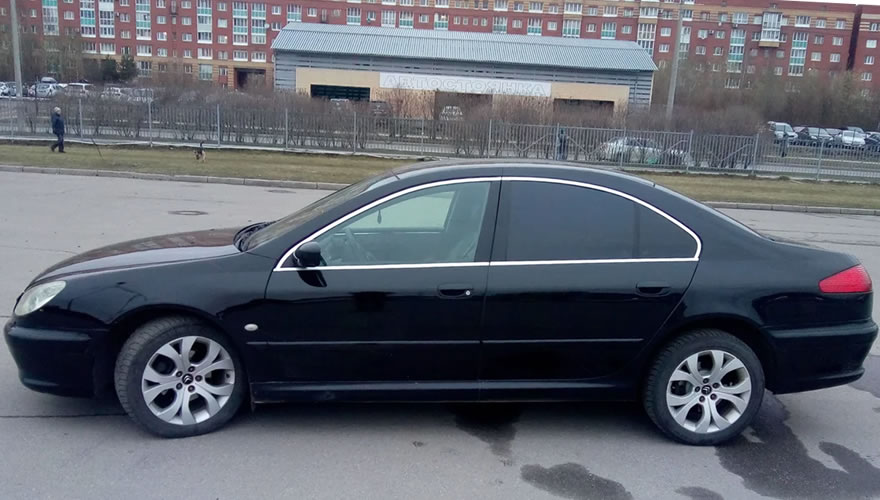
Peugeot 607, 2004 year, side view 
Peugeot 607, 2004 year, side view
There were five modifications of diesel engines with the following characteristics:
  • 2.0 liters (1997 cm³, DW10ATED, I4, 110 hp)
  • 2.0 liters (1997 cm³, DW10BTED4, I4, 136 hp)
  • 2.2 liters (2179 cm³, DW12TED4, I4, 133 hp)
  • 2.2 liters (2179 cm³, DW12BTED4, I4, Bi-Turbo 170 hp)
  • 2.7 liters (2720 cm³, DT17TED4, V6, Bi - Turbo, 204 hp)

The gearbox was a five- or six-speed manual, as well as a six- or four-speed automatic. The maximum speed of the most powerful cars reached 240 km/h.

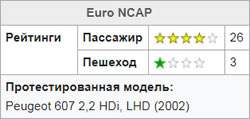
In 2002, the European committee "Euro NCAP" conducted tests to determine the safety of the car. See the results in the table.

In November 2004, the car was updated. In November 2009, it was announced that the "607" model would replace "Peugeot 508".

At the time of its release, the main classmates and competitors of the Peugeot 607 were the following cars: Audi A6, BMW 5 series, Citroen C6, Hyundai Genesis, Infiniti Q70, Jaguar XF, Kia Cadenza, Lexus LS, Mercedes-Benz E-Class and Toyota Crown.
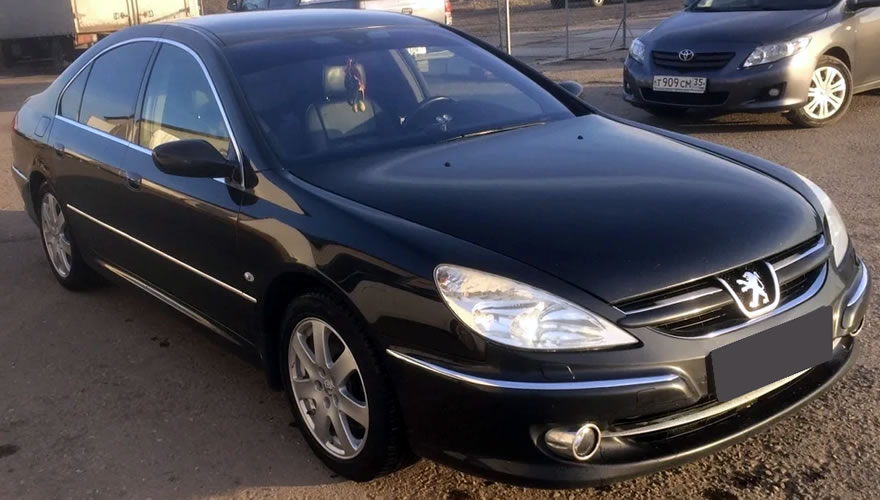
Peugeot 607, 2006 year, restyling 
Peugeot 607, 2006 year, restyling
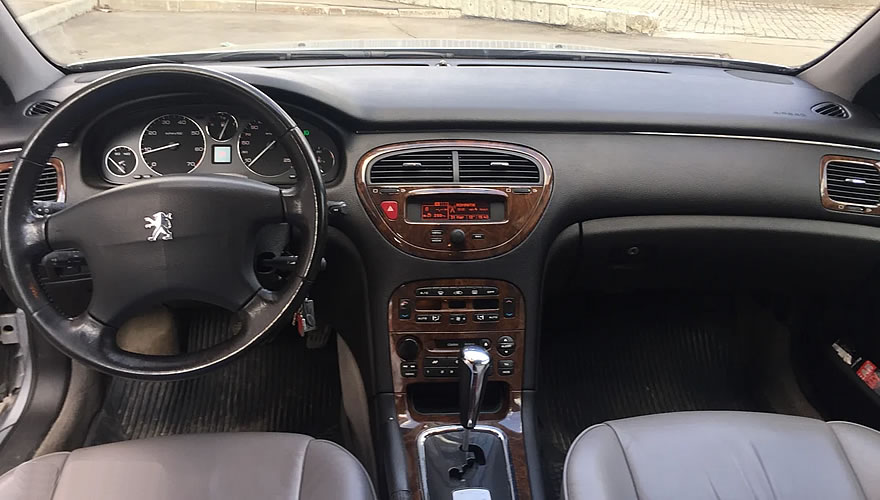
Peugeot 607, 2004 year, interior 
Peugeot 607, 2004 year, interior
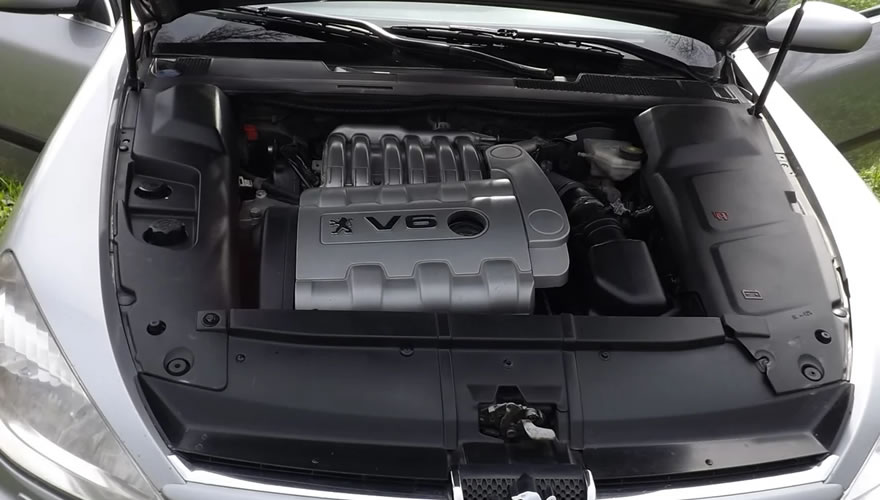
Peugeot 607, 2004 year, engine 
Peugeot 607, 2004 year, engine
Share information:
Link to this article in different formats
TEXTHTMLBB Code
Peugeot 605 (1989-2000) 
  • General information
  • User manual
  • Maintenance
  • Troubleshooting
  • Power unit
  • Petrol engines «XU»
  • Petrol engines «ZPJ»
  • Petrol engines «ES9J4»
  • Diesel engines
  • Cooling and heating
  • Fuel system
  • Exhaust system
  • Transmission
  • Clutch
  • Mechanical gearbox
  • Automatic gearbox
  • Chassis, running gear
  • Brake system
  • Car suspension
  • Steering
  • Body and interior
  • Body elements
  • Electrical equipment
  • Power devices
  • Electrical circuits
PeugeotBook.ru © 2018–2026 | Mobile version | Sitemap: EN BG BY UA RS HR RO PL SK HU | Write message | Site search | Add to bookmarks | Peugeot owners
106 (1991-2003) | 206 (1998-2012) | 207 (2006-2014) | 305 (1977-1989) | 306 (1993-2002) | 307 (2001-2008) | 405 (1987-1997) | 406 (1995-2004) | 605 (1989-2000) | Partner-I (1996-2008) | Eurovans-806 (1994-2002) | J5 (1981-1993) |
Cookies are used to ensure the correct display of pages on the site.