English Русский
Български
Беларускі
Український
Српски
Hrvatski
Română
Polski
Slovenský
Magyar
Bookmark Articles Sitemap Contacts :
Company Hyundai Company Opel Company Skoda Company Kia Company Mitsubishi Company LADA Company Audi
PeugeotBook.ru


Series 100   Series 200   Series 300   400-500   Series 600   Crossovers   Others
 
Peugeot 405 (1987-1997) Peugeot 406 (1995-2004)

Description and history of generations of Peugeot 400 and 500 series

  • Main
  • 40X
401 ↓ · 402 ↓ · 403 ↓ · 404 ↓ · 504 ↓ · 505 ↓ · 405 ↓ · 406 ↓ · 407 ↓ · 408 ↓ · 508 ↓

Peugeot 401 (1934-1935)


Peugeot 401, 1935 year, sedan 
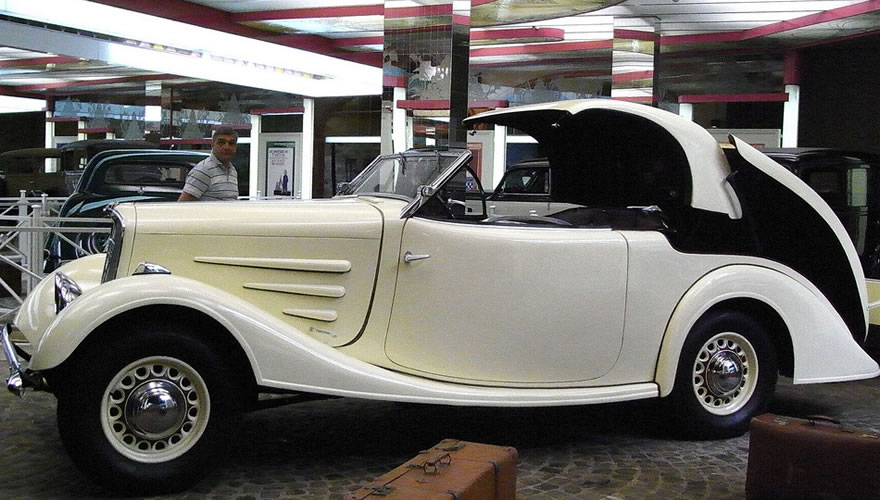
Peugeot 401, 1935 year, sedan
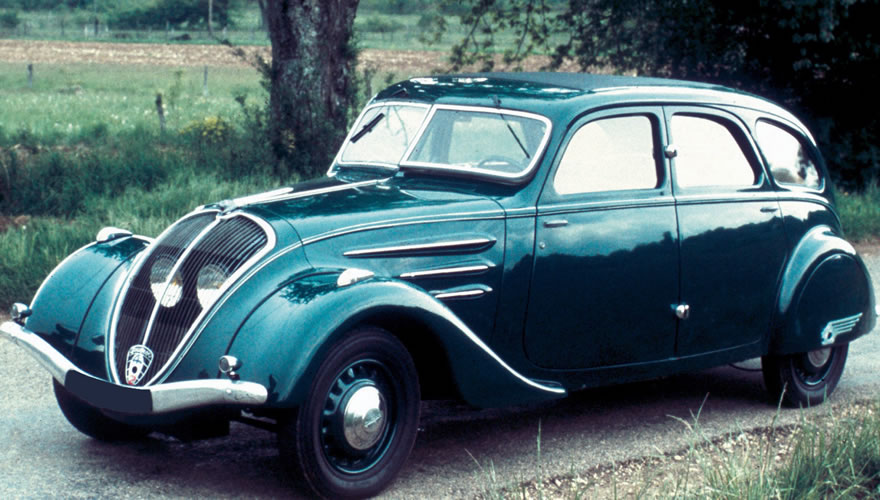
Peugeot 401 - a medium-sized car (D-segment according to European classification), which was produced by the Peugeot company from 1934 to August 1935. It was presented in October 1934 at the 28th Paris Motor Show. It replaced the outdated "Peugeot Type 176", produced between 1925 and 1928. Most bodies were four-door sedans, but there were other variants, including the world's first body with an electrically powered folding hardtop called the "401 Eclipse" (translated from English as "eclipse"). The length of the car was 4450 mm, width 1600 mm, height 1575 mm and the unladen weight was about 1150 kg. In total, about 13.5 thousand cars with the name "401" were produced.

Peugeot 401 Eclipse, 1934 year 
Peugeot 401 Eclipse, 1934 year
The car had independent front suspension, which had a positive effect on handling. The engine was located longitudinally in the front, and the drive was carried out on the rear wheels. The engine was the same in design as the "Peugeot 301", but with an increased volume of 1.7 liters (1720 cm³) and a power of 44 hp. The gearbox was mechanical three-speed. The maximum speed with such an engine and transmission was 100 km/h.

Peugeot 402 (1935-1942)


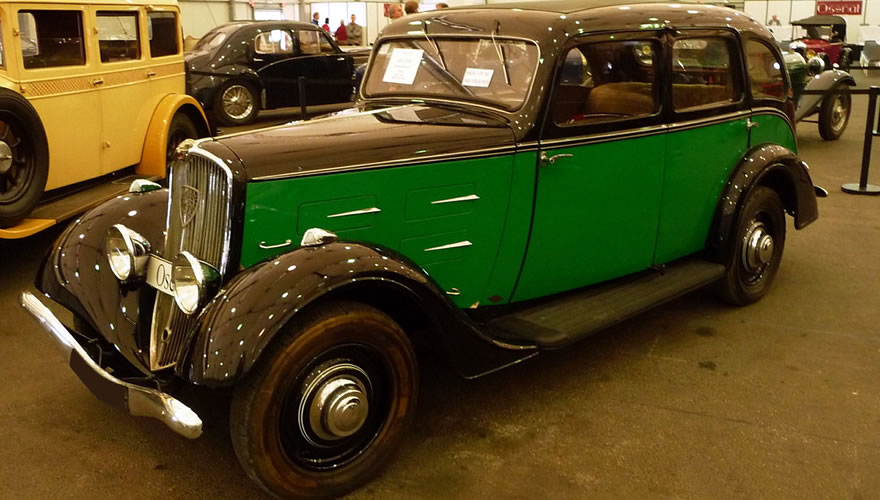
Peugeot 402, 1936 year, limousine 
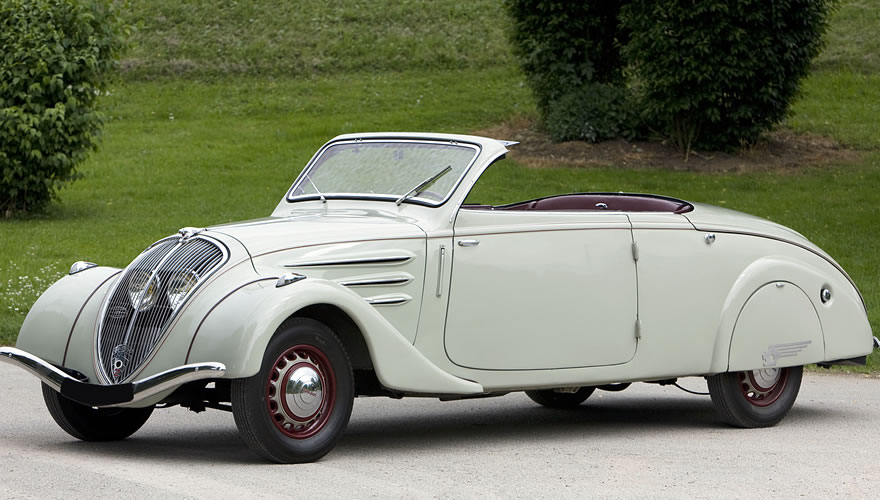
Peugeot 402, 1936 year, limousine
Peugeot 402 — a large family car (D-segment) of the French company "Peugeot", which was produced from 1935 to 1942. It was presented to the public at the 29th Paris Motor Show in October 1935. The car began to stand out from its other competitors of the 1930s, finding its own individual style of "typical Peugeot". It was produced with three wheelbases - short 2880 mm (from 1937 to 1940), normal 3150 mm (from 1935 to 1942) and long 3300 mm (from 1935 to 1940)the body was mainly a four-door sedan, but there were also other types, of which there were about sixteen by some estimates (convertibles, coupes, vans, municipal models). Different wheelbase lengths also diversified the length of the car, which varied from 4470 mm to 5000 mm, the width was 1640 mm, the height was 1580 mm and the unladen weight was 1265 kg. In total, about 75 thousand copies were produced.

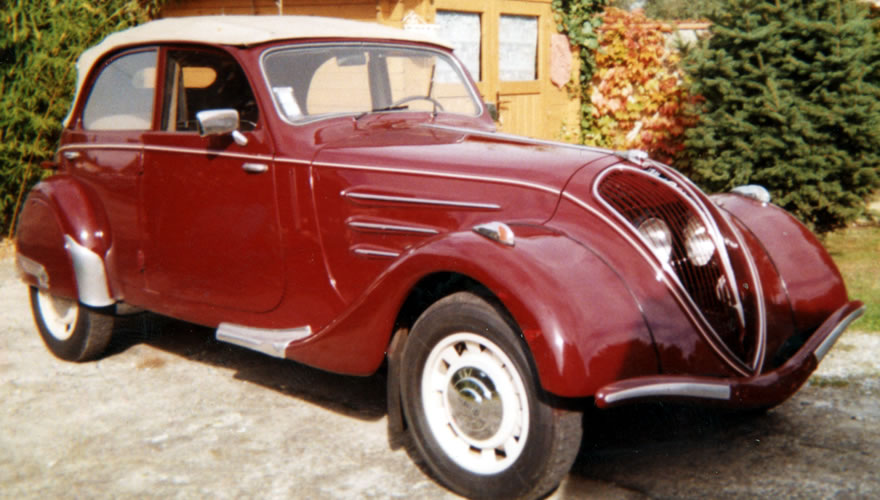
Peugeot 402 Eclipse, 1936 year 
Peugeot 402 Eclipse, 1936 year
Distinctive features that underlined the top-of-the-market status included twin electric windscreen wipers, semaphore direction indicators, a clock on the instrument panel, twin sun visors, a manual fuel reserve compartment, recessed 'safety' door handles and hydraulic brakes.

The engines were petrol four-cylinder, initially with a volume of 2.0 liters (1991 cm³) and a power of 55 hp, and from October 1938 it was replaced by a more powerful one, with a volume of 2.1 liters (2142 cm³) and a power of 60 hp. The maximum speed of the car with a standard sedan body was 125 km/h. The engine was located longitudinally in the front, the drive was carried out to the rear wheels through a three-speed manual transmission. There was an idea to use an automatic transmission, but due to the high cost, this was abandoned.

Peugeot 402, 1939 year, sedan 
Peugeot 402, 1939 year, sedan
In 1939, several dozen cars with a 2.3-liter (2,300 cm³) "HL50" diesel engine with a declared power of 55 hp were produced, which were used for taxis. If they had gone into further production, this would have been the world's first serial diesel saloon.

In 1940, the range of bodies offered was reduced to a standard saloon with a long wheelbase. This happened because of the outbreak of World War II in 1939 and the saloon was in great demand among the military. Due to the rapid defeat of France, gasoline became almost unavailable to ordinary citizens. For the Peugeot 402, equipment was released that could burn charcoal in a controlled manner and burn the gas emitted in the engines instead of gasoline. The boiler could be installed in the rear of the body, it held 35 kg of coal, which was enough for 80 kilometers.

Peugeot 403 (1955-1966)
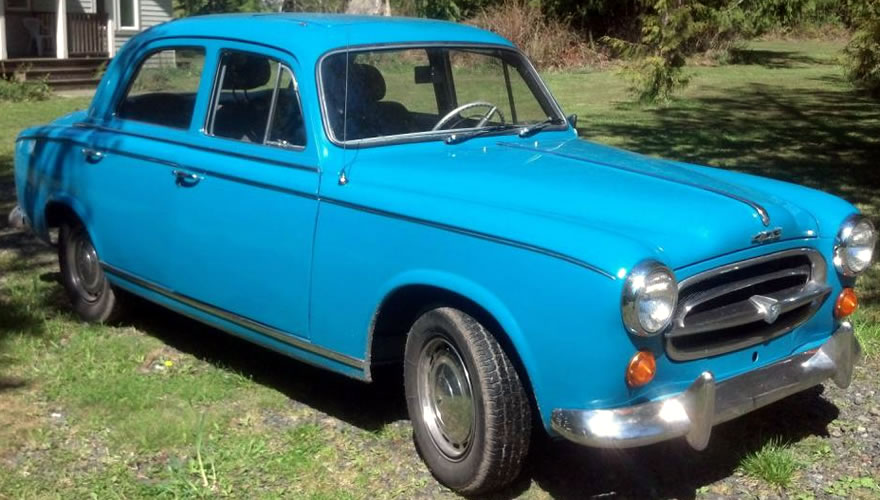


Peugeot 403, 1955 year, sedan 
Peugeot 403, 1955 year, sedan
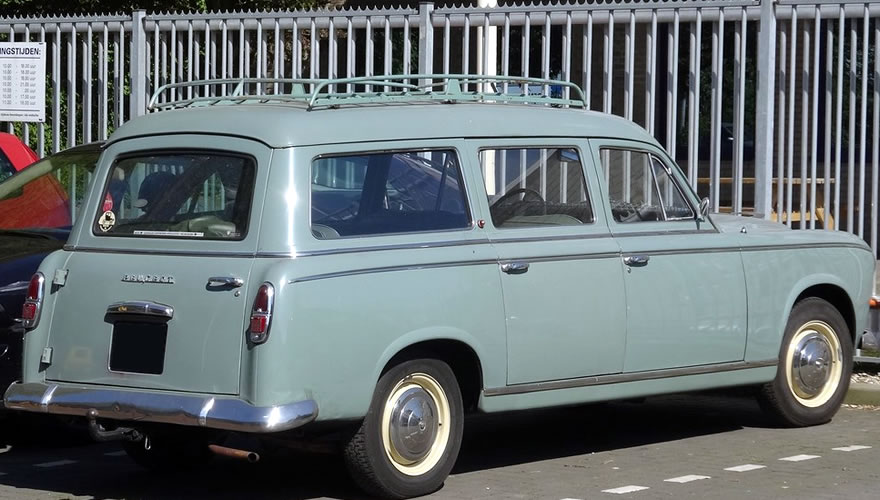
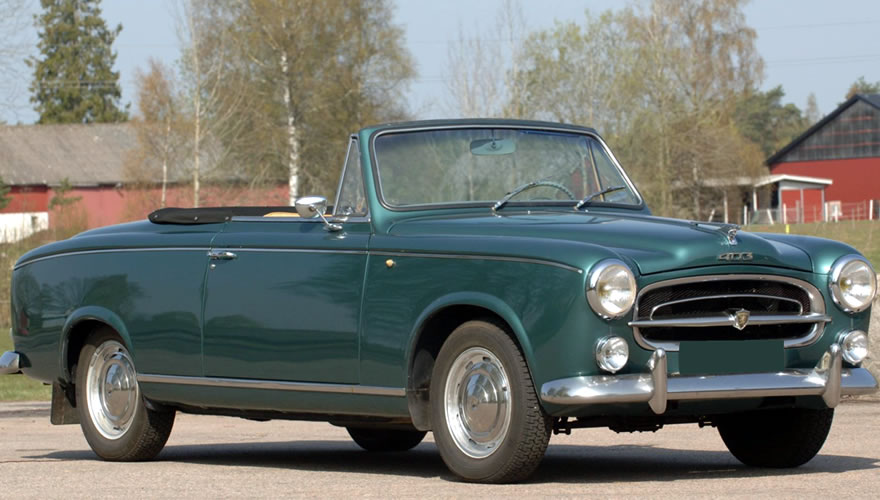
Peugeot 403 — a mid-size family car (D-segment). It was produced by the French car manufacturer Peugeot from May 1955 to October 1966, that is, 13 years after the end of production of its predecessor, the Peugeot 402. During this war and post-war period, the company focused on producing a cheaper and more popular "Peugeot 203". It was presented to the public in April 1955 in Paris. The body styles were as follows: a four-door sedan (wheelbase 2660 mm, length 4470 mm, width 1670 mm and height 1510 mm), five-door station wagon (wheelbase 2900 mm, length 4610 mm, width 1670 mm and height 1510 mm), a three-door van, as well as a two-door pickup and convertible. In total, more than 1.2 million cars of all types were produced, and this is the first Peugeot to exceed the million mark.

Peugeot 403, 1956 year, station wagon 
Peugeot 403, 1956 year, station wagon
The design was developed by an Italian company "Pininfarina" with signs of "pontoon" style and a three-body design, which became fully load-bearing. Other innovations were doors that opened wide to a full 90 degrees, fully lowering windows on the rear doors, semaphore turn signals were replaced by flashing lights, standardized headlights, twin parallel wipers were replaced by twin ones made in the "crossed arms" type. The originally protruding chrome lion's head, installed on the hood, was replaced with a flat one due to the increased risk of injury to pedestrians.

Peugeot 403, 1959 year, cabriolet 
Peugeot 403, 1959 year, cabriolet
The engine was located longitudinally in the front, with rear-wheel drive. At first, a four-cylinder, 1.3-liter gasoline engine was installed (1290 cm³, TM5) with a capacity of 42 hp, which was later increased to 1.5 liters (1468 cm³, TN3) 65 hp. For the first time, a thermal relay was used, which switched off the radiator fan when the engine temperature dropped to 75°C. At the end of 1958, a 1.8-liter diesel engine was added (1816 cm³, TMD85/XDP85) with a power of 48 hp. The gearbox was a mechanical four-speed with a shift lever on the steering column. As an option, it was possible to install an automatic clutch "Jaeger".

Peugeot 404 (1960-1975)


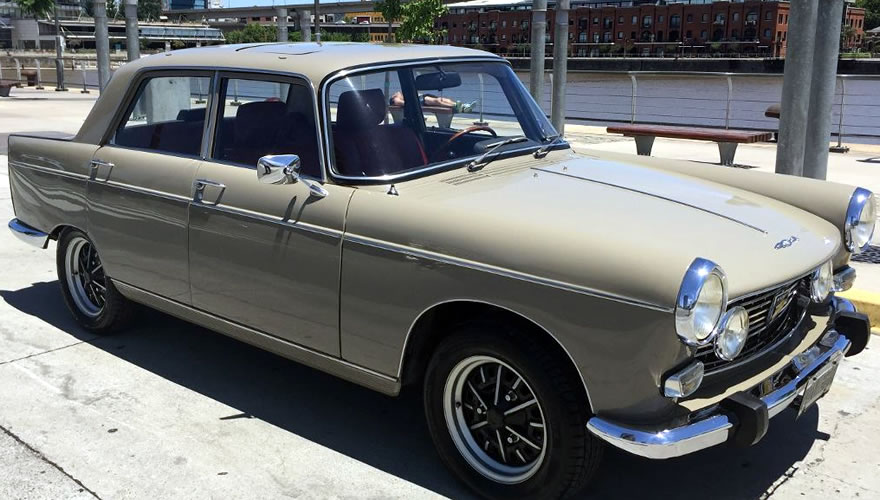
Peugeot 404, 1971 year, sedan 
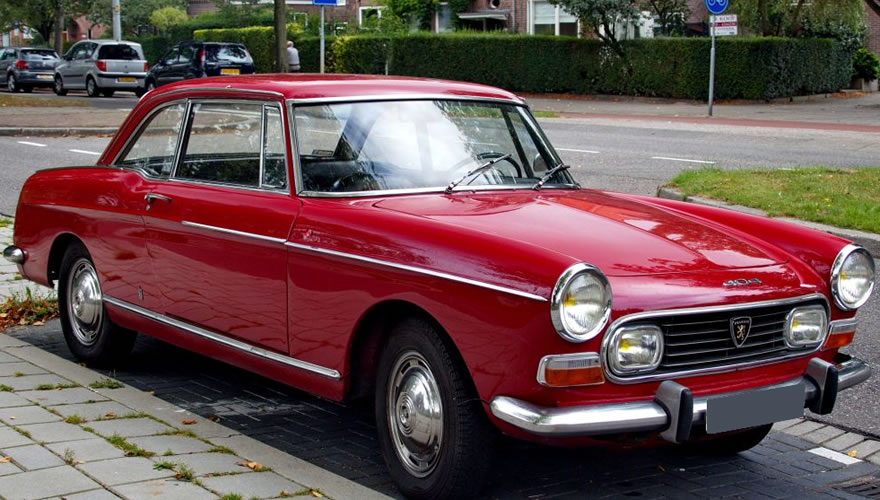
Peugeot 404, 1971 year, sedan
Peugeot 404 — a mid-size family car (D-segment), produced from May 1960 to 1975 (in Argentina until 1980, in Kenya until 1991) french car manufacturer "Peugeot". The design was developed by the Italian company "Pininfarina". The body was initially a four-door sedan (length 4442 mm, width 1612 mm, height 1450 mm), five-door station wagon (length 4580 mm, width 1612 mm, height 1490 mm) and a two-door pickup. A two-door convertible was added in 1962, and a two-door coupe was added in 1963 (length 4492 mm, width 1680 mm, height 1300 mm)the car's curb weight was 1060-1250 kg. About 2.9 million units were produced in all countries over the entire period, with French production being just over 1.8 million units.

Peugeot 404, 1963 year, coupe 
Peugeot 404, 1963 year, coupe
Engines offered were four-cylinder petrol engines with a capacity of 1.5 liters (1468 cm³, XB) with a capacity of 72 hp and 1.6 liters (1618 cm³, XC) 76 hp. The fuel injection system replaced the carburetors in 1962 and increased engine power by 10-20 hp. Since 1964, a 2.0-liter diesel engine has been installed (1948 cm³, XD85/XD88) with a capacity of 55/68 hp. The gearbox was a four-speed manual with synchronizers or a semi-automatic with a "Jaeger" clutch, as well as a three-speed automatic "ZF". The maximum speed of the car with the most powerful engine was 167 km / h.

During the entire production cycle, the cars were modified. Changes concerned the exterior, interior design, but most of the changes were made to the engines due to the appearance of fuel injection in 1962.

Peugeot 504 (1968-1983)
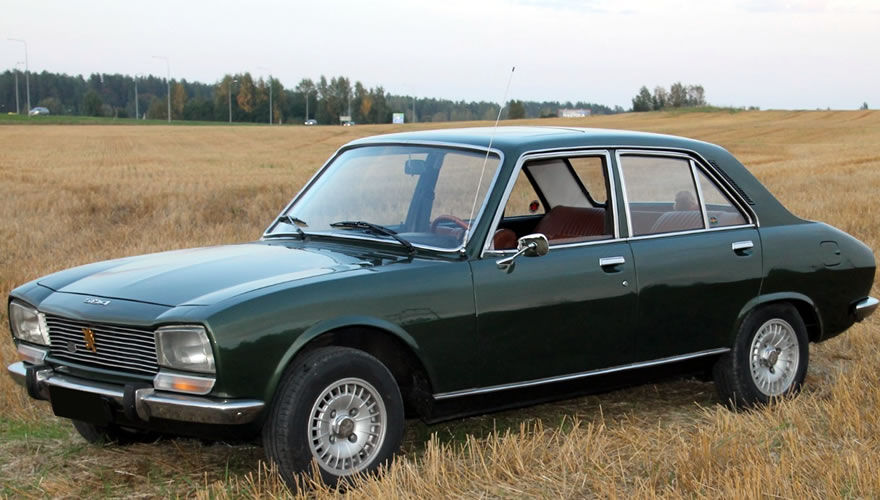


Peugeot 504, 1974 year, sedan 
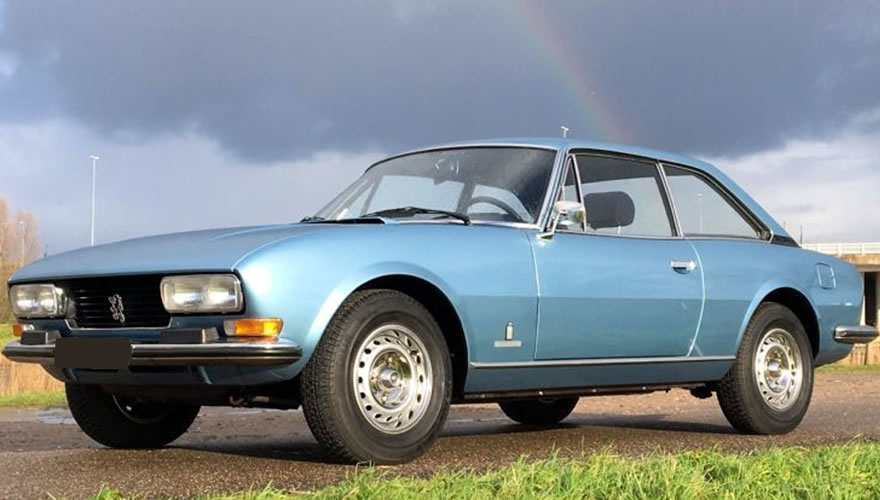
Peugeot 504, 1974 year, sedan
Peugeot 504 — a mid-size car (D-segment), the successor to the "404" model, produced from 1968 to 1983 by the French company "Peugeot". Assembly continued in some other countries under license until 2006. Debuted in October 1968 at the Paris Motor Show, although the show was initially planned for June. In 1969, it deservedly received the title of "European Car of the Year". At first there was a four-door sedan body (length 4486 mm, width 1690 mm, height 1460 mm, wheelbase 2740 mm), then other options were added - a five-door station wagon (length 4800 mm, width 1690 mm, height 1550 mm, wheelbase 2900 mm), a two- or four-door pickup truck and a two-door coupe or convertible. The curb weight was 1200-1300 kg. Assembly was carried out in 17 countries around the world, including under license.

Peugeot 504, 1975 year, coupe 
Peugeot 504, 1975 year, coupe
The engine is located longitudinally at the front, with rear-wheel drive. There were three models of petrol engines, two four-cylinder 1.8 (1796 cm³, 79 hp) and 2.0 liters (1971 cm³, carburetor 97 hp, injection 104 hp), as well as one six-cylinder V-shaped 2.7-liter (2664 cm³, 136-144 hp)there were three modifications of the diesel four-cylinder engines with a volume of 1.9 liters (1948 cm³, 49-56 hp), 2.1 liters (2112 cm³, 59-65 hp) and 2.3 liters (2304 cm³, 70 hp). Due to the introduction of fuel injection in 1962, the engines were constantly being improved during the production of the "504" model. The gearbox was a four- or five-speed manual, as well as a three-speed automatic "ZF 3HP12", "ZF 3HP22" or "GM 407".

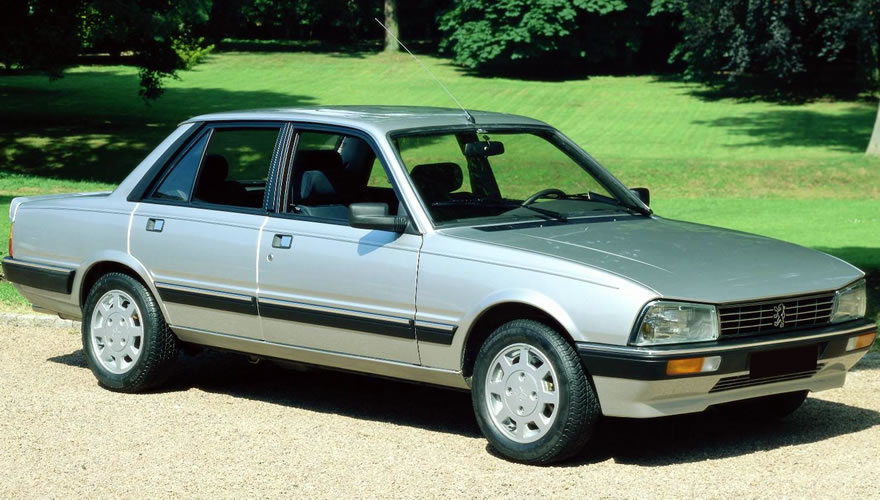
Peugeot 505 (1979-1990)


Peugeot 505, 1980 year, sedan 
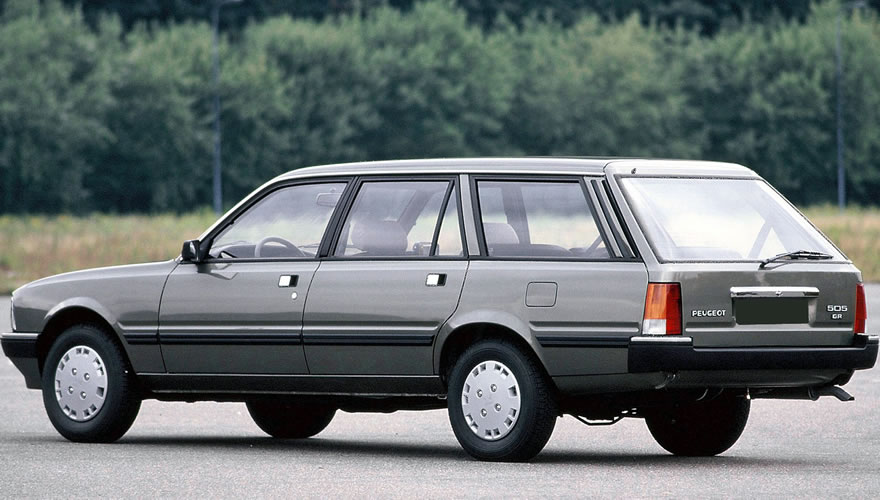
Peugeot 505, 1980 year, sedan
Peugeot 505 — a large French family car (D-segment), which was produced by Peugeot from 1979 to 1990 in Europe, and in some other countries until 1997. It was first shown to the public in May 1979, and later it was exhibited at the Geneva Motor Show in 1982. This is the last rear-wheel drive car with a front longitudinal engine in this line, and all the company's products. The design was developed by the Italian company "Pininfarina" in collaboration with the Peugeot design department and was very similar to "Peugeot 305". There were two body styles - a four-door sedan (wheelbase 2743 mm, length 4579 mm, width 1737 mm, height 1446 mm) and a five-door station wagon (wheelbase 2900 mm, length 4898 mm, width 1730 mm, height 1540 mm). The station wagon was available with seven seats. The curb weight was 1210-1410 kg. Over the entire period, more than 1.3 million cars were produced in all countries.

Peugeot 505, 1985 year, station wagon 
Peugeot 505, 1985 year, station wagon
The petrol four-cylinder engines were the following models:
  • 1.8 liters (1796 cm³, XM7/XM7A, OHV, 79 hp)
  • 2.0 liters (1971 cm³, XN1/XN1A/XN6, OHV, 95/99/107/111 hp)
  • 2.0 liters (1995 cm³, ZEJ "Douvrin", OHC, 108 hp)
  • 2.2 liters (2155 cm³, N9T "Simca 180", turbocharged, OHC, 148/158/178 hp)
  • 2.2 liters (2165 cm³, ZDJ "Douvrin", OHC, 115/120/128 hp)

There was also one petrol six-cylinder V-shaped engine with a volume of 2.8 liters (2849 cm³, ZN3J "PRV", V6) with a power of 145/168 hp with fuel injection "Jetronic". There were two models of diesel engines with a volume of 2.3 liters (2304 cm³, XD2/XD2C/XD2S, I4, 69/66/79 hp) and 2.5 liters (2498 cm³, XD3/XD3T/XD3TE, I4, 75/94/108 hp), both turbocharged. The gearboxes were as follows - automatic three- (ZF 3HP22) and four-speed (ZF 4HP22), as well as mechanical four- (BA 7/4) and five-speed (BA 7/5 and BA 10/5).

Journalists praised the car for its comfortable ride and handling on uneven roads with potholes. The interior was also positively assessed in the press. The French company "Dangel" produced all-wheel drive models based on it.

The range was updated in 1986, including a completely new interior. In 1987, following the launch of the Peugeot 405, European production of the 505 was greatly reduced. Saloon production ceased in 1989, when the new Flagship "Peugeot 605", business class sedan.

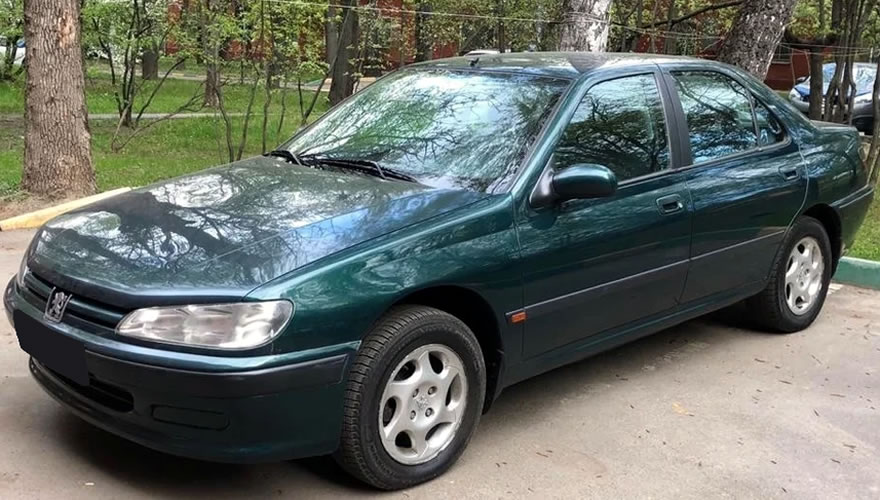
Peugeot 405 (1987-1997)
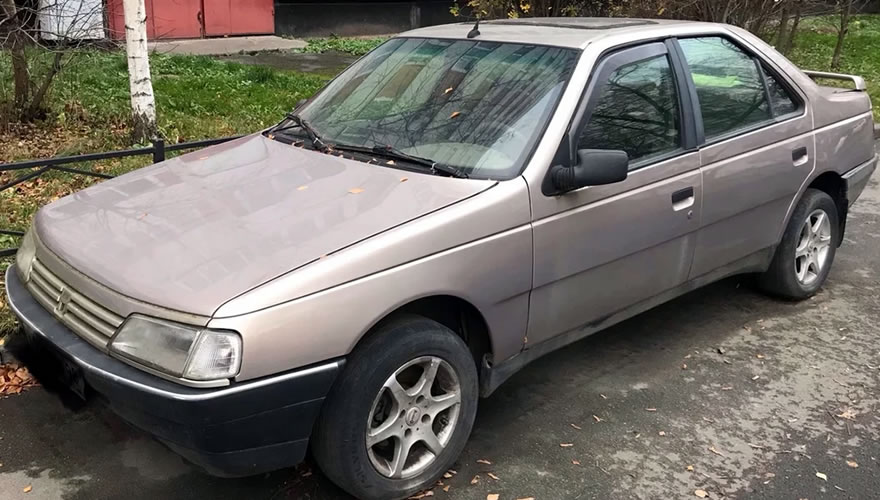


Peugeot 405, 1993 year, sedan 
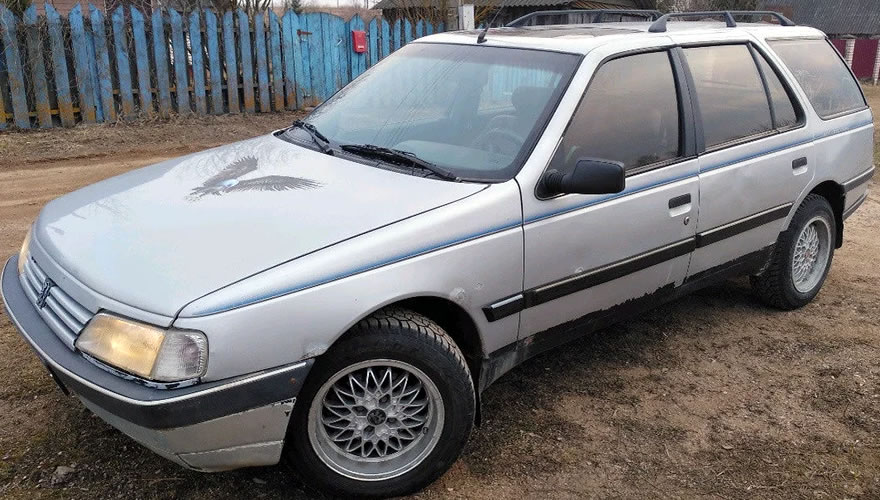
Peugeot 405, 1993 year, sedan
Peugeot 405 — a French mid-size car (D-segment), produced by Peugeot from July 1987 to 1997 in Europe and in some countries (Egypt and Iran) is still produced under license. It was named European Car of the Year in 1988. One of the best-selling family cars in Europe. The design was also developed by the Italians from the company "Pininfarina". The most important innovation was the transition from rear to front wheel drive and transverse engine placement. There were also all-wheel drive models. The body was produced in two versions - a four-door sedan (length 4409 mm, width 1709 mm, height 1410 mm, aerodynamic coefficient 0.29) and a five-door station wagon (length 4399, width 1709 mm, height 1440 mm, aerodynamic coefficient 0.33). The curb weight was 934-1021 kg. The car was assembled in many countries in addition to France - Argentina, Great Britain, Egypt, Zimbabwe, Indonesia, Iran, Malaysia, Poland, Taiwan and Chile. In total, more than 2.5 million cars were produced.

Peugeot 405, 1990 year, station wagon 
Peugeot 405, 1990 year, station wagon
There were three models of 1.4-liter petrol engines (1360 cm³, TU, 65-70 hp), 1.6 liters (1580 cm³, XU, 92 hp) and 1.9 liters (1905 cm³, XU), the 8-valve developed 110-125 hp, and the 16-valve produced 160 hp. There were two modifications of 1.8-liter diesel engines (1769 cm³, XUD, turbocharged, 90 hp) and 1.9 liters (1905 cm³, XUD, 71 hp). The gearbox was either a four-speed automatic or a five-speed manual.

In 1991, the instrument panel, steering wheel and sound insulation were updated. In 1993, the "Phase II" model appeared with a new trunk design with an improved entry, new taillights and a new instrument panel.

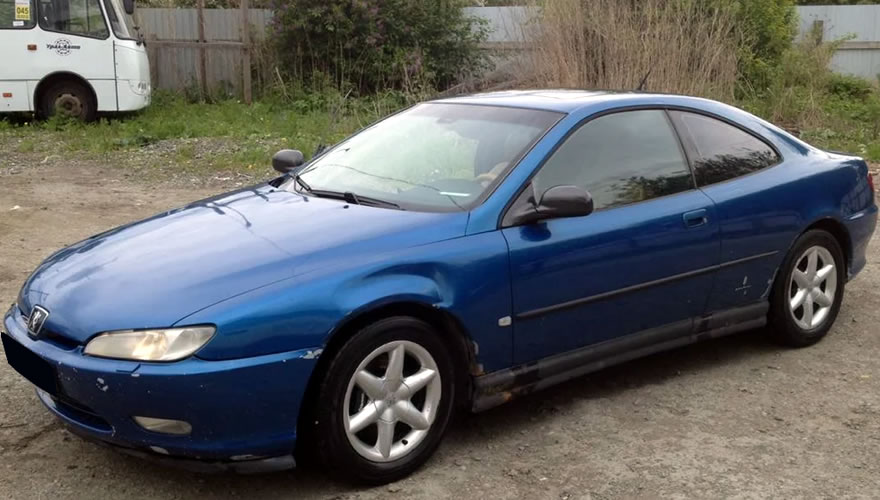
Peugeot 406 (1995-2004)


Peugeot 406, 1998 year, sedan 
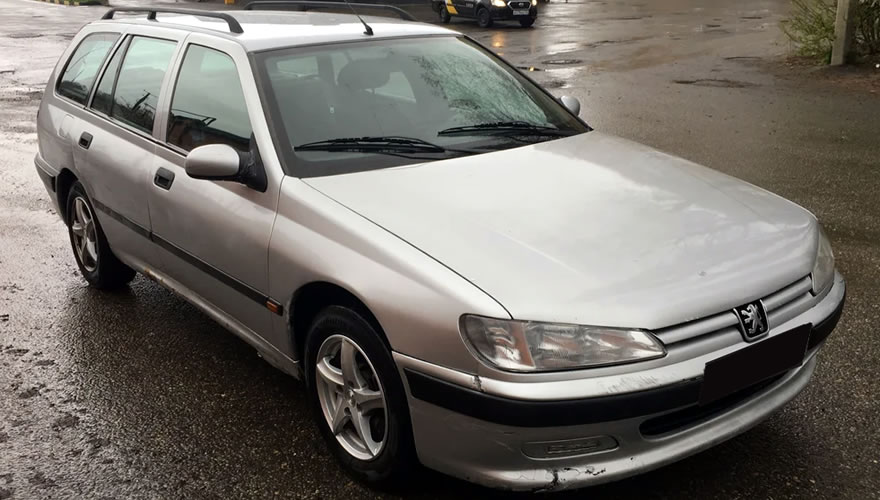
Peugeot 406, 1998 year, sedan
Peugeot 406 — a large French family car (D-segment), which was produced by Peugeot from October 1995 to June 2004. It is the successor of the "405", which had a strong influence on the design and technical solutions of the "406", as it showed itself very well in operation. The body was initially a four-door sedan (length 4555 mm, width 1764 mm, height 1396 mm), in October 1996 a five-door station wagon was added (length 4736 mm, width 1760 mm, height 1396 mm), and since May 1997 a two-door coupe (length 4615 mm, width 1780 mm, height 1396 mm), which was shown at the Paris Motor Show in 1996. The wheelbase of all bodies was the same and was 2700 mm, the curb weight varied from 1215 to 1430 kg. In total, more than 1.6 million cars were produced.

Peugeot 406, 1999 year, station wagon 
Peugeot 406, 1999 year, station wagon
The engine is located transversely at the front, with front-wheel drive. The range of four-cylinder petrol engines was as follows:
  • 1.6 liters (1580 cm³, XU5, 8 valves, 87 hp)
  • 1.8 liters (1761 cm³, XU7, 8 valves, 89 hp)
  • 1.8 liters (1761 cm³, XU7, 16 valves, 110 hp)
  • 1.8 liters (1749 cm³, EW7, 16 valves, 115 hp)
  • 2.0 liters (1998 cm³, XU10, 16 valves, 130 hp)
  • 2.0 liters (1997 cm³, EW10, 16 valves, 134/137/140 hp)
  • 2.0 liters (1998 cm³, XU10, turbocharged, 8 valves, 145 hp)
  • 2.2 liters (2231 cm³, EW12, 16 valves, 156 hp)

Peugeot 406, 2001 year, coupe 
Peugeot 406, 2001 year, coupe
They also installed one V-shaped six-cylinder engine with a volume of 2.9 liters (2946 cm³, ES9, 24 valves, 190/204 hp). All diesel engines were four-cylinder, 1.9 liters (1905 cm³, XUD9, 8 valves, 89 hp), 2.0 liters (1997 cm³, DW10, 8 valves, 89/108 hp), 2.1 liters (2088 cm³, XUD11, 12 valves, 108 hp) and 2.2 liters (2179 cm³, DW12, 16 valves, 131 hp). The transmission was a four-speed automatic or a five-speed manual.

In February 1999, an update of the car was presented, increasing speed, strength and safety. The tables below show the crash tests of pre- and post-restyling cars, which were carried out by the European committee "Euro NCAP". Changes in the appearance affected more pronounced ribs, transparent headlights, chrome trim, taillights and a radiator grille. The interior was also redesigned to improve comfort and increase space.
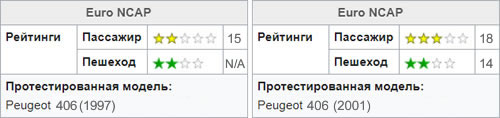

The popular British magazine "What Car?" awarded the car the "Car of the Year" award in 1997. In August 2002, a diesel "406 HDi" car set a world record for the longest distance on a single tank of fuel without refuelling. It traveled between Melbourne and Rockhampton in Australia, a total distance of 2,348 km. In the famous French film "Taxi" in 1998, the main character had a white Peugeot 406, which was also in the second and third parts of this film.

Peugeot 407 (2004-2011)
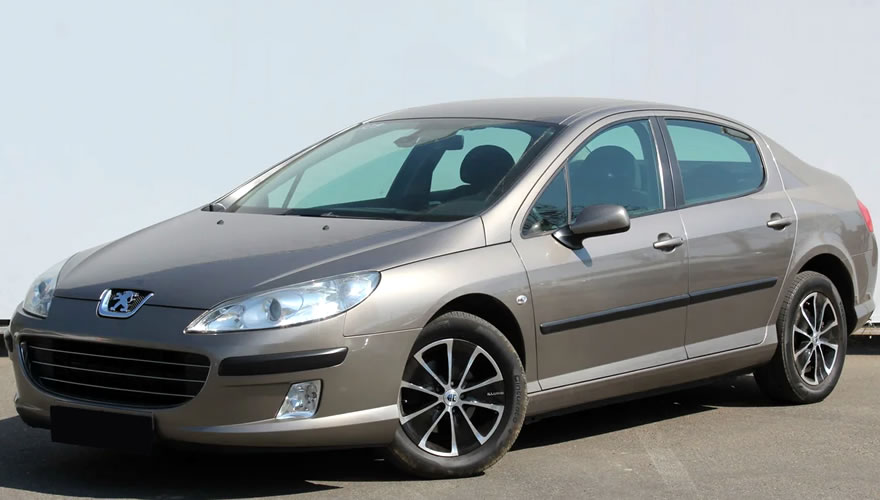


Peugeot 407, 2008 year, sedan 
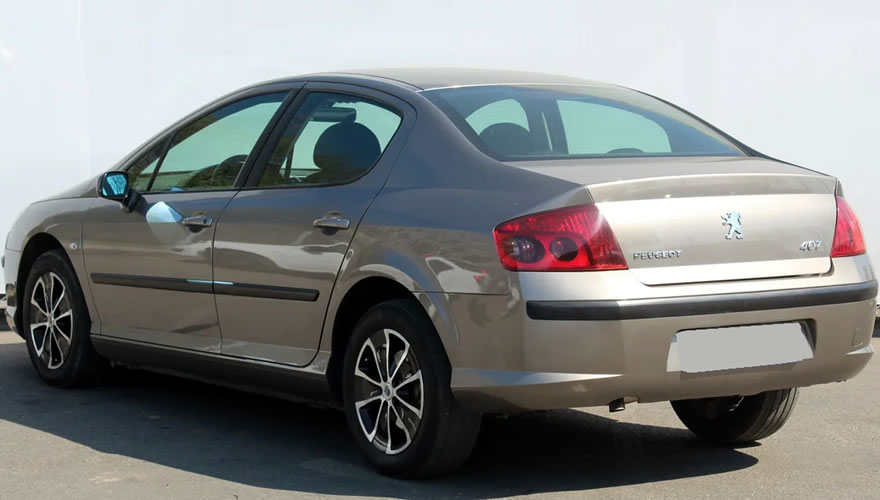
Peugeot 407, 2008 year, sedan
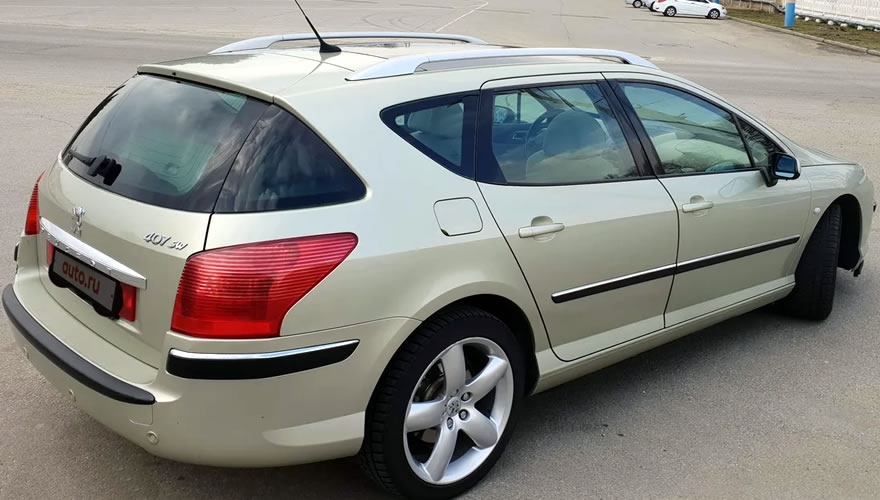
Peugeot 407 — a mid-size family car (D-segment) of the French automobile manufacturer Peugeot. It was the successor to the very successful Peugeot 406. It was produced and sold from April 2004 to January 2011. It was shown to the press in Paris in December 2003. It is based on the PSA PF3 platform, designed specifically for the D-segment, which is also used for "Citroën C5", "Citroën C6" and "Peugeot 508". The car's streamlined design was considered quite radical. The body was initially a four-door sedan (length 4676 mm, width 1811 mm, height 1455 mm), five-door station wagon (length 4763 mm, width 1811 mm, height 1494 mm) and a two-door coupe (length 4815 mm, width 1868 mm, height 1400 mm). The station wagon appeared in August 2004, and the coupe was presented at the Frankfurt Motor Show in September 2005, and went on sale in January 2006. The wheelbase was 2725 mm, the curb weight was 1555-1715 kg. In 2005, it was one of the winners for the title of "European Car of the Year". Almost 900 thousand cars were produced in 7 years.

Peugeot 407, 2008 year, back view 
Peugeot 407, 2008 year, back view
The gasoline four-cylinder engines were 16-valve DOHC, with multi-point fuel injection, with the following characteristics:
  • 1.8 liters (1749 cm³, EW7, 113/123 hp)
  • 2.0 liters (1997 cm³, EW10, 134/138 hp)
  • 2.2 liters (2230 cm³, EW12, 156/161 hp)

A six-cylinder petrol engine with a volume of 3.0 liters was installed (2946 cm³, ES9, DOHC, 24 valves) with a capacity of 208 hp.

Peugeot 407, 2004 year, station wagon 
Peugeot 407, 2004 year, station wagon
There were four models of diesel four-cylinder engines, all 16-valve DOHC, with direct fuel injection "Common Rail" the following volumes:
  • 1.6 liters (1560 cm³, DV6 TED4, HDi, 108 hp)
  • 2.0 liters (1997 cm³, DW10 BTED4, HDi, 134/138 hp)
  • 2.0 liters (1997 cm³, DW10 CTED4, HDi, 161 hp)
  • 2.2 liters (2179 cm³, DW12 BTED4, HDi, 168 hp)

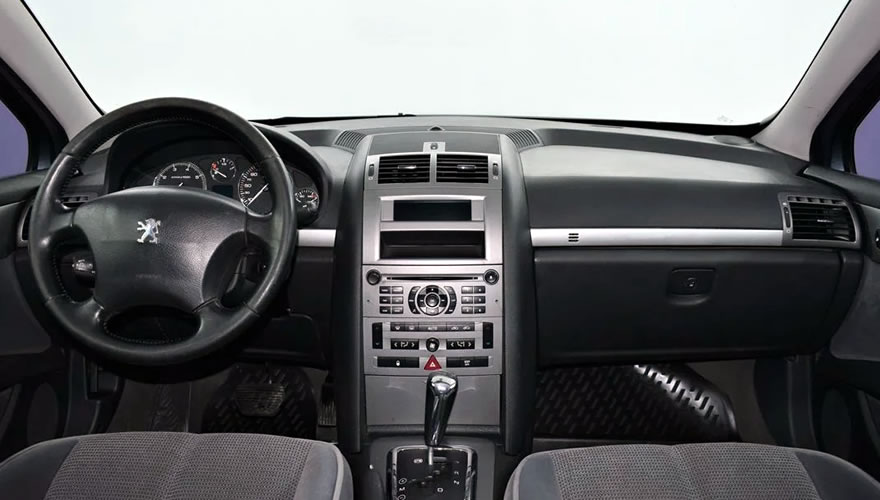
Peugeot 407, 2006 year, interior 
Peugeot 407, 2006 year, interior
Also for the first time, six-cylinder V-shaped diesel engines with a volume of 2.7 liters began to be used (2720 cm³, DT17 TED4, DOHC, 201 hp) and 3.0 liters (2993 cm³, DT20, DOHC, 238 hp), both with direct injection "Common Rail". The gearbox was a five- or six-speed manual, as well as a four- or six-speed automatic.

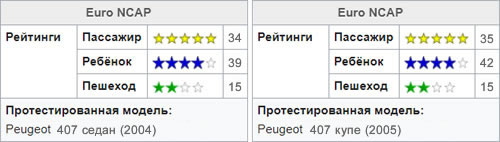
In August 2008, all models were slightly redesigned. The European Committee "Euro NCAP" conducted crash tests on the 2004 sedan and 2005 coupe, the results of which you can see in the tables below. In the famous French film "Taxi" in the fourth and fifth parts, the "Peugeot 407" was the main character's personal car.

In 2009, it was announced that the successor to the 407 would be the 508, and the car, called the Peugeot 408, would be sold in China and some other countries as "308" model.


Peugeot 408 (2010-present)


Peugeot 408 — a compact family car (C-segment), produced from November 2010 to the present by the French company "Peugeot" for China and other developing markets. It is not a successor to the "Peugeot 407", but a sedan "308" models with an extended wheelbase. The body is only a four-door sedan. The engine is located in the front transversely with front-wheel drive. The drag coefficient is 0.3.

First generation (2010-2014)
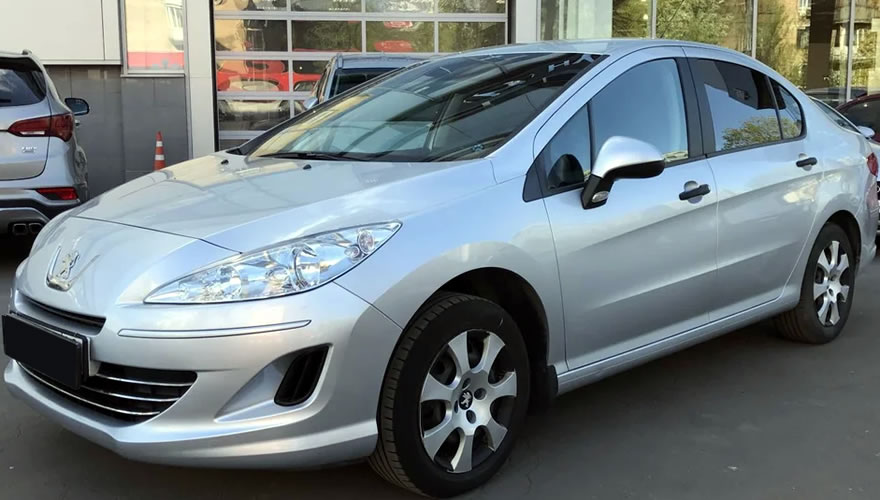


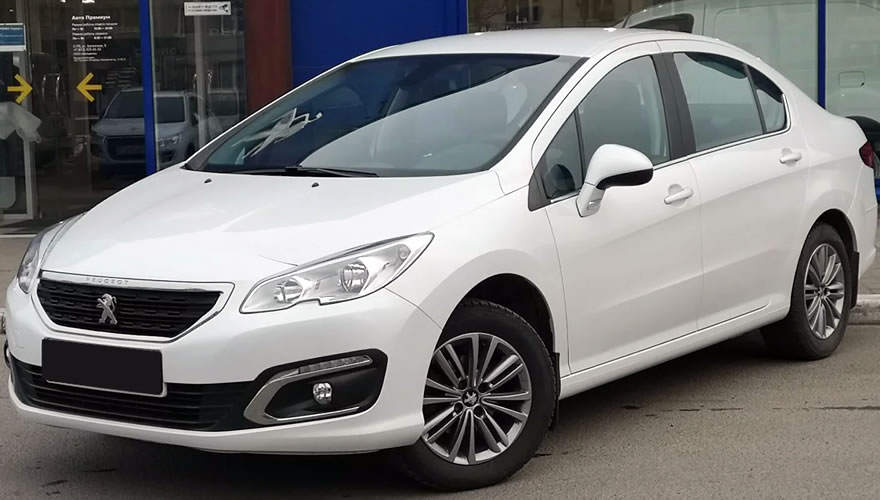
Peugeot 408 I, 2012 year, sedan 
Peugeot 408 I, 2012 year, sedan
The car was shown to the public at the Beijing Auto Show in January 2010, and then officially presented at an exhibition in Sao Paulo (Brazil) in October 2010. It is assembled on the "PSA PF2" platform, which is also used to assemble the first-generation "307" and "308". The body is produced as a four-door sedan with a length of 4680 mm, a width of 1815 mm, a height of 1525 mm, a wheelbase of 2710 mm and a curb weight of 1390-1425 kg. Assembly was carried out in Argentina, China, Malaysia and Russia. In 2013, a minor restyling of the model was carried out.

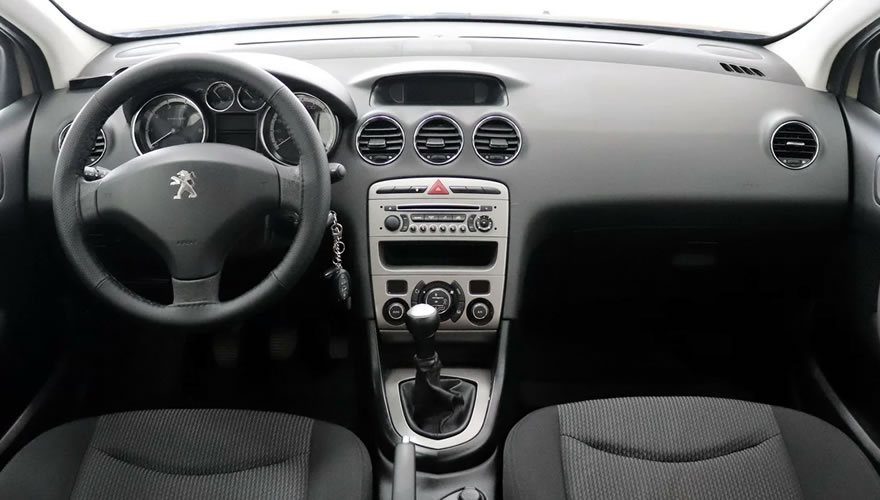
Peugeot 408 I, 2013 year, interior 
Peugeot 408 I, 2013 year, interior
The engines were petrol four-cylinder with the following characteristics: 1.6 liters (1587 cm³, TU5JP4, 110 hp), 1.6 liters (1598 cm³, Prince, turbocharged, 163 hp) and 2.0 liters (1997 cm³, EW10A+, 145 hp). The diesel engine was also a four-cylinder 1.6-liter (1560 cm³, HDi, 114 hp). The maximum speed with diesel was 188 km/h. The gearbox was a five-speed manual, as well as a four- or six-speed automatic.

Second generation (2014-present)


Peugeot 408 II, 2017 year, sedan 
Peugeot 408 II, 2017 year, sedan
In April 2014, the second generation of the Peugeot 408 was presented at the Beijing Auto Show. The car is based on the new PSA EMP2 platform, which is also used for the second generation Peugeot 308. The body is presented as a four-door sedan. The length was 4750 mm, the width was 1820 mm, the height was 1488 mm, the wheelbase was 2730 mm and the curb weight was 1420 kg. Assembly was carried out in China and Malaysia, and the first generation continues to be produced in Argentina and Russia. The engines and transmission are the same as those of the first generation with minor modifications. The model was restyled in 2018. The front end, rear bumper and taillights were updated.

Peugeot 508 (2010-present)


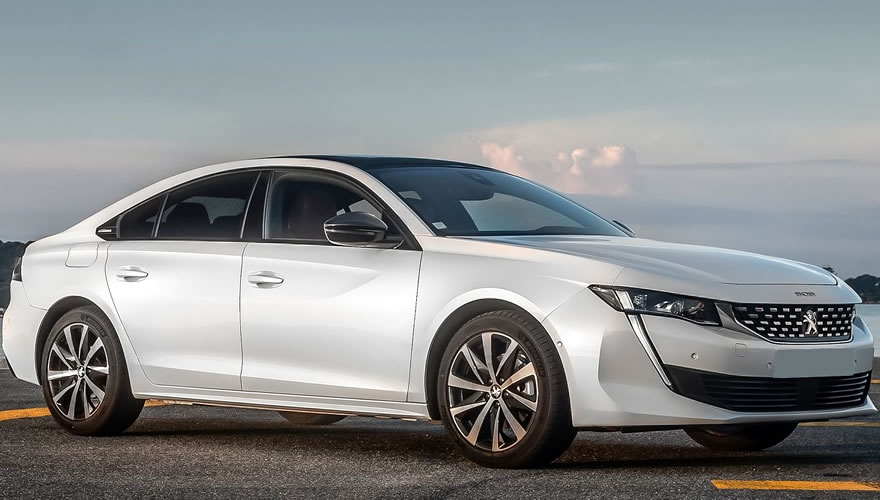
Peugeot 508 — a large family car (D-segment) of the French company "Peugeot", which has been produced since 2010 to the present. It is a direct successor of the "Peugeot 407", as well as a snake "Peugeot 607". In 2011, it received several international awards, including "Car of the Year".

First generation (2010-2018)


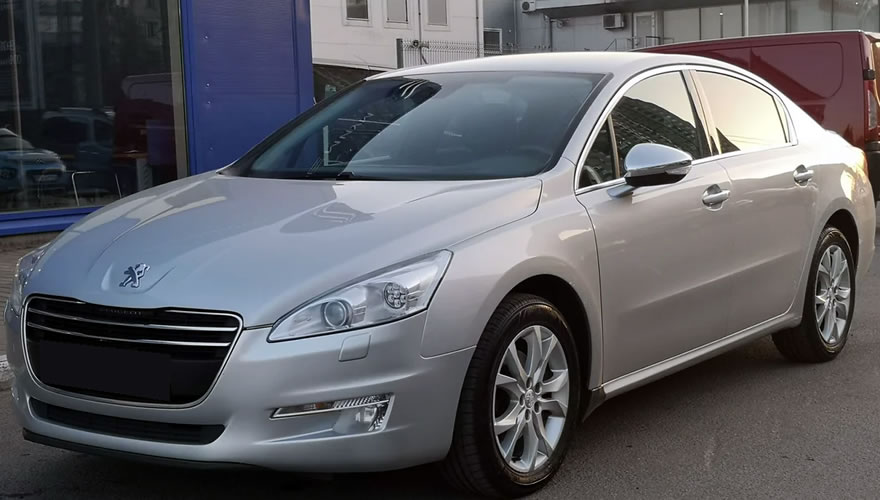
Peugeot 508 I, 2012 year, sedan 
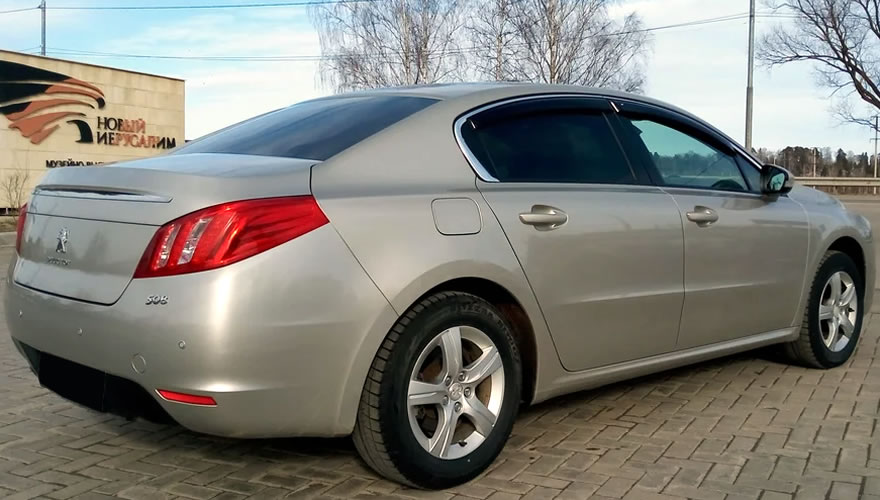
Peugeot 508 I, 2012 year, sedan
The first generation was officially presented at the Paris Motor Show in October 2010. The car is based on the well-proven "PSA PF3" platform. The body is produced as a four-door sedan (length 4790 mm) and the five-door station wagon "508 SW" (length 4810 mm). The width of the car was 1853 mm, the height was 1456 mm, the wheelbase was 2817 mm and the curb weight was 1390 kg. Assembly lines were located in China, Nigeria, France and Malaysia, where the first generation is still produced. About 560 thousand cars were produced. In 2011, the hybrid station wagon "508 RXH" was presented at the Frankfurt Motor Show. In 2014, a minor restyling was carried out.

Peugeot 508 I, 2012 year, back view 
Peugeot 508 I, 2012 year, back view
The petrol four-cylinder engines were available in two models with the following characteristics: 1.6 litres (1598 cm³, VTi/THP/e-THP, 120/155/165 hp) and 1.8 liters (1751 cm³, THP, 200 hp). There were three different models of four-cylinder diesel engines, but with very different characteristics:
  • 1.6 liters (1560 cm³, HDi/e-HDi/BlueHDi, 112/115/120 hp)
  • 2.0 liters (1997 cm³, HDi/BlueHDi, 136/140/150/163/180 hp)
  • 2.2 liters (2179 cm³, HDi, 204 hp)

The hybrid model was equipped with a 2.0-liter diesel engine (1997 cm³, HYbrid4) with a power of 163 hp plus an electric motor with a power of 37 hp. The gearbox was a six-speed manual, as well as a six- or five-speed automatic "AM6" or "EAT6".

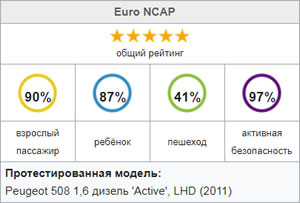
The European committee "Euro NCAP" tested the 2011 car for occupant and pedestrian safety and awarded the maximum five-star rating, for more details see the table.

Second generation (2018-present)


Peugeot 508 II, 2019 year, sedan 
Peugeot 508 II, 2019 year, sedan
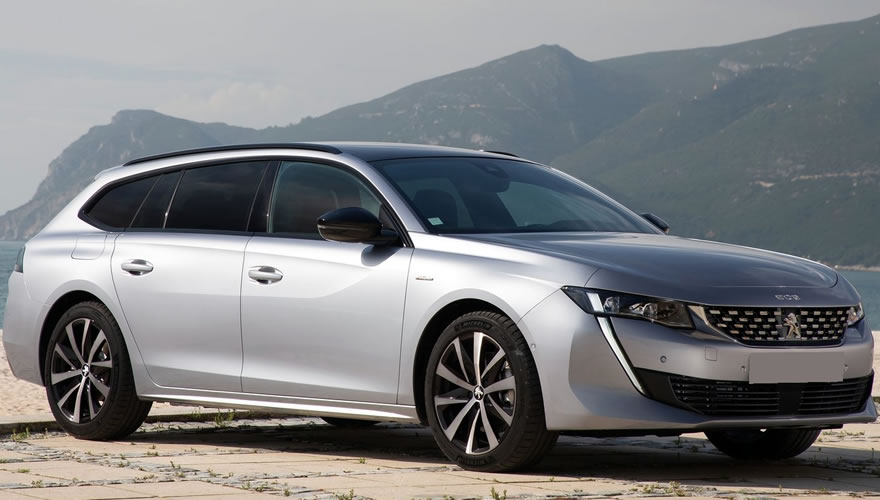
The second generation was first shown in February 2018, and in March the car took part in the Geneva International Motor Show and in April at the Beijing Motor Show. Sales began in September 2018. It is assembled on the new PSA EMP2 platform. The body is presented in three versions - a five-door station wagon (length 4770 mm, width 1859 mm, height 1420 mm) and a four-door sedan and liftback coupe (length 4750 mm, width 1859 mm, height 1403 mm). The wheelbase was 2793 mm, the curb weight was 1415-1535 kg. The air resistance coefficient was only 0.26. For China, a car was produced with a 57 mm longer wheelbase and a slightly modified design called "Peugeot 508L". The length of this car was 4860 mm, the width was 1859 mm and the height was 1460 mm.

There were two models of petrol engines, both four-cylinder with a capacity of 1.6 liters (1598 cm³, PureTech) with a capacity of 180 and 225 hp. Diesel engines were installed with a volume of 1.5 liters (1499 cm³, BlueHDI, 128 hp) and 2.0 liters (1997 cm³, BlueHDI, 158/178 hp). Gearbox: six-speed manual or eight-speed automatic "EAT8".

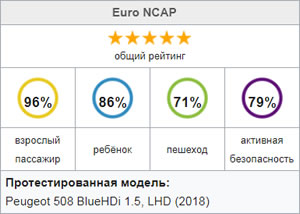
In 2018, the European committee "Euro NCAP" tested the car to determine its safety and awarded it the highest rating.

At the moment, the main competitors and classmates of the second generation Peugeot 508 are Audi A 4, BMW 3 series, Chevrolet Epica, Citroen C5, Ford Mondeo, Honda Accord, Hyundai Sonata, Infiniti Q70, Kia Optima, Mazda 6, Mercedes C -class, Mitsubishi Galant, Nissan Teana, Opel Insignia, Renault Laguna, Skoda Superb, Suzuki Kizashi, Subaru Legacy, Toyota Avensis, Toyota Camry, Volkswagen Passat.
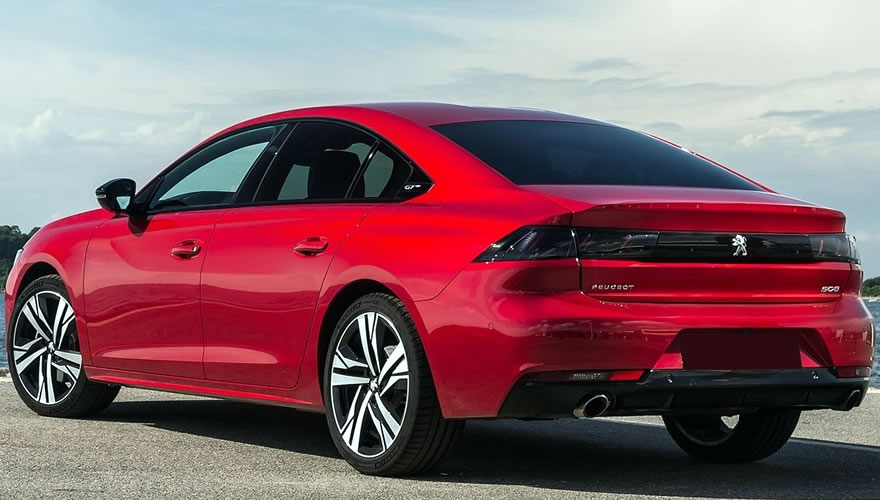
Peugeot 508 II, 2019 year, back view 
Peugeot 508 II, 2019 year, back view
Peugeot 508 II, 2019 year, station wagon 
Peugeot 508 II, 2019 year, station wagon
Peugeot 508 II, 2019 year, interior 
Peugeot 508 II, 2019 year, interior
Share information:
Link to this article in different formats
TEXTHTMLBB Code
Peugeot 406 (1995-2004) 
  • General information
  • User manual
  • Maintenance (gasoline)
  • Maintenance (diesel)
  • Power unit
  • Gasoline engines
  • Diesel engines
  • Engine overhaul
  • Cooling and heating
  • Fuel system (gasoline)
  • Fuel system (diesel)
  • Engine electrical equipment
  • Transmission
  • Clutch and drive shafts
  • Mechanical gearbox
  • Automatic gearbox
  • Chassis, running gear
  • Brake system
  • Car suspension
  • Steering
  • Body and interior
  • Exterior (external elements)
  • Interior (internal elements)
  • Doors, locks and windows
  • Electrical equipment
  • Equipment and devices
  • Electrical circuits
Peugeot 405 (1987-1997) 
  • General information
  • User manual
  • Maintenance
  • Power unit
  • Petrol engines 1.4 l
  • Petrol engines 1.6-2.0 l
  • Diesel engines
  • Ignition system
  • Fuel system (carburetor)
  • Single point fuel injection
  • Multipoint fuel injection
  • Cooling and lubrication system
  • Exhaust system
  • Transmission
  • Clutch
  • Manual gearbox MA
  • Manual gearbox BE
  • Automatic gearbox
  • Drive shafts
  • Chassis, running gear
  • Steering
  • Front suspension
  • Rear suspension
  • Brake system
  • Body and interior
  • Exterior (external elements)
  • Interior (internal elements)
  • Doors, locks and windows
  • Electrical equipment
  • Equipment and devices
  • Electrical circuits
PeugeotBook.ru © 2018–2025 | Mobile version | Sitemap: EN BG BY UA RS HR RO PL SK HU | Write message | Site search | Add to bookmarks | Peugeot owners
106 (1991-2003) | 206 (1998-2012) | 207 (2006-2014) | 305 (1977-1989) | 307 (2001-2008) | 405 (1987-1997) | 406 (1995-2004) | 605 (1989-2000) | Partner-I (1996-2008) | Eurovans-806 (1994-2002) |