



Share information:
1.4 liter petrol engines Peugeot 405

1.4 liter petrol engine — design description
TU3 Engine Sections a – cross-section, b – longitudinal section Peugeot 405 cars with 1.4 dm³ petrol engines intended for the Polish market have been assembled in Poland since 1993 (at the car factory in Lublin) with...
TU3 Engine Sections a – cross-section, b – longitudinal section Peugeot 405 cars with 1.4 dm³ petrol engines intended for the Polish market have been assembled in Poland since 1993 (at the car factory in Lublin) with...

Technical characteristics of 1.4 liter engines
Engine The engine is four-stroke, four-cylinder, in-line, carburetor, water-cooled, the camshaft is in the cylinder head, mounted transversely at the front of the car with an inclination of 6° to the rear, front-wheel...
Engine The engine is four-stroke, four-cylinder, in-line, carburetor, water-cooled, the camshaft is in the cylinder head, mounted transversely at the front of the car with an inclination of 6° to the rear, front-wheel...

Checking and adjusting valve clearance
Spark advance characteristics of the TU3.2 K engine A – centrifugal regulator, B – vacuum regulator When testing on a bench, the values should be reduced by half. When checking in the car, the initial ignition timing...
Spark advance characteristics of the TU3.2 K engine A – centrifugal regulator, B – vacuum regulator When testing on a bench, the values should be reduced by half. When checking in the car, the initial ignition timing...

Checking and adjusting the ignition timing angle
Ignition system the picture above is a schematic diagram the picture below is the connection diagram 1 – battery, 2 – ignition coil, 3 – booster module, 4 – ignition distributor Signs for setting the ignition on the...
Ignition system the picture above is a schematic diagram the picture below is the connection diagram 1 – battery, 2 – ignition coil, 3 – booster module, 4 – ignition distributor Signs for setting the ignition on the...

Carburetor adjustment
Ignition distributor with booster module and ignition coil 1 – ignition distributor housing; 2 – ignition distributor; 3 – distributor rotor; 4 – casing; 5 – bearing; 6 – fastening ring; 7 – rotor; 8 – pulse generator;...
Ignition distributor with booster module and ignition coil 1 – ignition distributor housing; 2 – ignition distributor; 3 – distributor rotor; 4 – casing; 5 – bearing; 6 – fastening ring; 7 – rotor; 8 – pulse generator;...

Removal the air filter
1. Remove the clamps, disconnect the vacuum hose (indicated by the arrow) and a hose (indicated by the arrow) engine crankcase ventilation. 2. Remove the clamps and disconnect the hose connecting the air filter housing...
1. Remove the clamps, disconnect the vacuum hose (indicated by the arrow) and a hose (indicated by the arrow) engine crankcase ventilation. 2. Remove the clamps and disconnect the hose connecting the air filter housing...
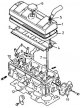
Removal the cylinder head
Cylinder head assembly 1 – valve cover, 2 – valve cover gasket, 3 – sheet casing (oil deflector), 4 – spacer sleeve, 5 – cover mounting bolt, 6 – oil filler plug, 7 – cylinder head bolt, 8 – valve guides, 9 – valve...
Cylinder head assembly 1 – valve cover, 2 – valve cover gasket, 3 – sheet casing (oil deflector), 4 – spacer sleeve, 5 – cover mounting bolt, 6 – oil filler plug, 7 – cylinder head bolt, 8 – valve guides, 9 – valve...
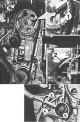
Installing the cylinder head
Installation of the gas distribution system 1 – adjusting rod for fixing the camshaft, 2 – adjusting rod for fixing the crankshaft, 3 – tightening the tension roller, 4 – unscrewing the tension roller, 5 – direction of...
Installation of the gas distribution system 1 – adjusting rod for fixing the camshaft, 2 – adjusting rod for fixing the crankshaft, 3 – tightening the tension roller, 4 – unscrewing the tension roller, 5 – direction of...
Removal and installation of the power unit
The power unit with a 1.4 dm³ engine (type TU3) is removed from the vehicle in the same way as power units with petrol engines (type XU) (see subsection 3.1.2.2.1 ).
The power unit with a 1.4 dm³ engine (type TU3) is removed from the vehicle in the same way as power units with petrol engines (type XU) (see subsection 3.1.2.2.1 ).
Features of disassembling a 1.4 L petrol engine
The difference in the design of TU3 and XU engines is insignificant. In the TU3 engine, the main journal bearings of the crankshaft form one single unit (as the lower part of the cylinder block divided along the axis of...
The difference in the design of TU3 and XU engines is insignificant. In the TU3 engine, the main journal bearings of the crankshaft form one single unit (as the lower part of the cylinder block divided along the axis of...
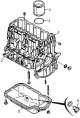
Disassembling the TU3 engine
Cylinder Block Assembly 1 – upper part of the cylinder block, 2 – lower part of the cylinder block, 3 – cylinder liner, 4 – cylinder liner sealing ring, 5 – oil pan, 6 – oil drain plug Crank mechanism 1 - crankshaft, 2...
Cylinder Block Assembly 1 – upper part of the cylinder block, 2 – lower part of the cylinder block, 3 – cylinder liner, 4 – cylinder liner sealing ring, 5 – oil pan, 6 – oil drain plug Crank mechanism 1 - crankshaft, 2...
Disassembling the cylinder head
1. Unscrew the ignition distributor, remove the fuel pump and ignition coil. 2. Remove the ignition distributor bracket. 3. Unscrew the spark plugs from the cylinder head. 4. Remove the thermostat and unscrew the...
1. Unscrew the ignition distributor, remove the fuel pump and ignition coil. 2. Remove the ignition distributor bracket. 3. Unscrew the spark plugs from the cylinder head. 4. Remove the thermostat and unscrew the...
Cylinder head assembly
1. Before assembly, it is necessary to clean all parts and check their condition. 2. Degrease all cylinder head parts. 3. Lubricate the valve stems with engine oil, then insert the valves into the appropriate guides. 4....
1. Before assembly, it is necessary to clean all parts and check their condition. 2. Degrease all cylinder head parts. 3. Lubricate the valve stems with engine oil, then insert the valves into the appropriate guides. 4....

Determining the size of the liners
Location of the mark on the cylinder block and crankshaft The marks on the cylinder block are located on the left side of the block, and the marks on the crankshaft are located on the end of the crankshaft bridge....
Location of the mark on the cylinder block and crankshaft The marks on the cylinder block are located on the left side of the block, and the marks on the crankshaft are located on the end of the crankshaft bridge....
TU3 Engine Assembly
1. Install the piston rings in the piston grooves, paying attention to the correct installation order and the inscriptions on the rings, which should be visible from above, as well as the correct installation of the...
1. Install the piston rings in the piston grooves, paying attention to the correct installation order and the inscriptions on the rings, which should be visible from above, as well as the correct installation of the...
Removal the oil pump
1. Drain the oil from the engine by unscrewing the drain plug in the oil pan. 2. Remove the oil pan by unscrewing the corresponding mounting bolts. 3. Unscrew the three bolts securing the oil pump to the cylinder block....
1. Drain the oil from the engine by unscrewing the drain plug in the oil pan. 2. Remove the oil pan by unscrewing the corresponding mounting bolts. 3. Unscrew the three bolts securing the oil pump to the cylinder block....
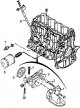
Disassembling the oil pump
Elements of the lubrication system 1 – oil pump cover with oil receiver, 2 – bypass valve, 3 – pump body, 4 – pump drive chain, 5 – pump sprocket, 6 – oil filter, 7 – oil pressure sensor, 8 – tube and oil level...
Elements of the lubrication system 1 – oil pump cover with oil receiver, 2 – bypass valve, 3 – pump body, 4 – pump drive chain, 5 – pump sprocket, 6 – oil filter, 7 – oil pressure sensor, 8 – tube and oil level...

Removal the coolant pump
1. Disconnect the ground cable from the battery. 2. Drain the coolant from the system. 3. Remove the alternator V-belt. 4. Unscrew the three crankshaft pulley mounting bolts and remove the pulley. 5. Unscrew the...
1. Disconnect the ground cable from the battery. 2. Drain the coolant from the system. 3. Remove the alternator V-belt. 4. Unscrew the three crankshaft pulley mounting bolts and remove the pulley. 5. Unscrew the...
This section is available on russian, bulgarian, belarusian, ukrainian, serbian, croatian, romanian, polish, slovak, hungarian
See similar information for other Peugeot models
➨ Power unit: Petrol engines Peugeot 106 (1991-2003)
➨ Power unit: Gasoline engines Peugeot 206 (1998-2012)
➨ Power unit: Petrol engines EW10 Peugeot 307 (2001-2008)
➨ Power unit: Petrol engines «ES9J4» Peugeot 605 (1989-2000)
➨ Power unit: Gasoline engines Peugeot 807 (2002-2014)
Link to this section in different formats
TEXTHTMLBB Code
- General information
- User manual
- Maintenance (gasoline)
- Maintenance (diesel)
- Power unit
- Gasoline engines
- Diesel engines
- Engine overhaul
- Cooling and heating
- Fuel system (gasoline)
- Fuel system (diesel)
- Engine electrical equipment
- Transmission
- Clutch and drive shafts
- Mechanical gearbox
- Automatic gearbox
- Chassis, running gear
- Brake system
- Car suspension
- Steering
- Body and interior
- Exterior (external elements)
- Interior (internal elements)
- Doors, locks and windows
- Electrical equipment
- Equipment and devices
- Electrical circuits
- General information
- User manual
- Maintenance
- Power unit
- Petrol engines 1.4 l
- Petrol engines 1.6-2.0 l
- Diesel engines
- Ignition system
- Fuel system (carburetor)
- Single point fuel injection
- Multipoint fuel injection
- Cooling and lubrication system
- Exhaust system
- Transmission
- Clutch
- Manual gearbox MA
- Manual gearbox BE
- Automatic gearbox
- Drive shafts
- Chassis, running gear
- Steering
- Front suspension
- Rear suspension
- Brake system
- Body and interior
- Exterior (external elements)
- Interior (internal elements)
- Doors, locks and windows
- Electrical equipment
- Equipment and devices
- Electrical circuits