



Cylinder Block Assembly
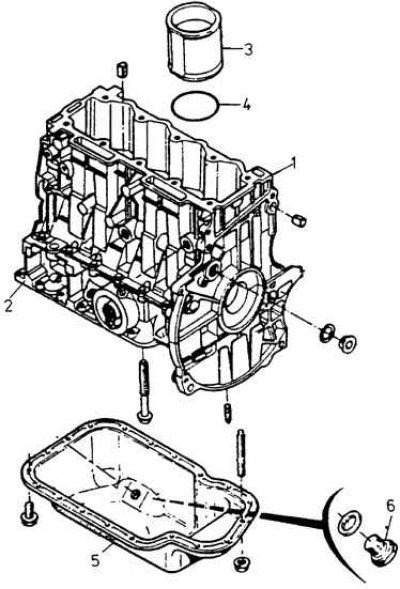
1 – upper part of the cylinder block, 2 – lower part of the cylinder block, 3 – cylinder liner, 4 – cylinder liner sealing ring, 5 – oil pan, 6 – oil drain plug
Crank mechanism
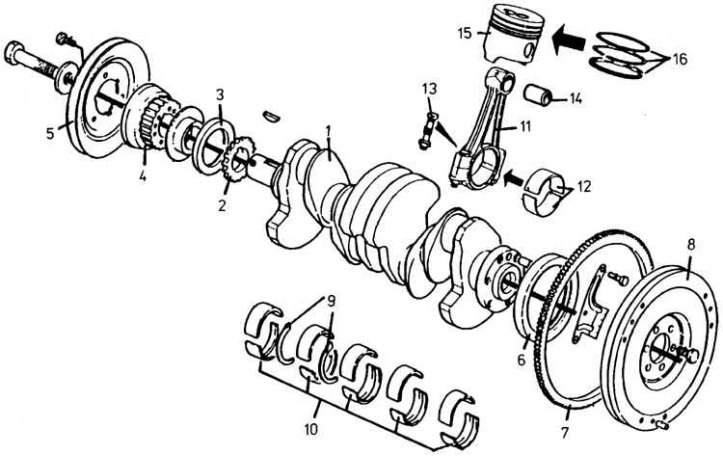
1 - crankshaft, 2 - oil pump drive sprocket, 3 - front crankshaft seal, 4 - crankshaft pulley, 5 - crankshaft pulley (V-belt), 6 - rear crankshaft seal, 7 - flywheel ring gear, 8 - flywheel, 9 - crankshaft thrust bearings, 10 - crankshaft main bearings, 11 - connecting rod, 12 - connecting rod bearings, 13 - connecting rod bolt, 14 - piston pin, 15 - piston, 16 - piston rings
1. Remove the starter.
2. Disconnect the gearbox from the engine.
3. Drain the oil from the engine oil system by unscrewing the drain plug in the oil pan.
4. Remove the V-belt and generator.
5. Attach the engine to the mounting frame.
6. Remove the valve cover, remove the two spacer bushings and the sheet metal casing (oil deflector).
7. Unscrew the oil filter located on the side at the bottom of the cylinder block on the left side (looking from the flywheel side).
8. Unscrew the oil pressure sensor located at the top of the cylinder block above the oil filter support and remove the crankshaft pulley.
[Information posted on the website: Peugeotbook.ru]
9. Remove the oil level indicator tube.
10. Remove the ignition timing plate above the flywheel by unscrewing the two bolts from the rear wall at the top of the cylinder block.
11. Extract (if present) crankshaft position sensor (tDC sensor), and also unscrew the bolt of the sensor cage in the rear wall of the cylinder block opposite the flywheel.
12. Fix the flywheel using the special Peugeot device (fixture 0132).
13. Unscrew the mounting bolts and remove the three-piece timing belt cover.
14. Unscrew the three pulley mounting bolts (crankshaft, camshaft and tension roller), remove the toothed belt and tension roller.
15. Unscrew the cylinder head bolts in several stages in order from the middle outwards.
16. Remove all five valve lever axle brackets with levers and axle.
17. Tilt the cylinder head using two bends around one of the lower long edges of the head to separate it from the cylinder block.
18. Carefully remove the cylinder head gasket.
19. Attach the cylinder liners to the cylinder block using two special Peugeot plates (fixture 0132 A1Z), screwing each plate with two M10 bolts 40 mm long.
20. Remove the two cylinder head centering bushings from the holes on the top surface of the cylinder block.
21. Unscrew the four coolant pump mounting bolts from the cylinder block.
22. Unscrew the six bolts securing the clutch master cylinder to the flywheel in several stages to avoid bending the master cylinder.
23. Unscrew the flywheel from the crankshaft.
24. Unscrew the upper and lower bolts connecting both parts of the cylinder block.
25. Unscrew the two threaded plugs of the main oil channel, located in the front and rear walls of the upper part of the cylinder block.
26. Turn the engine upside down and remove the oil pan by unscrewing the corresponding bolts.
27. Unscrew the three oil pump mounting bolts and remove it, leaving the chain in the cylinder block.
28. Unscrew and remove 10 crankshaft main bearing bolts, remove the lower part of the cylinder block.
29. Mark the relative positions of the connecting rods and their caps by applying marks on the side of the oil filter support, unscrew the connecting rod cap bolts and remove them together with the liners.
30. Remove the crankshaft together with the oil pump drive chain from the cylinder block.
31. Remove the main bearings from the cylinder block socket.
32. Place the cylinder block on the front wall (from the timing drive side) and remove two special Peugeot plates (cylinder liners) from the top of the cylinder block.
33. Remove the cylinder liners together with the corresponding pistons and connecting rods towards the cylinder head.
34. Remove the piston with the connecting rod from each cylinder liner.
35. Pistons should only be separated from connecting rods if the piston is damaged. It is necessary to press the piston pin out of the piston on a hydraulic press using a special Peugeot nozzle (fixture 0139). The removed connecting rod can be reused, but the piston should be replaced.
36. Remove the piston rings using special pliers.