



Disassemble the engine in the following order:
1. Loosen the cylinder head cover mounting nuts and remove the cover with the gasket.
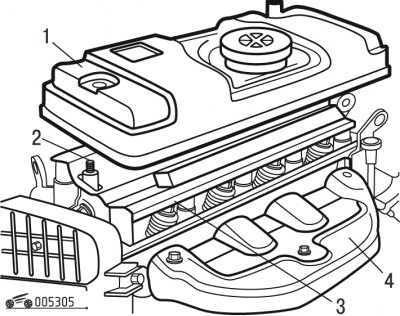
Figure 3.5. Removing the cylinder head cover: 1 - cylinder head cover with gasket; 2 - spacer bushings; 3 - oil deflector screen; 4 - exhaust manifold heat shield
2. Remove the spacer bushings 2 (figure 3.5) and an oil-deflecting screen.
3. Remove the exhaust manifold heat shield.
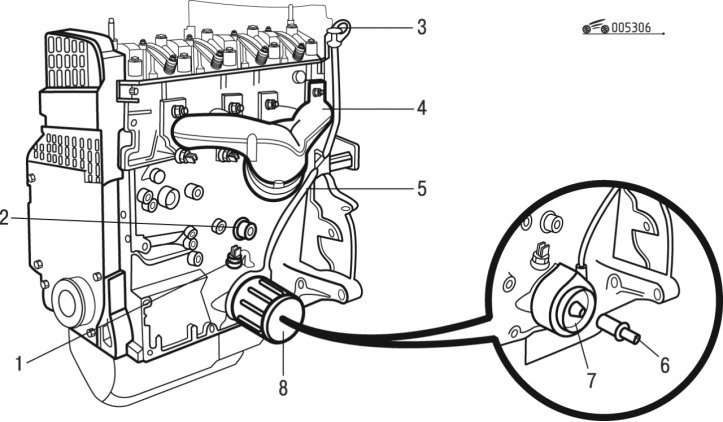
Figure 3.6. Removing the exhaust manifold and elements located on the exhaust manifold installation side: 1 - oil pressure indicator sensor (depending on the configuration); 2 - oil pressure warning light sensor; 3 - oil dipstick; 4 - exhaust manifold; 5 - feeler gauge guide tube; 6 - threaded nipple (depending on the configuration); 7 - heat exchanger (depending on the configuration); 8 - oil filter
4. Remove the exhaust manifold 4 (figure 3.6) and its gasket.
5. Unscrew the oil filter 8.
Note: On some engines (depending on the configuration) a heat exchanger can be installed under the oil filter, into which a threaded extension is screwed for installing the oil filter.
6. Remove the threaded fitting and heat exchanger, if installed (see figure 3.6).
7. Remove the dipstick from the guide tube.
8. Remove the dipstick guide tube.
9. Use a wrench to remove the oil pressure indicator sensor, if installed (depending on the configuration) (see figure 3.6).
10. Use a wrench to unscrew the oil pressure indicator lamp sensor.
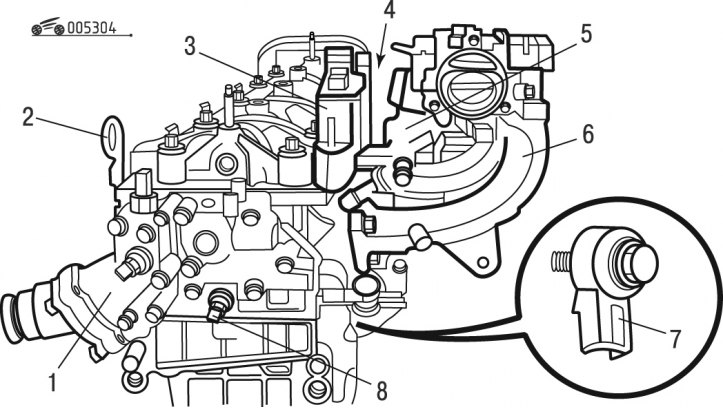
Figure 3.7. Removing the intake manifold and elements located on the intake manifold installation side: 1 - cooling system thermostat block; 2 - lifting eyes for slinging the power unit; 3 - compact ignition coil block (depending on the engine type); 4 - fuel rail with injectors; 5 - intake manifold; 6 - knock sensor; 7 - coolant temperature sensor
11. Remove block 3 from the intake manifold installation side (depending on the engine type) (figure 3.7) ignition coils.
12. Remove the fuel rail with injectors.
13. Remove the intake manifold.
14. Remove the cooling system thermostat unit from the end of the cylinder head.
15. Unscrew the coolant temperature sensor from the end of the cylinder head.
16. Remove the lifting eyes for the power unit from the cylinder head.
17. Remove the knock sensor (it is located on the cylinder block under the intake manifold).
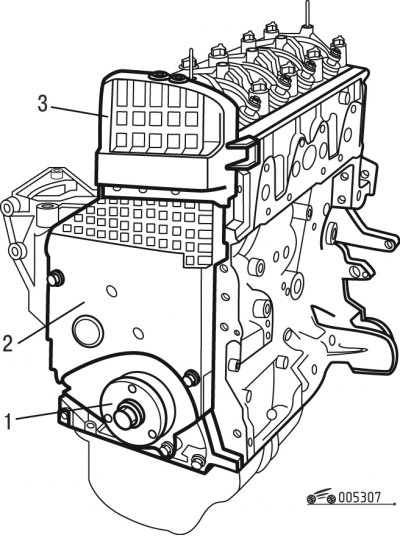
Figure 3.8. Removing the timing belt covers: 1 - Upper cover of the camshaft drive belt; 2 - middle cover of the camshaft drive belt; 3 - lower cover of the camshaft drive belt
18. Remove the three timing belt covers (figure 3.8).
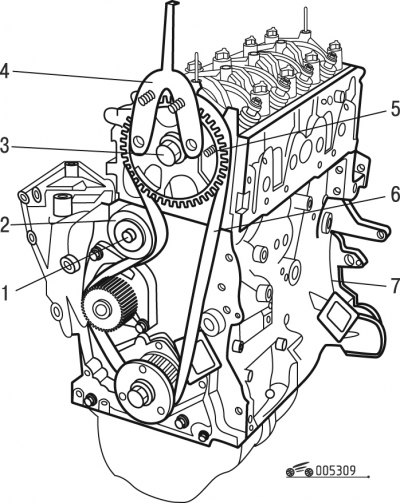
Figure 3.9. Fixing the flywheel and camshaft: 1 - timing belt tensioner mounting bolt; 2 - roller of the toothed belt tensioning mechanism; 3 - camshaft toothed pulley mounting bolt; 4 - special key; 5 - device 0132 A for fixing the camshaft; 6 - toothed belt; 7 - device for fixing the engine flywheel (depending on the engine type)
19. Lock the crankshaft flywheel with tool 7 (figure 3.9) to fix it (a pin or bolt with a diameter of 6 mm can be used as a retainer), inserting it into the hole in the front left flange of the cylinder block.
20. Loosen the generator drive pulley mounting bolts and remove the pulley.
21. Loosen the timing belt tensioner mounting bolt.
22. Loosen and remove the timing belt.
23. Remove the timing belt tensioner roller.
24. Lock the camshaft toothed pulley using tool 0132A, unscrew its mounting bolt and remove the pulley.
25. Remove the toothed pulley from the crankshaft.
26. Loosen the coolant pump mounting bolts. Remove the coolant pump with the gasket from its seat in the cylinder block.
Note: If complete disassembly of the engine is not required, the cylinder head can be removed as a complete assembly with pipelines and auxiliary units.
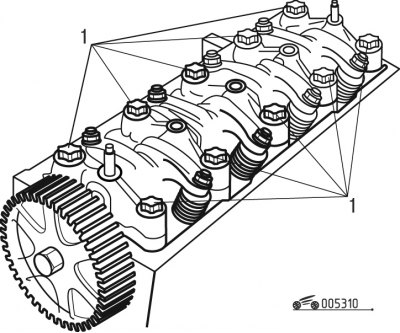
Figure 3.10. Unscrewing the cylinder head mounting bolts: 1 - cylinder head mounting bolts
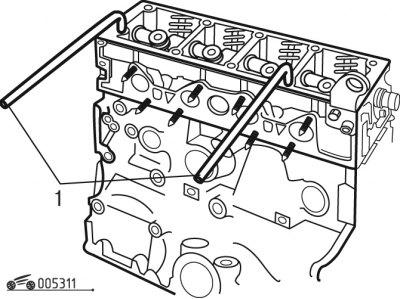
Figure 3.11. Removing the cylinder head using levers (fixture 0153-Q): 1 - set of tools for removing the cylinder head
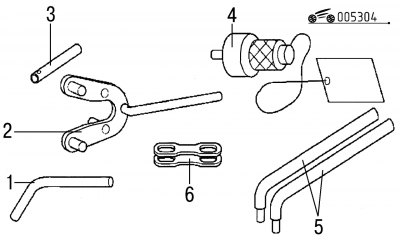
Figure 3.4. Special tool and devices for engine disassembly: 1 - device for fixing the engine flywheel; 2 - special key; 3 - device for fixing the camshaft; 4 - flywheel stopper; 5 - levers; 6 - Clamping plates for holding cylinder liners (used when disassembling engines with aluminum cylinder blocks)
27. Unscrew bolts 1 (figure 3.10) cylinder head fastenings and remove it together with the camshaft. If necessary, disassemble the cylinder head. To separate the head from the cylinder block, use the 0153-Q tool kit; these devices are L-shaped levers (figure 3.11), which are inserted into the holes of the head mounting bolts (see figure 3.4).
Note: It is necessary to unscrew the cylinder head mounting bolts starting from the periphery in a spiral, moving towards the center of the head.
28. Remove the cylinder head gasket.
Warning! Operation item 29 is only for engines with an aluminum alloy cylinder block.
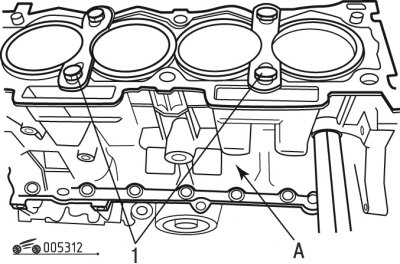
Figure 3.12. Installing clamping plates on the cylinder block to hold the cylinder liners (fixture 0132-A1Z): 1 - set of clamping plates for holding cylinder liners (fixture 0132-A1Z); A - aluminum alloy cylinder block
29. Install two clamping plates 1 on the cylinder block (figure 3.12) to hold the cylinder liners. The plates are mounted on bolts that are screwed into the holes for the cylinder head mounting bolts.
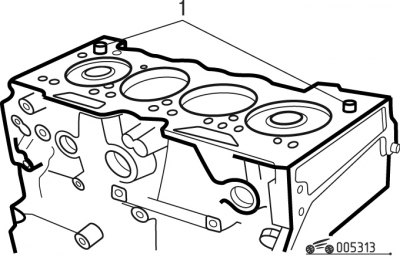
Figure 3.13. Removing the bushings for centering the head on the cylinder block: 1 - bushings for centering the head on the cylinder block
30. Remove bushings 1 (figure 3.13) for centering the head on the cylinder block.
31. Remove tool 0132-QZ (see figure 3.4) for fixing the engine flywheel.
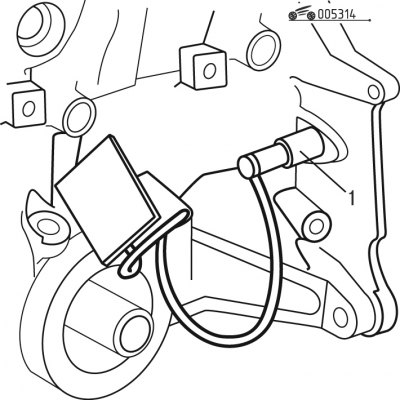
Figure 3.14. Installing the 0132-P flywheel stopper into the hole in the cylinder block: 1 - flywheel stopper
32. Install stopper 1 into the hole in the cylinder block (figure 3.14) flywheel.
Warning! Operations 33–37 are only for engines with an aluminum alloy cylinder block.
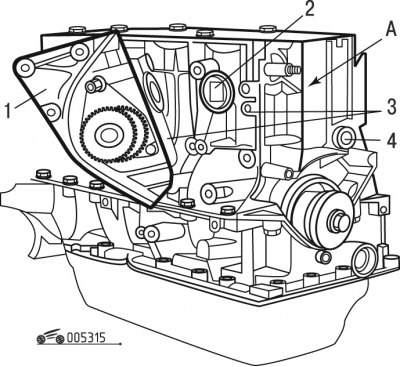
Figure 3.15. Removing the cooling system pump on engines with an aluminum alloy cylinder block: 1 - cooling system pump; 2 - sealing ring; 3 - centering pins of the cooling system pump; 4 - oil channel plug; A - cylinder block
33. Loosen the mounting bolts and remove the cover with pump 1 (figure 3.15) cooling systems.
34. Remove the cooling system pump centering pins from the cylinder block.
35. Remove the sealing ring.
36. Remove the cooling system pump.
37. Remove the oil channel plug.
Warning! Operations 38-39 are only for engines with a cast iron cylinder block.
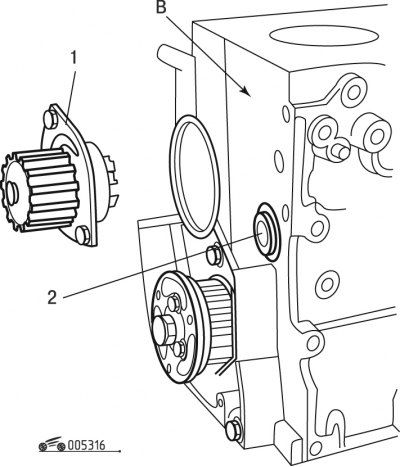
Figure 3.16. Removing the cooling system pump on engines with a cast iron cylinder block: 1 - cooling system pump; 2 - oil channel plug; B - cast iron cylinder block
38. Loosen the mounting bolts and remove pump 1 (figure 3.16) cooling systems.
39. Remove plug 2 of the oil channel.
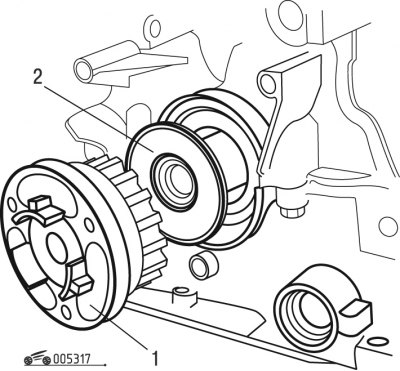
Figure 3.17. Removing the crankshaft toothed pulley: 1 - toothed pulley of the crankshaft; 2 - spacer washer
40. Loosen the mounting bolt and remove the toothed pulley 1 (figure 3.17) crankshaft.
41. Remove spacer washer 2 from the crankshaft end.
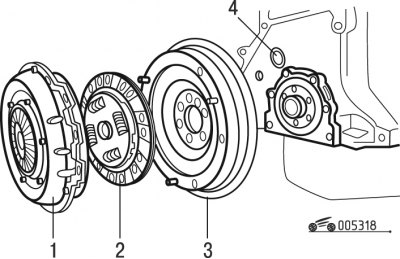
Figure 3.18. Removing the crankshaft flywheel: 1 - housing with pressure plate assembly; 2 - driven clutch disc; 3 - flywheel; 4 - oil channel plug
If the clutch was not removed during disassembly of the power unit, then remove the clutch housing with the pressure plate assembly and the clutch disc (figure 3.18).
42. Loosen the mounting bolts and remove flywheel 3 from the crankshaft.
43. Remove plug 4 of oil channel.
Warning! Operations 44–61 are only for engines with an aluminum alloy cylinder block.
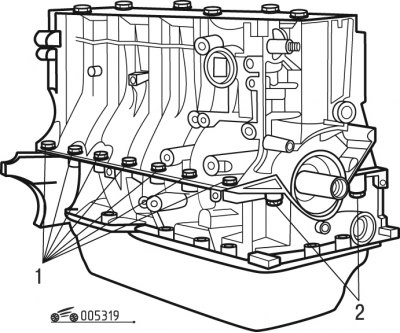
Figure 3.19. Unscrewing the bolts securing the lower crankshaft main bearing cap housing from the cylinder block: 1 - bolts for fastening the housing of the lower caps of the crankshaft main bearings to the cylinder block; 2 - bolts for fastening the housing of the lower main bearing caps of the crankshaft to the cylinder block
44. Unscrew the bolts securing the lower crankshaft main bearing cap housing from the cylinder block (figure 3.19).
45. Turn the engine over with the crankcase facing up.
46. Unscrew the nuts and bolts securing the pan.
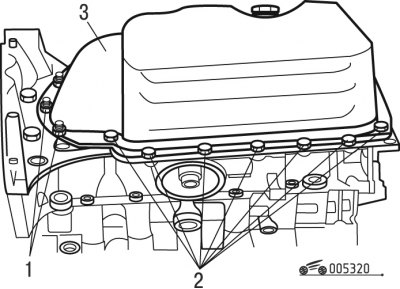
Figure 3.20. Removing the cylinder block oil pan: 1 - pan mounting nuts; 2 - tray mounting bolts; 3 - oil pan
47. Remove the tray 3 (figure 3.20).
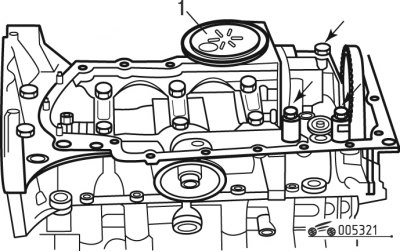
Figure 3.21. Removing the oil pump: 1 - oil pump with oil receiver
48. Loosen the oil pump mounting bolts and remove the oil pump 1 (figure 3.21) with oil receiver.
49. Remove the oil pump centering pin.
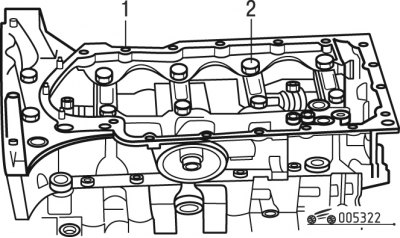
Figure 3.22. Removing the lower main bearing cap housing of the crankshaft: 1 - housing of lower main bearing caps of crankshaft; 2 - mounting bolts
50. Loosen the mounting bolts 2 (figure 3.22) and remove the lower crankshaft main bearing cap housing.
51. Remove the engine crankshaft oil seal (from the valve timing side).
52. Remove the engine crankshaft oil seal (from the flywheel side of the crankshaft).
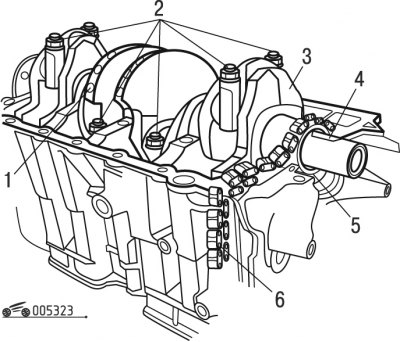
Figure 3.23. Removing the crankshaft: 1 - crankshaft thrust half rings; 2 - connecting rod caps; 3 - crankshaft; 4 - key; 5 - oil pump drive gear; 6 - oil pump drive chain
53. Remove gear 5 (figure 3.23) and the oil pump drive chain.
54. Remove the key from the crankshaft groove.
55. Loosen the connecting rod bolt nuts and remove the connecting rod caps.
56. Remove the crankshaft from the main bearing seats.
57. Remove the upper crankshaft main bearing shells.
58. Remove the thrust half rings from the crankshaft center support.
Note: Mark the connecting rod cap shells before removal to ensure they are installed in the same locations during reassembly.
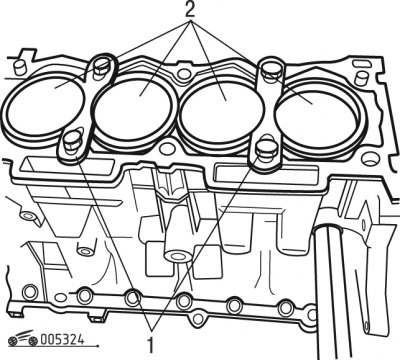
Figure 3.24. Removing the clamping plates holding the cylinder liners (fixture 0132-A1Z): 1 - set of clamping plates for holding cylinder liners (fixture 0132-A1Z); 2 - cylinder liners
59. Remove the clamping plates 1 (figure 3.24), holding the cylinder liners.
60. Remove the liners from the cylinder block together with the pistons and connecting rods attached to the pistons. If the liners are to be reused, mark their locations in the cylinder block.
Warning! Operations pp. 61-79 are only for engines with a cast iron cylinder block.
61. Thoroughly clean all mating surfaces with D2 to remove any remaining metal.
62. Unscrew the nuts and bolts securing the pan.
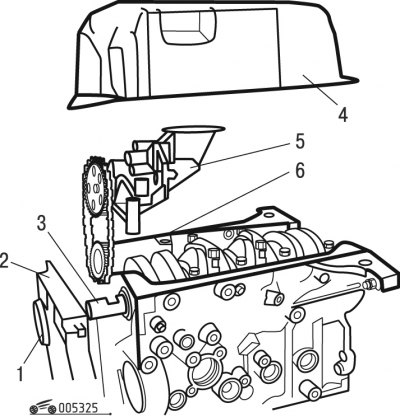
Figure 3.25. Removing the cylinder block oil pan and oil pump: 1 - front crankshaft oil seal; 2 - front crankshaft oil seal holder; 3 - key; 4 - oil pan; 5 - oil pump with oil receiver; 6 - oil pump centering pin
63. Remove the tray 4 (figure 3.25).
64. Remove the front crankshaft oil seal holder.
65. Remove the front oil seal from the holder.
66. Loosen the oil pump mounting bolts and remove the pump with the oil receiver.
67. Remove the oil pump centering pin.
68. Remove the oil pump drive gear and chain.
69. Remove the key from the crankshaft groove.
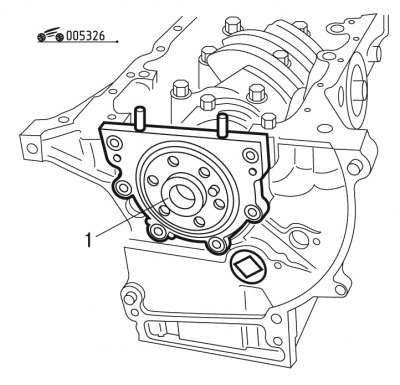
Figure 3.26. Removing the crankshaft rear oil seal holder: 1 - Crankshaft rear oil seal holder
70. Loosen the mounting bolts and remove the holder 1 (figure 3.26) rear crankshaft oil seal.
71. Remove the rear oil seal from the holder.
Note: Mark the bearings and caps before removal so that they are installed in the same locations during reassembly.
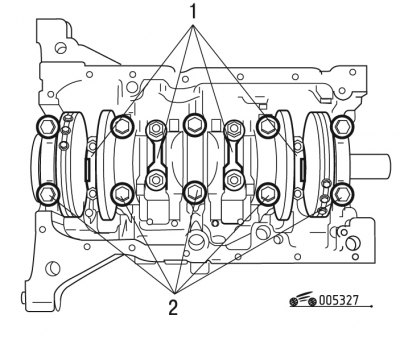
Figure 3.27. Removing the crankshaft: 1 - connecting rod caps; 2 - crankshaft main bearing cap bolts
72. Unscrew the nuts of the connecting rod bolts, remove the covers 1 (see figure 3.27) connecting rods.
73. Loosen bolts 2 securing the crankshaft main bearing caps and remove the caps together with the lower liners.
Note: The crankshaft main bearings are marked 1 through 5, mark 1 (first bearing) located on the flywheel side of the engine.
74. Remove the thrust half rings from the main bearing seat No.2 (they are located in the cylinder block).
75. Remove the crankshaft from the main bearing seats.
76. Remove the upper main bearing shells from the beds.
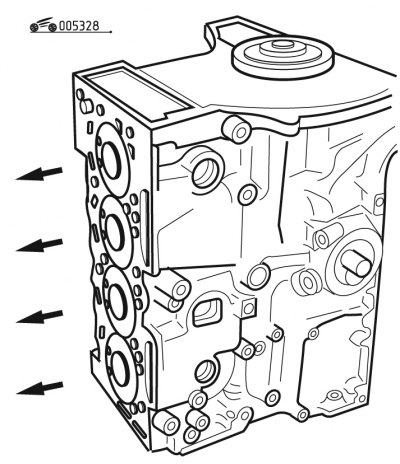
Figure 3.28. Removing the pistons together with the connecting rods (the arrows indicate the direction in which the pistons should be removed)
77. Install the cylinder block as shown in Figure 3.28.
78. Remove the pistons together with the connecting rods, having previously marked their locations in the cylinder block (if they are to be reused during engine assembly).
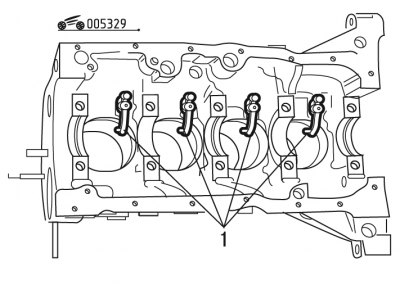
Figure 3.29. Removing the piston bottom oil cooling nozzles: 1 - piston bottom oil cooling nozzles
79. Remove the injectors 1 (see figure 3.29) oil cooling of the piston bottom.