



Table of contents: Engines with aluminum alloy cylinder…🠇 Engines with cast iron cylinder block 🠇
Engines with aluminum alloy cylinder block
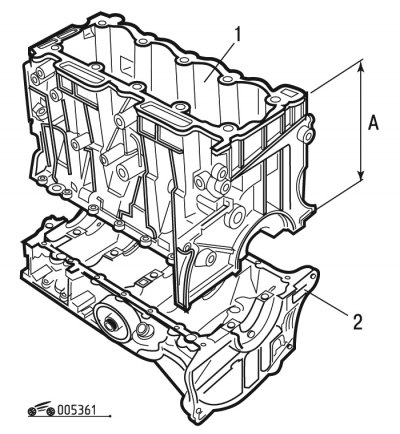
Figure 3.61. Aluminum alloy cylinder block: 1 - cylinder block; 2 - housing of lower main bearing caps of crankshaft
Cylinder block of engines with a working volume of 1.1; 1.4 l is cast from aluminum alloy and subjected to heat treatment. In the upper and middle parts of the block there are holes for installation of cylinder liners. In the lower part of the liner there is a ground belt, in which a groove is made for installation of a sealing rubber ring. Sealing in the upper part is provided by a cylinder head gasket. The height of the cylinder block A is given in Figure 3.61. The height of the cylinder block for different engines is given in Table 3.5.
Table 3.5. Cylinder Block Height
| Engine type | A ±0.05 mm |
| TU9-TU1-TU2.4 | 187,48 |
| TU3-TU2J2 | 206,98 |
Warning! The housing of the lower main bearing caps is machined together with the cylinder block. Therefore, the housings are not interchangeable. Installation of the housing of the lower main bearing caps from another engine on the cylinder block is not allowed.
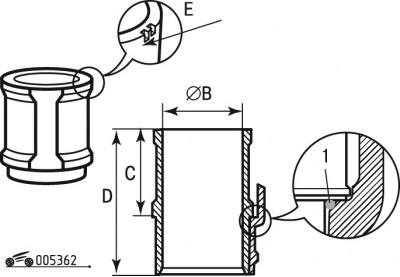
Figure 3.62. Cylinder liner: 1 - cylinder liner sealing ring
Text taken from the website Peugeotbook.ru
The tightness of the cylinder block is ensured by a rubber sealing ring 1 (figure 3.62).
The cylinder liner diameters (dimension B) are divided into 3 classes. The liner class can be determined (see footnote E) in two ways:
- by the line (notch) applied to the end of the sleeve from above;
- by inscription (letter + stroke).
Class identification:
- class A sleeve - inscription or one stroke;
- class B cartridge case - inscription or two strokes;
- class C sleeve - inscription or three lines.
Warning! When assembling the engine, pistons of the same class as the liner must be installed in the liners.
The dimensions of the cylinder liner are given in Table 3.6.
Table 3.6. Cylinder liner dimensions
| Engine code designation | Size (internal diameter) B (see figure 3.62), mm | Size (height) (see figure 3.62), mm | |||
| | class A | class B | class C | C | D |
| TU9 | from 70 to 70.01 | from 70.01 to 70.02 | from 70.02 to 70.03 | 85+0,030 | |
| TU1 | from 72 to 72.01 | from 72.01 to 72.02 | from 72.02 to 72.03 | | |
| TU2J2-TU3 | from 75 to 75.01 | from 75.01 to 75.02 | from 75.02 to 75.03 | 90±0,015 | 135,4 |
| TU2.4 | | | | 85+0,030 | 120,9 |
The flatness tolerance of the cylinder block is 0.05 mm.
Engines with cast iron cylinder block
The cylinder block of 1.6-liter engines is made of special low-alloy cast iron, the cylinders are made directly in the block.
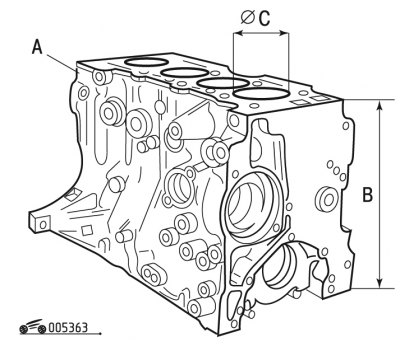
Figure 3.63. Cast iron cylinder block
Footnote A (figure 3.63): identification mark (R1), engraved on the cylinder block - repair size. Some dimensions of the cast iron cylinder block are given in Table 3.7.
Table 3.7. Dimensions of cast iron cylinder block
| Engine code designation | Size (internal diameter) WITH (figure 3.63), mm | Nominal size (height) B (figure 3.63), mm | ||
| | nominal | repair | | |
| TU3 | 75 | 75,4 | 265,23 | |
| TU5 | 78,5 | 78,9 | | |
It is possible to bore cylinders for repair pistons. After boring the cylinders, their surfaces must be honed.
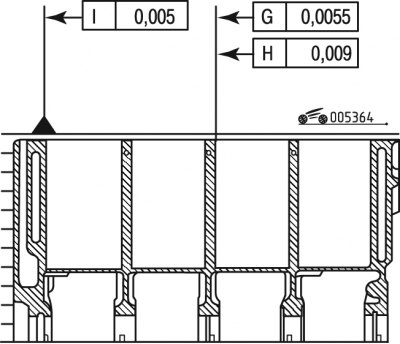
Figure 3.64a. Tolerance of shape and position of cylinders in the block: G - deviation of the cylinder axis from the vertical; H - compliance with the cylinder shape standard; I - flatness
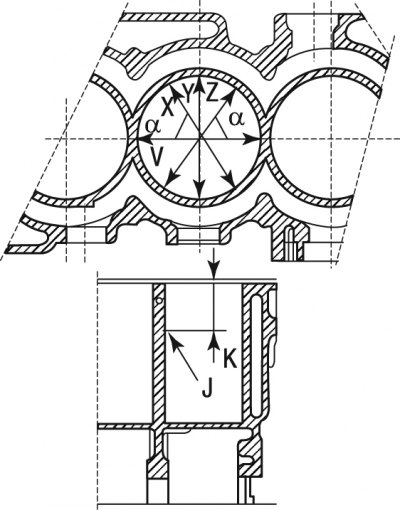
Figure 3.64b. Measuring the hardness of the cylinder wall: J - location of the ball; K=50 mm; a=60°
Measure diameters in the V, X, Y, Z directions (figure 3.64b).
The measured values (in mm) should be within the range:
- for TU3 engines: 75 =< V, X, Y, Z =< 75,018;
- for TU5 engines: 78.5 =< V, X, Y, Z =< 78,518.
The maximum spread between 12 measurements is 0.018 mm.
The main bearing caps are machined together with the cylinder block. Therefore, they are not interchangeable and have marks on the outer surface to differentiate them.