



Table of contents: Cleaning 🠇 Examination 🠇
Cleaning
1. Remove all parts and electrical sensors from the cylinder block. For complete cleaning, remove the process plugs. To remove the plugs, drill small holes in them and screw a self-tapping screw into the holes. Pull the screw head to remove the plug.
2. On cylinder blocks made of aluminum, remove the steel cylinder liners.
3. Where installed, unscrew the bolts and remove the oil spray pipe from the inside of the cylinder block.
4. Remove all traces of gaskets from the mating surfaces of the engine block.
5. Remove all oil line plugs. Use new plugs when installing.
6. Clean the dirtiest areas with steam.
7. Clean all oil holes and oil lines. Flush all internal passages with warm water until the water runs clear. It is necessary to dry the cylinder block completely and lubricate all mating surfaces with a thin layer of oil to prevent corrosion. On cast iron cylinder blocks, also lubricate the engine cylinders. If compressed air is available, use it to speed up the drying process and blow out all oil holes and lines.
8. If the cylinder block is not very dirty, it can be washed with warm soapy water and a stiff brush.
[Source of the article is website: PEUGEOTBOOK.ru]
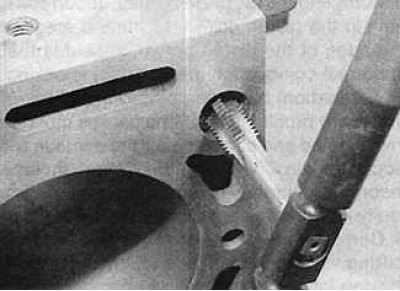
9. Thoroughly clean all threaded holes using a tap with the appropriate thread size, then blow out the holes with compressed air.
10. Install the plugs into the oil line in the engine block and tighten them securely.
11. Clean and install the oil spray pipe into the cylinder block and secure it with the bolt.
12. If the engine is not to be reassembled immediately, cover the cylinder block with a large plastic bag to protect it from contamination.
Examination
Cast iron engine cylinder block
1. Visually inspect the cylinder block for cracks and corrosion. Check the integrity of the threads in the threaded holes.
2. Check the engine cylinder bore for wear by looking for a step at the top of the cylinder.
3. If you have a measuring tool, measure the bore diameter of each cylinder at the top (under the wear step), in the center and at the base parallel to the crankshaft axis.
4. Then make the same measurements perpendicular to the crankshaft axis and compare them with the technical data (see subsection 3.3).
Aluminium cylinder block with wet liners
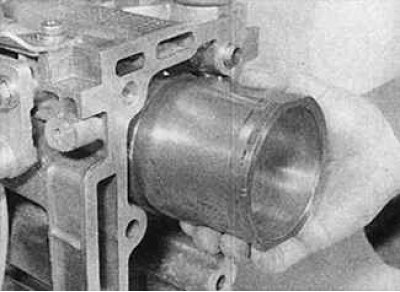
5. Remove the cylinder liner retainer, then use a hard wooden drift to knock the liners out of the inside of the cylinder block. Remove the liners from the top of the cylinder block and mark them.
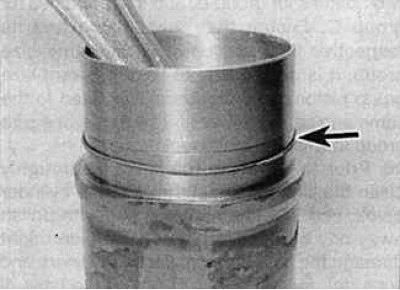
6. Remove the sealing ring from each sleeve (indicated by the arrow) circular cross-section.
7. Check each sleeve for wear and damage.
8. If you have a measuring tool, measure the diameter of the sleeve at the top (under the wear step), in the center and at the base parallel to the crankshaft axis.
9. Then make the same measurements perpendicular to the crankshaft axis and compare them with the technical data (see subsection 3.3).
10. Repeat the measurement procedure on the remaining sleeves.
11. If the wear of the sleeve exceeds the permissible values or there is other damage, it is necessary to replace the sleeves.
12. New liners are supplied complete with pistons and piston rings.
13. Pistons and liners are divided into three size groups. The size group of each piston is designated by the symbol (A, B or C), applied to the top of the piston, and the group of sizes of each sleeve is designated by notches (from 1 to 3) on the upper end of the sleeve; one notch for Group A, two notches for Group B, three notches for Group C. Check that each piston and the corresponding liner are of the same size group. It is not allowed to use a piston of one size group and a liner of another size group.
14. Before installing the liners, thoroughly clean the mating surfaces of the liners in the cylinder block and, using fine-grained sandpaper, sand off any burrs or sharp edges that could damage the O-ring. Clean the liners and wipe them dry. Install a new O-ring on the liners. To facilitate installation of the O-ring, lubricate it and the outer surface of the liners with engine oil.
15. If previously removed engine liners are being installed, install them in their places according to the previously made markings. Insert each liners into the cylinder block and press them in by hand until they stop. Using a hammer and a wooden block, install the liners completely in place.
16. After installing all the liners, use a ruler and feeler gauge to check that the protrusion of each liners above the cylinder block meets the specifications (see subsection 3.3).
17. When installing new liners, it is permissible to swap them in order to match their protrusion from the engine cylinder block.
18. If the protrusion of the sleeve does not meet technical requirements, then you must contact an engine repair specialist.