English Русский
Български
Беларускі
Український
Српски
Hrvatski
Română
Polski
Slovenský
Magyar
Bookmark Articles Sitemap Contacts
Company Hyundai Company Opel Company Skoda Company Kia Company Mitsubishi Company LADA Company Audi
PeugeotBook.ru


Series 100   Series 200   Series 300   400-500   Series 600   Crossovers   Others
 
Peugeot 405 (1987-1997) Peugeot 406 (1995-2004)

Pistons and connecting rods — check (Peugeot 406)

  • Main
  • 40X
  • Peugeot 406 (1995-2004)
  • Power unit
  • Engine overhaul
  • Pistons and connecting rods — check
0

Elements of the piston group
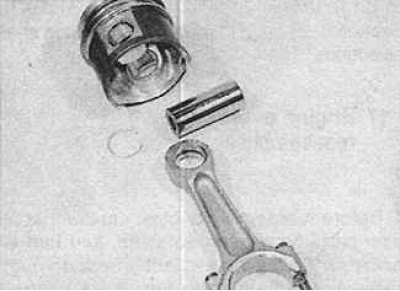


Correct positioning of the piston relative to the connecting rod on diesel engines
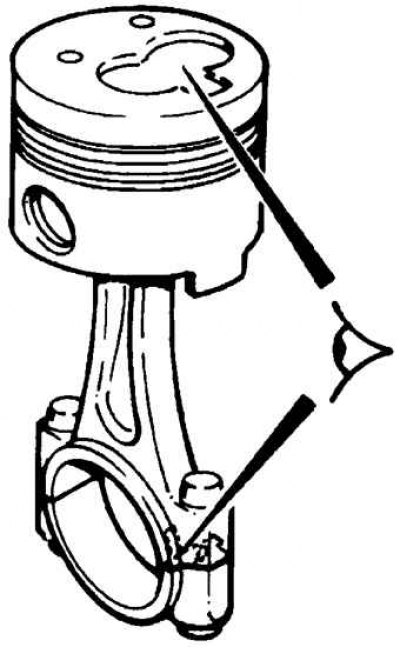

Correct positioning of the piston relative to the connecting rod on diesel engines


Examination


Examination


1. Before checking the pistons with connecting rods, remove the piston rings from the pistons and thoroughly clean the pistons.
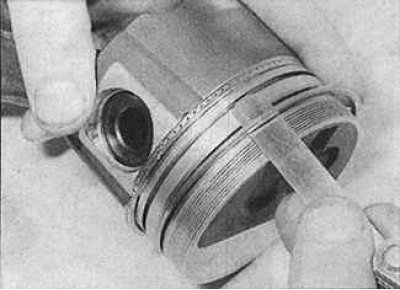
2. To remove piston rings from pistons, spread the ring apart and insert two or three old feeler…


2. To remove piston rings from pistons, spread the ring apart and insert two or three old feeler gauge blades evenly around the circumference of the ring and slide the ring off the piston using them. Be careful not to scratch the piston with the ends of the ring. Rings are very fragile and can crack if spread too much. The working edges of the rings are very sharp, so handle them carefully to avoid cutting yourself.


3. Keep each set of rings with the piston for reinstallation.

4. Clean all traces of carbon from the top of the piston.

5. Remove carbon deposits from the piston ring grooves using an old ring.

6. After removing the deposits, clean the piston and connecting rod with a suitable solvent and wipe them dry.

7. When assembling the engine, it is advisable to use new piston rings.

8. Carefully inspect each piston for cracks around the skirt and piston pin holes.

9. Check for wear on the piston skirt, piston head bore, and burn marks on the top of the piston.

10. Traces of pitting corrosion on the piston indicate that coolant has entered the combustion chamber. It is necessary to find the cause of the liquid entering the combustion chamber and eliminate it.

11. On engines with aluminum cylinder blocks with wet liners, pistons cannot be replaced separately; pistons are supplied complete with rings and sleeves.

12. Check each connecting rod for wear, cracks, and distortion.

13. It is recommended to replace the studs and nuts securing the lower connecting rod head during each disassembly.

14. On all petrol engines the piston pins are pressed into the upper head of the connecting rod, so connecting rod replacement must be carried out in a specialized workshop.

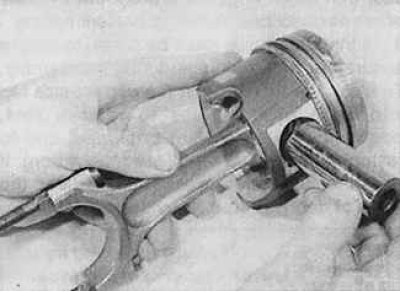
15. On diesel engines, the piston pins are installed with a sliding fit and are fixed in the piston by two retaining rings. On these engines, the pistons and connecting rods can be separated as follows.
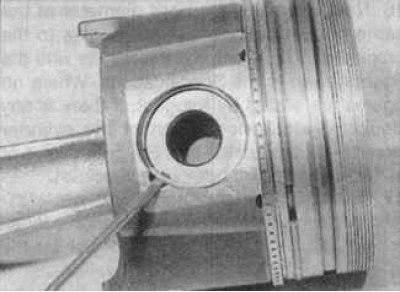
16. Using a thin screwdriver blade, remove the retaining ring from the piston and push out the…

16. Using a thin screwdriver blade, remove the retaining ring from the piston and push out the piston pin by hand. When reinstalling the piston pin, use only new retaining rings.


17. Check the piston pin and big end bearing for wear.

18. Connecting rods usually do not require replacement unless the engine has seized up beforehand.

19. Install the piston on the small end of the connecting rod so that the arrow on the piston crown is on the side of the small end marking. Lubricate the piston pin and insert it into the piston and small end of the connecting rod. Check that the piston rotates easily and freely on the piston pin, then secure the piston pin with new circlips. Check that each circlip is correctly positioned in the piston groove (see figure Correct piston position relative to connecting rod on diesel engines).
This article is available at russian, bulgarian, belarusian, ukrainian, serbian, croatian, romanian, polish, slovak, hungarian
Article reviewed by editor: Vinogradov Robert
Share information:
Previous
Peugeot 406: Engine overhaul
Next

Cylinder block
Removal the crankshaft
Removal pistons with connecting rods
Cylinder head assembly
Cleaning and inspection of the cylinder head
Crankshaft — check
Inspection of main and connecting rod bearings
Sequence of engine assembly during major repairs
Installing piston rings
Selecting New Crankshaft Main Bearings
See similar information for other Peugeot models

➨ Piston/connecting rod assembly — refitting and big-end bearing… Peugeot 106 (1991-2003)
➨ Oil pressure check procedure (petrol engines EP3, EP6) Peugeot 207 (2006-2014)
➨ Pistons, connecting rods and crankshaft — removal Peugeot 305 (1977-1989)
➨ Fuel injection system — general check Peugeot 605 (1989-2000)
➨ Pistons and connecting rods — disassembly, inspection and… Peugeot 806 (1994-2002)
Link to this article in different formats
Comments and feedback from visitors
No comments yet


Add two numbers 29 + 48


Peugeot 406 (1995-2004) 
  • General information
  • User manual
  • Maintenance (gasoline)
  • Maintenance (diesel)
  • Power unit
  • Gasoline engines
  • Diesel engines
  • Engine overhaul
  • Cooling and heating
  • Fuel system (gasoline)
  • Fuel system (diesel)
  • Engine electrical equipment
  • Transmission
  • Clutch and drive shafts
  • Mechanical gearbox
  • Automatic gearbox
  • Chassis, running gear
  • Brake system
  • Car suspension
  • Steering
  • Body and interior
  • Exterior (external elements)
  • Interior (internal elements)
  • Doors, locks and windows
  • Electrical equipment
  • Equipment and devices
  • Electrical circuits
Peugeot 405 (1987-1997) 
  • General information
  • User manual
  • Maintenance
  • Power unit
  • Petrol engines 1.4 l
  • Petrol engines 1.6-2.0 l
  • Diesel engines
  • Ignition system
  • Fuel system (carburetor)
  • Single point fuel injection
  • Multipoint fuel injection
  • Cooling and lubrication system
  • Exhaust system
  • Transmission
  • Clutch
  • Manual gearbox MA
  • Manual gearbox BE
  • Automatic gearbox
  • Drive shafts
  • Chassis, running gear
  • Steering
  • Front suspension
  • Rear suspension
  • Brake system
  • Body and interior
  • Exterior (external elements)
  • Interior (internal elements)
  • Doors, locks and windows
  • Electrical equipment
  • Equipment and devices
  • Electrical circuits
PeugeotBook.ru © 2018–2026 | Mobile version | Sitemap: EN BG BY UA RS HR RO PL SK HU | Write message | Site search | Add to bookmarks | Peugeot owners
106 (1991-2003) | 206 (1998-2012) | 207 (2006-2014) | 305 (1977-1989) | 306 (1993-2002) | 307 (2001-2008) | 405 (1987-1997) | 406 (1995-2004) | 605 (1989-2000) | Partner-I (1996-2008) | Eurovans-807 (2002-2014) | Eurovans-806 (1994-2002) | J5 (1981-1993) |
Cookies are used to ensure the correct display of pages on the site.