
English Русский
Български
Беларускі
Український
Српски
Hrvatski
Română
Polski
Slovenský
Magyar
Bookmark Articles Sitemap Contacts
Company Hyundai Company Opel Company Skoda Company Kia Company Mitsubishi Company LADA Company Audi
PeugeotBook.ru


Series 100   Series 200   Series 300   400-500   Series 600   Crossovers   Others
 
Peugeot 405 (1987-1997) Peugeot 406 (1995-2004)

Inspection of main and connecting rod bearings (Peugeot 406)

  • Main
  • 40X
  • Peugeot 406 (1995-2004)
  • Power unit
  • Engine overhaul
  • Inspection of main and connecting rod bearings
0

Typical bearing defects
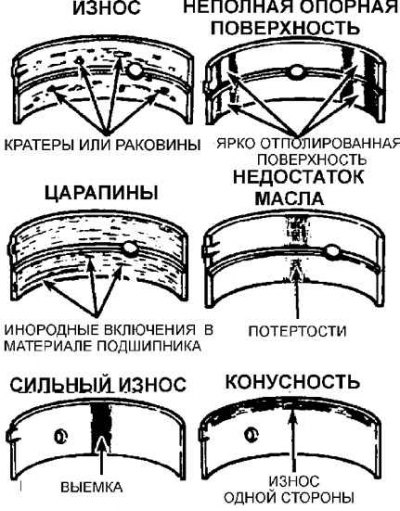


1. Even though the main and connecting rod bearings are subject to replacement during an engine…


1. Even though the main and connecting rod bearings are subject to replacement during an engine overhaul, they should be carefully inspected as they can provide valuable information regarding the condition of the engine.

2. Bearing failure may be due to lack of lubrication, dirt or other foreign particles, engine overload, or corrosion. Regardless of the cause of bearing failure, the cause of the bearing failure must be corrected before the engine is reassembled.

3. When inspecting the bearings, remove them and arrange them in the same order as they were installed on the engine. This will help identify the corresponding crankshaft journal and make troubleshooting easier.

4. Foreign particles can enter the engine in a variety of ways. Metal particles can be found in the engine oil as a result of normal engine wear. Small particles can enter the bearings along with the engine oil and easily become embedded in the soft bearing material. Large particles entering the bearing will scratch the bearing or crankshaft journal. The best way to prevent bearing failure for this reason is to thoroughly clean all internal engine surfaces and keep them clean when assembling the engine. Frequent and regular oil and filter changes are also recommended.


5. Insufficient lubrication of the crankshaft journals can be caused by many different reasons, such as high oil temperatures, engine overload and oil leaks.

6. The driving style also affects the durability of the bearing. A fully open throttle valve at low engine speeds creates a high load on the bearings and squeezes out the oil film from the contact area. These loads lead to cracks in the working part of the bearing, which weakens the bearing and can lead to the antifriction layer being torn off from the steel base.

7. Short-distance driving causes bearing corrosion because the engine does not reach a stabilized operating temperature, which removes water vapor and corrosive gases. These vapors and gases condense in the engine oil, forming acid and sediment. The acid gets to the bearings along with the engine oil, and bearing corrosion begins.

8. Incorrect selection of bearings during engine assembly also leads to bearing failure. Bearings installed with preload leave insufficient bearing operating clearance, resulting in a reduced or absent oil layer for lubrication.
This article is available at russian, bulgarian, belarusian, ukrainian, serbian, croatian, romanian, polish, slovak, hungarian
Article reviewed by editor: Vinogradov Robert
Share information:
Previous
Peugeot 406: Engine overhaul
Next

Crankshaft — check
Pistons and connecting rods — check
Cylinder block
Removal the crankshaft
Removal pistons with connecting rods
Sequence of engine assembly during major repairs
Installing piston rings
Selecting New Crankshaft Main Bearings
Checking the working clearance of the crankshaft main bearings
Installing the crankshaft (XU and XUD engines)
See similar information for other Peugeot models

➨ Main and big-end bearings — inspection Peugeot 106 (1991-2003)
➨ Features of front suspension wheel bearings Peugeot 207 (2006-2014)
➨ Connecting rod and main bearings — inspection and maintenance Peugeot 305 (1977-1989)
➨ Main and connecting rod bearings — inspection Peugeot Partner I (1996-2008)
Link to this article in different formats
Comments and feedback from visitors
No comments yet


Add two numbers 43 + 40


Peugeot 406 (1995-2004) 
  • General information
  • User manual
  • Maintenance (gasoline)
  • Maintenance (diesel)
  • Power unit
  • Gasoline engines
  • Diesel engines
  • Engine overhaul
  • Cooling and heating
  • Fuel system (gasoline)
  • Fuel system (diesel)
  • Engine electrical equipment
  • Transmission
  • Clutch and drive shafts
  • Mechanical gearbox
  • Automatic gearbox
  • Chassis, running gear
  • Brake system
  • Car suspension
  • Steering
  • Body and interior
  • Exterior (external elements)
  • Interior (internal elements)
  • Doors, locks and windows
  • Electrical equipment
  • Equipment and devices
  • Electrical circuits
Peugeot 405 (1987-1997) 
  • General information
  • User manual
  • Maintenance
  • Power unit
  • Petrol engines 1.4 l
  • Petrol engines 1.6-2.0 l
  • Diesel engines
  • Ignition system
  • Fuel system (carburetor)
  • Single point fuel injection
  • Multipoint fuel injection
  • Cooling and lubrication system
  • Exhaust system
  • Transmission
  • Clutch
  • Manual gearbox MA
  • Manual gearbox BE
  • Automatic gearbox
  • Drive shafts
  • Chassis, running gear
  • Steering
  • Front suspension
  • Rear suspension
  • Brake system
  • Body and interior
  • Exterior (external elements)
  • Interior (internal elements)
  • Doors, locks and windows
  • Electrical equipment
  • Equipment and devices
  • Electrical circuits
PeugeotBook.ru © 2018–2026 | Mobile version | Sitemap: EN BG BY UA RS HR RO PL SK HU | Write message | Site search | Add to bookmarks | Peugeot owners
106 (1991-2003) | 206 (1998-2012) | 207 (2006-2014) | 305 (1977-1989) | 306 (1993-2002) | 307 (2001-2008) | 405 (1987-1997) | 406 (1995-2004) | 605 (1989-2000) | Partner-I (1996-2008) | Eurovans-807 (2002-2014) | Eurovans-806 (1994-2002) | J5 (1981-1993) |
Cookies are used to ensure the correct display of pages on the site.