
English Русский
Български
Беларускі
Український
Српски
Hrvatski
Română
Polski
Slovenský
Magyar
Bookmark Articles Sitemap Contacts
Company Hyundai Company Opel Company Skoda Company Kia Company Mitsubishi Company LADA Company Audi
PeugeotBook.ru


Series 100   Series 200   Series 300   400-500   Series 600   Crossovers   Others
 
Partner I (1996-2008) Peugeot 807 (2002-2014) Peugeot 806 (1994-2002) Peugeot J5 (1981-1993)

Main and connecting rod bearings — inspection (Peugeot Partner I)

  • Main
  • Пежо
  • Partner I (1996-2008)
  • Power unit
  • Overhaul of petrol engines
  • Main and connecting rod bearings — inspection
0
1. Although the main and connecting rod bearing shells must be replaced during a major engine overhaul, the "old" shells should be retained for the most careful inspection, as they can provide valuable information about the condition of the entire engine. Bearing liners are classified by thickness, with the class of each liners indicated by a color code printed on the liners.

2. Bearing failure may occur due to lack of lubrication, the presence of dirt or other foreign particles, engine overload or corrosion (figure 14.2). Regardless of the cause of the bearing failure, it should be corrected before engine assembly to prevent recurrence.
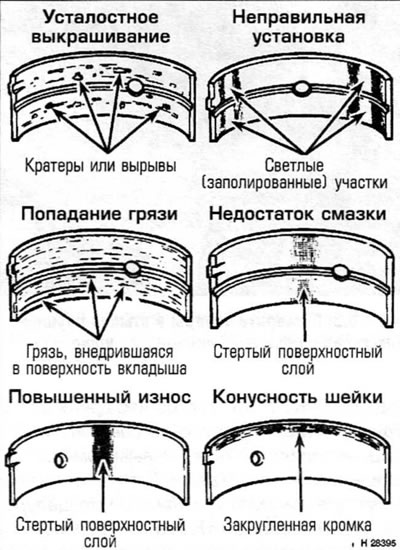
Figure 14.2. Typical bearing faults

Figure 14.2. Typical bearing faults


3. When examining the bearing shells, remove them from the cylinder block/crankcase and main bearing caps and from the connecting rods and small end bearing caps. Place them on a clean surface, maintaining the same order in which they are located in the engine. This will enable you to determine which crankshaft journal a particular defective bearing corresponds to. Do not touch the inner surfaces of the bearing shells with your fingers when inspecting them, as you may scratch this very delicate surface.


4. Dirt and other foreign matter enters the engine in various ways. They could have remained in the engine after assembly, or could have passed through filters or the engine crankcase ventilation system. They could get into the oil and from there into the bearings. Metal shavings from machining and normal engine wear are often present. Small abrasive and metallic particles sometimes remain in the engine after repair, especially if cleaning was performed poorly, using improper cleaning methods. Regardless of the cause, these foreign objects often become embedded in the soft bearing material and are easily detected. Large particles will not penetrate the bearing structure, but will scratch the bearing and journal to varying degrees. The best measure to prevent this cause of bearing failure is to thoroughly clean all parts and maintain impeccable cleanliness when assembling the engine. Frequent and regular replacement of engine oil and filter is also recommended.

5. Lack of lubrication (or decomposition of the lubricant) has a number of interrelated causes. Overheat (which liquefies the oil), overload (which squeezes the oil from the supporting surface) and oil leaks (due to increased bearing clearances, wear of the oil pump or high crankshaft speed) — all these factors contribute to the decomposition of the lubricant. Blockage of lubrication channels, which is usually the result of misalignment of lubrication holes in bearing shells, also causes "oil starvation" of bearings and leads to their failure. If the cause of bearing failure is insufficient lubrication, the soft working material is rubbed off or squeezed out of the steel bearing base. The temperature may increase to the point; in which the steel base turns blue from overheating.


6. In addition, the durability of the bearing can be somewhat affected by the driving style. Full throttle, low speed operation (low speed) places very high loads on the bearings, causing the oil film to be squeezed out. These loads cause the bearings to deform, which leads to the formation of fine cracks on the bearing surface (fatigue failure). Eventually, the bearing material no longer adheres as firmly to the steel base and breaks away from it.

7. Short distance driving leads to bearing corrosion because the engine does not generate enough heat to remove condensed water and corrosive gases. These products collect in the motor oil, forming acid and sludge. When oil is supplied to the bearings, the acid attacks the bearing material and corrodes it.

8. Incorrect installation of the bearing during engine assembly also leads to malfunction. Tightly seated bearing shells provide insufficient operating clearance, leading to oil starvation. Dirt or foreign particles accumulated behind the bearing shell cause localized "bulges" that lead to failure.

9. Do not touch the inner surfaces of the bearing shells with your fingers when assembling them, as you may scratch this very delicate surface or cause dirt particles to be deposited on them.

10. As mentioned at the beginning of this paragraph, bearing liners must be replaced during major repairs. Using "old" liners is a false economy.
This article is available at russian, bulgarian, belarusian, ukrainian, serbian, croatian, romanian, polish, slovak, hungarian
Article reviewed by editor: Nikonova Veronica
Share information:
Previous
Partner I: Overhaul of petrol engines
Next

Crankshaft — inspection
Piston and connecting rod assembly — inspection
Cylinder block/engine crankcase — cleaning and inspection
Crankshaft — removal
Pistons with connecting rods — removal
Engine Overhaul — assembly sequence
Piston rings — installation
Crankshaft — installation
Piston and connecting rod assembly — installation
Engine — first start after repair
See similar information for other Peugeot models

➨ Main and big-end bearings — inspection Peugeot 106 (1991-2003)
➨ Features of front suspension wheel bearings Peugeot 207 (2006-2014)
➨ Connecting rod and main bearings — inspection and maintenance Peugeot 305 (1977-1989)
➨ Inspection of main and connecting rod bearings Peugeot 406 (1995-2004)
Link to this article in different formats
Comments and feedback from visitors
No comments yet


Add two numbers 24 + 46


Partner I (1996-2008) 
  • General information
  • Introduction to the guide
  • Faults en route
  • Weekly checks
  • User manual
  • Maintenance (petrol)
  • Maintenance (diesel)
  • Power unit
  • Petrol engines
  • Diesel engines «XUD»
  • Diesel engines «DW»
  • Overhaul of petrol engines
  • Overhaul of diesel engines
  • Cooling and heating
  • Power and exhaust (petrol)
  • Power and exhaust (XUD diesels)
  • Power and exhaust (DW diesels)
  • Emission reduction
  • Starting and charging system
  • Transmission
  • Clutch
  • Mechanical gearbox
  • Drive shafts
  • Chassis, running gear
  • Brake system
  • Car suspension
  • Steering
  • Body and interior
  • Exterior (external elements)
  • Interior (internal elements)
  • Doors, locks and windows
  • Electrical equipment
  • Equipment and devices
  • Electrical circuits
Peugeot 807 (2002-2014) 
  • General information
  • Operating instructions
  • Maintenance
  • Troubleshooting
  • Power unit
  • Gasoline engines
  • Diesel engines
  • Cooling and heating
  • Fuel injection (petrol)
  • Fuel system (diesel)
  • Fuel system
  • Exhaust system
  • Ignition system
  • Transmission
  • Clutch
  • Manual gearbox
  • Automatic gearbox
  • Chassis, running gear
  • Brake system
  • Car suspension
  • Steering system
  • Body and interior
  • Exterior (external elements)
  • Interior (internal elements)
  • Electrical equipment
  • Power devices
  • Electrical circuits
Peugeot 806 (1994-2002) 
  • General information
  • User manual
  • Maintenance
  • Power unit
  • Petrol engines
  • Diesel engines
  • Lubrication system
  • Cooling system
  • Fuel injection (petrol)
  • Fuel system (diesel)
  • Ignition and exhaust systems
  • ECM Bosch Motronic MP 3.2
  • ECM Magneti-Marelli (MM)
  • Transmission
  • Clutch
  • Mechanical gearbox
  • Chassis, running gear
  • Brake system
  • Car suspension
  • Steering
  • Electrical equipment
  • Equipment and devices
  • Electrical circuits
Peugeot J5 (1981-1993) 
  • General information
  • Introduction to manual
  • Specifications
  • Gasoline engine
  • Engine repair
  • Lubrication system
  • Cooling system
  • Fuel system
  • Ignition system
  • Diesel engine
  • Engine repair (DB9)
  • Lubrication system (DB9)
  • Cooling system (DB9)
  • Fuel injection (DB9)
  • Engine repair (U25)
  • Lubrication system (U25)
  • Cooling system (U25)
  • Fuel injection (U25)
  • Transmission
  • Clutch
  • Gearbox
  • Drive shafts
  • Chassis, running gear
  • Steering system
  • Car suspension
  • Brake system
  • Electrical equipment
  • Power devices
  • Electrical circuits
PeugeotBook.ru © 2018–2026 | Mobile version | Sitemap: EN BG BY UA RS HR RO PL SK HU | Write message | Site search | Add to bookmarks | Peugeot owners
106 (1991-2003) | 206 (1998-2012) | 207 (2006-2014) | 305 (1977-1989) | 306 (1993-2002) | 307 (2001-2008) | 405 (1987-1997) | 406 (1995-2004) | 605 (1989-2000) | Partner-I (1996-2008) | Eurovans-807 (2002-2014) | Eurovans-806 (1994-2002) | J5 (1981-1993) |
Cookies are used to ensure the correct display of pages on the site.