



2. Gently pry the rings apart to release them from the grooves. To prevent the rings from springing back into the vacated grooves, use two or three old feeler gauges (figure 12.2). Be careful not to scratch the piston with the ends of the ring lock. The rings are fragile and will break if you push them too hard. They are also very sharp, so protect your palms and fingers. Keep in mind that in the third (oil scraper) the ring has a built-in spacer element (expander). Always remove rings through the top of the piston. If you are installing "old" rings, store each set of rings with the corresponding piston.
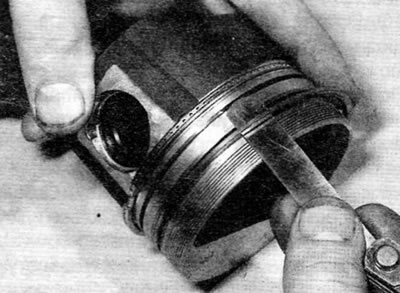
Figure 12.2. Remove the piston rings using a feeler gauge
3. Use a scraper to remove carbon deposits from the top of the piston. Once most of the deposits have been removed, a wire brush can be used (or fine-grained sandpaper).
4. Remove carbon deposits from the piston grooves. For this, use an "old" ring. Break the ring in half (be careful not to cut your fingers—piston rings are very sharp). Be careful to remove only the carbon deposits—do not remove metal or scratch the sides of the grooves.
5. After removing the carbon deposits, clean the piston and connecting rod assembly with kerosene or a suitable solvent and dry thoroughly. Clean the oil return holes (in the grooves).
6. If the pistons and cylinder "mirrors" are not damaged and do not have increased wear, and the cylinder block does not require cylinder boring (if possible), you can install the original pistons in place. Normal piston wear appears as uniform vertical wear on the piston surfaces subject to lateral pressure and slight looseness of the top ring in the corresponding groove. When assembling the engine, be sure to use new piston rings.
[Information posted on the website: peugeotbook.ru]
7. Carefully inspect each piston for cracks in the skirt, around the piston pin bore, and in the areas between the piston ring grooves.
8. Inspect the piston for holes in the piston head, a "burned" area on the edge of the head, and scratches and wear on the skirt. If the skirt is scratched or worn, the engine may have been overheated and/or experienced abnormal combustion resulting in excessively high operating temperatures. The cooling and lubrication systems should be carefully checked. Burn marks on the piston walls indicate a gas breakthrough. A hole in the piston crown or "burned" areas on the edge of the piston crown indicate abnormal combustion (premature ignition or detonation). If any of these defects are present, their causes should be identified and corrected. Otherwise, the damage will occur again. The reasons may be a malfunction of the injectors or engine management system.
9. Piston pitting indicates coolant leakage into the combustion chamber and/or crankcase. The cause must be eliminated. If this is not done, the problem may also appear on a rebuilt engine.
10. On engines with an aluminum cylinder block with "wet" liners, it is not possible to replace the pistons individually. Pistons are supplied only with piston rings and liners, as part of an assembly, all elements of which are supplied together (see paragraph 11). For engines with a cast iron cylinder block, pistons can be purchased from a Peugeot/Citroen dealer or an engine repair specialist.
11. Carefully inspect each connecting rod for signs of damage such as cracks near the big-end and big-end bearings. Check if the connecting rod is bent. Unless the engine was seized or severely overheated, damage is very unlikely. A detailed inspection of the connecting rod assembly can only be performed by a dealer or engine repair specialist with the necessary equipment.
12. The connecting rod bearing cap nuts should be replaced after each unscrewing. Although Peugeot/Citroen does not specify that the bolts should also be replaced, it is recommended that the nuts and bolts be replaced as a set.
13. The piston pins are installed in the bearings of the upper heads of the connecting rods using a press fit. Therefore, replacement of pistons and/or connecting rods should be entrusted to an engine repair specialist who has the necessary set of tools for removing and installing piston pins.