



Note: If the engine has been seriously overheating, it's best to assume the cylinder head is warped—check the head thoroughly for any signs of warping.
Cleaning
2. Remove all traces of the "old" gasket material from the cylinder head.
3. Remove carbon deposits from the combustion chambers and intake and exhaust ports and thoroughly clean the cylinder head with kerosene or a suitable solvent.
4. Remove any heavy carbon deposits that may be present on the valves, and then use a wire brush driven by an electric drill to remove deposits from the valve heads and stems.
Inspection
Note: Before deciding whether to take your vehicle to a service center or an engine overhaul specialist, please complete all inspection procedures described below. Write down all the points that require attention.
Cylinder head
5. Carefully inspect the head for cracks, signs of coolant leakage and other damage. If cracks are found, a new cylinder head will be required. Using a ruler and feeler gauge, check the cylinder head surface for deformation (figure 7.5). If there is deformation, the head surface can be re-ground, but on the condition that the height of the cylinder head does not decrease below the prescribed minimum height.
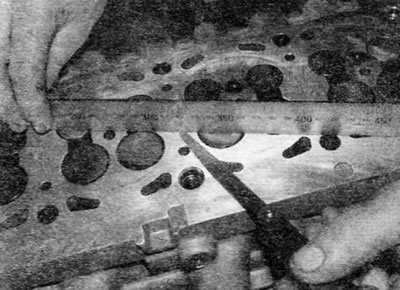
Figure 7.5. Check the mating surface of the cylinder head for deformation
6. Inspect the valve seats in each combustion chamber. If they are badly pitted, cracked or burned, they require replacement or mechanical treatment, which can be performed by an engine overhaul specialist. If the seats are only slightly pitted, this can be remedied by lapping the valve head and seat with a fine-grained valve lapping compound as described below.
7. Check the valve guides for wear. To do this, insert each valve into its guide and check the lateral movement of the valve. Very slight movement is allowed. If the movement appears increased, remove the valve. Measure the valve stem diameter (see below) and replace the valve if it is worn. If the valve stem is not worn, the wear should be in the guide bushing and the bushing should be replaced. It is recommended that valve guide replacement be performed by an engine overhaul specialist who has the necessary equipment to perform this procedure. Where the valve stem diameter is not specified by the manufacturer, consult your Peugeot/Citroen dealer or engine overhaul specialist who can advise on the best course of action.
8. When replacing valve guides, the valve seats should be re-sharpened or re-ground only after the guides have been installed.
Valves
9. Inspect each valve head for pitting, burning, cracks and general wear and check the valve stem for scoring and wear. Rotate the valve and check if it is bent. Inspect the tip of each valve stem for pitting and excessive wear. If such signs of wear or damage are present, replace the valve.
10. If the valve appears to be OK at this stage, measure the valve stem diameter in several places using a micrometer (figure 7.10). Any significant difference in the readings obtained indicates rod wear. If any of these conditions are present, the valve must be replaced.
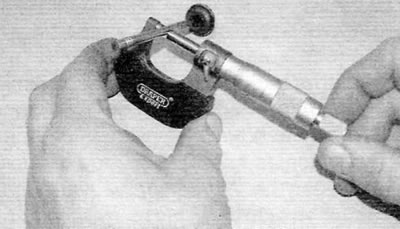
Figure 7.10. Measure the valve stem diameter with a micrometer
11. If the valves are in satisfactory condition, they should be lapped to their seats, which will ensure a gas-tight seal. If the seat is only lightly pitted or has already been re-ground to achieve the required surface finish, use only a fine grinding compound. Coarse valve lapping compound should not be used unless the seats are badly burned or deeply pitted. If this is the case, to decide what is needed - seat regrinding, valve replacement or seat replacement, consult a specialist. He should inspect the cylinder head and valves.
12. Lapping of valves is performed as follows. Turn the cylinder head over with the combustion chambers facing up and secure it in this position on the workbench.
13. Apply lapping compound of the appropriate grit to the seat surface and press the lapping tool with a suction cup onto the valve head. Using a rotating motion in both directions, grind the valve head onto the seat, occasionally lifting the valve to redistribute the grinding compound (figure 7.13). A weak spring installed under the valve head will make this job much easier.
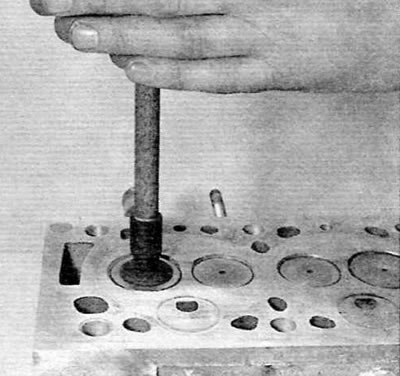
Figure 7.13. Valve regrinding
14. If using a coarse compound, work only until a smooth, matte finish is achieved on both the valve seat and the valve itself. Then wipe off the used compound and repeat the process with a fine-grained compound (for fine grinding). When you have a smooth, solid ring of light grey colour with a matte finish on both the valve and the seat, the lapping process is complete. Do not grind the valves more than is absolutely necessary. Otherwise, the seat will be too recessed into the cylinder head.
15. After fitting all valves, before assembling the cylinder head, thoroughly wash off all traces of abrasive paste with kerosene or a suitable solvent.
Valve elements
16. Inspect the valve springs for signs of damage and discoloration. Peugeot/Citroën does not specify the free length of the spring. Therefore, the only way to assess valve spring wear is by comparing it to a new component.
(Original text is located at: peugeotbook.ru)
17. Place each spring on a flat surface and check that it is perpendicular (figure 7.17). If any of the springs are damaged, deformed or have lost their elasticity, purchase a complete set of new springs. It is usually recommended to replace all valve springs when performing a major overhaul.
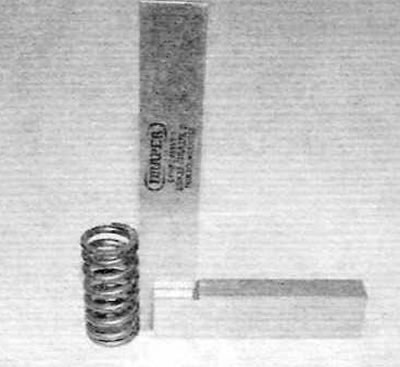
Figure 7.17. Check the perpendicularity of each valve spring
18. Replace the valve stem seals regardless of their external condition.