



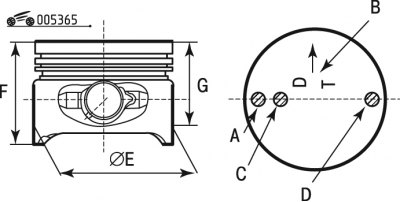
Figure 3.65. Main dimensions of the piston and marks applied to the piston
The piston is aluminum, cast. According to the outer diameter, the pistons are divided into three classes (A, B, C) through 0.01 mm. The outer surface of the piston has a complex shape. Therefore, it is necessary to measure the piston diameter only in the plane perpendicular to the piston pin, at a certain distance from the piston bottom. The main dimensions of the piston are shown in Figure 3.65 and in Tables 3.8, 3.9.
- mark A: Mark for oversize pistons;
- mark B: Mark oriented towards the timing drive;
- mark C: Piston identification mark;
- mark D: Class marking to ensure a non-disassemblable pair with the sleeve (class 3).
Table 3.8. Main dimensions of pistons of 1st generation engines
| Parameter | Engine code designation | ||
| | TU9 | TU1 | TU2-TU3 |
| Size, mm: | Engines: aluminum alloy cylinder block | ||
| d E class A | from 69.94 to 69.95 | from 71.94 to 71.95 | from 74.95 to 74.96 |
| d E class B | from 69.95 to 69.96 | from 71.95 to 71.96 | from 74.96 to 74.97 |
| d E class C | from 69.96 to 69.97 | from 71.96 to 71.97 | from 74.97 to 74.98 |
| F | 58 | 64,05±0,15 | 64±0,05 |
| G | 11 | 13 | 10 |
| | Engine code designation | |
| | TU3F-TU3J2 | TU5 |
| Size, mm: | Engines: cast iron cylinder block | |
| d E (nominal) | 74,96 | 78,455+0,015 |
| d E (repair size 1) | 75,36 | 78,855+0,015 |
| F | 64±0,05 | 57,5 |
| G | 11 | |
Table 3.9. Main dimensions of pistons of 2nd generation engines
| Parameter | Engine code designation | |||||
| | TU1/K | TU1M+ | TU1JP | |||
| Size, mm: | Engines: aluminum alloy cylinder block | |||||
| d E class A | from 71.95 to 71.959 | |||||
| d E class B | from 71,960 to 71,969 | |||||
| d E class C | from 71,970 to 71,980 | |||||
| F | 47,5±0,15 | |||||
| G | 8 | |||||
| Label C | 1Z | 1X | 1Y | | ||
| | Engine code designation | |||||
| | TU3JP/L3 | TU3JP/K | TU3JP/L4 | | ||
| Size, mm: | Engines: aluminum alloy cylinder block | |||||
| d E class A | from 74.95 to 74.959 | |||||
| d E class B | from 74,960 to 74,969 | |||||
| d E class C | from 74,970 to 74,980 | |||||
| F | 49,75±0,15 | |||||
| G | 8 | |||||
| Label C | 3Y | 3Z | 3X | | ||
| | Engine code designation TU5JP | |||||
| Size, mm: | - | |||||
| d E (nominal) | 78,455+0,015 | |||||
| d E (repair 1) | 78,855+0,015 | |||||
| F | 57,5 | |||||
| G | 11 | |||||
| Label C | JP+ | - | - | | ||
Attention! Pistons are supplied complete with piston pins; replacing piston rings with rings from another piston is not permitted.
The piston rings are made of special cast iron. The upper compression ring has a chrome-plated barrel-shaped outer surface. The lower compression ring is of the scraper type. The oil scraper ring has chrome-plated working edges and a twisted expansion spring.
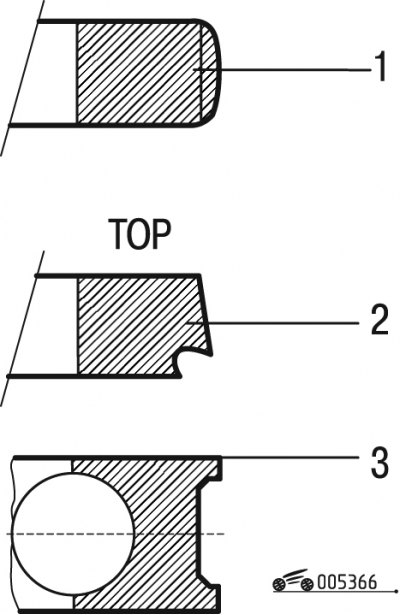
Figure 3.66. Piston rings: 1 - upper compression ring; 2 - lower compression ring; 3 - oil scraper ring
The upper compression ring 1 is shown in Figure 3.66 (installation direction does not matter). The lower compression ring 2 is installed with the "top" mark facing up. The oil scraper ring 3 can be oriented upwards with either side when installed.
The 2nd generation engines have new improved piston rings, the rings are color coded:
- tU1 engines - orange;
- tU3 engines - purple.
The piston pin is steel, tubular in cross-section, pressed into the upper head of the connecting rod and rotates freely in the piston bosses.
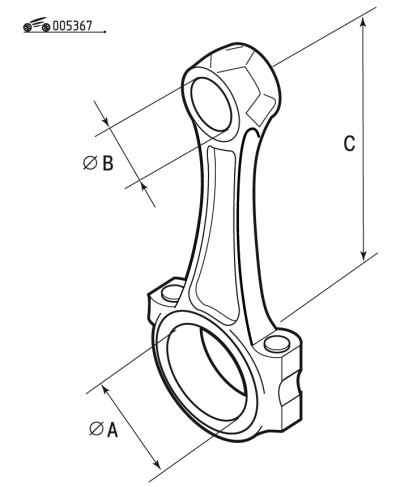
Figure 3.67. Connecting rod of 1st generation engines
Connecting rod — steel, forged. The connecting rod is processed together with the cover, so they are not interchangeable separately. To avoid mixing up the covers and connecting rods during assembly, they are stamped with the number of the cylinder in which they are installed. The dimensions of the connecting rods are shown in Figure 3.67 and in Tables 3.10, 3.11.
Table 3.10. Main dimensions of connecting rods of 1st generation engines
| Parameter | Engine code designation | |||||
| | TU9 | TU1-TU2.4 | TU2J2 | TU3 | TU5 | |
| Nominal size (cm.figure 3.67), mm: | | |||||
| d A+0,016 | 41,128 | 48,655 | | |||
| d B+0,017 | 17,939 | 19,463 | | |||
| C ±0,07 | 122,8 | 112,3 | 133,5 | 126,8 | 133,5 | |
Table 3.11. Main dimensions of connecting rods of 2nd generation engines
| Parameter | Engine code designation | ||
| | TU1 | TU3 | |
| Nominal size, mm: | | ||
| d A+0,016 | 48,655 | ||
| d B+0,011 | 19,463 | ||
| C ±0,05 | 125,3 | 140,25 | |
Note: The connecting rods from the 1st generation TU5 engines continue to be used on the 2nd generation engines.
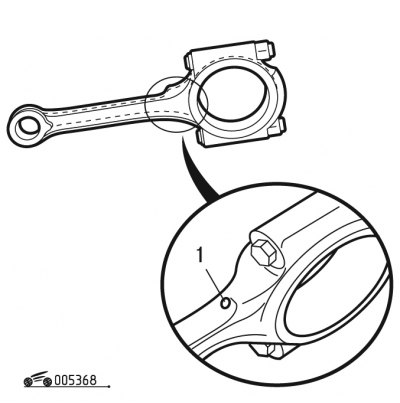
Figure 3.68. Connecting rod of 2nd generation engines: 1 - oil splash hole
The new connecting rod has a hole (figure 3.68) to spray oil onto the inner surface of the piston.
The connecting rod also has a new insert with a hole.