


Share information:

Daily car care Peugeot 207

Vehicle lifting
If the car is jacked up in a workshop workshop (service stations), then the lift should be installed under the front edge of the engine carrier frame. Mobile jack installation areas Note. When installing, do not damage...
If the car is jacked up in a workshop workshop (service stations), then the lift should be installed under the front edge of the engine carrier frame. Mobile jack installation areas Note. When installing, do not damage...

Self-service frequency
Note. The table of periodic maintenance of all vehicle components is given in section 2 « Engine ». The engine compartment of a car with a gasoline engine: 1 − expansion tank of the cooling system; 2 - cabin filter; 3 -...
Note. The table of periodic maintenance of all vehicle components is given in section 2 « Engine ». The engine compartment of a car with a gasoline engine: 1 − expansion tank of the cooling system; 2 - cabin filter; 3 -...

Bonnet — opening and closing
Opening Open the front left door. Pull handle A located at the bottom of the doorway. Pull the outer lock lever B to the left and raise the hood. Release stop C from the retainer. Insert the stop into one of the two...
Opening Open the front left door. Pull handle A located at the bottom of the doorway. Pull the outer lock lever B to the left and raise the hood. Release stop C from the retainer. Insert the stop into one of the two...

Fuel system
Gasoline fuel Gasoline engines are designed to use RON 95 fuel. Note. The use of petrol with an octane rating of 91 is only permitted in exceptional cases. 95 octane fuel can be used for normal driving. 98 octane fuel...
Gasoline fuel Gasoline engines are designed to use RON 95 fuel. Note. The use of petrol with an octane rating of 91 is only permitted in exceptional cases. 95 octane fuel can be used for normal driving. 98 octane fuel...

Refueling a car
To open the fuel filler door, pull the slot. Cork with a key Turn the key a quarter of a turn to open or close it. When refueling, place the plug in the socket provided on the bracket on the inside of the hatch. On the...
To open the fuel filler door, pull the slot. Cork with a key Turn the key a quarter of a turn to open or close it. When refueling, place the plug in the socket provided on the bracket on the inside of the hatch. On the...

Engine oil
Attention. Use only recommended quality oil (see service book). Check the oil level frequently and change it regularly. Using a lower quality oil than recommended or operating the vehicle with a low oil level will...
Attention. Use only recommended quality oil (see service book). Check the oil level frequently and change it regularly. Using a lower quality oil than recommended or operating the vehicle with a low oil level will...

Cooling liquid
When checking, the coolant level must be between the marks «MIN» And «MAX» on the expansion tank (see drawings with general views of the engine compartment). If the level drops below the mark «MIN», add liquid. For...
When checking, the coolant level must be between the marks «MIN» And «MAX» on the expansion tank (see drawings with general views of the engine compartment). If the level drops below the mark «MIN», add liquid. For...
Windshield washer fluid
Windshield and headlight washers have a common reservoir (see drawings with general views of the engine compartment). In cold weather, use antifreeze. Wash the wiper blades when topping up with washer fluid.
Windshield and headlight washers have a common reservoir (see drawings with general views of the engine compartment). In cold weather, use antifreeze. Wash the wiper blades when topping up with washer fluid.
Brake and clutch fluid
Clutch and brake fluid is poured into a common tank. The level must be between the marks «MIN» And «MAX». Change the brake fluid once every two years or on time; every second scheduled maintenance. Note. If the brake...
Clutch and brake fluid is poured into a common tank. The level must be between the marks «MIN» And «MAX». Change the brake fluid once every two years or on time; every second scheduled maintenance. Note. If the brake...

Refueling volumes
Fluid level in the windshield washer reservoir: 3.5 liters. Engine oil * After changing the engine oil with changing the oil filter.
Fluid level in the windshield washer reservoir: 3.5 liters. Engine oil * After changing the engine oil with changing the oil filter.
Battery care
The power supply system is powered by an alternator and battery and has an operating voltage of 12 V. The system is single-pole, in which the chassis and engine frame are used as conductors. The battery is located on...
The power supply system is powered by an alternator and battery and has an operating voltage of 12 V. The system is single-pole, in which the chassis and engine frame are used as conductors. The battery is located on...
Battery replacement
Removing the battery Switch off the ignition. Wait five minutes before touching any electrical leads. During this time, information about the state of the electrical equipment system has time to be recorded in various...
Removing the battery Switch off the ignition. Wait five minutes before touching any electrical leads. During this time, information about the state of the electrical equipment system has time to be recorded in various...

Starting the engine with an additional battery
If the battery is dead, it may be necessary to use an external battery or another vehicle's battery. A - battery on a faulty car. B - additional battery. C - grounding point on «mass» on a damaged vehicle. Attention....
If the battery is dead, it may be necessary to use an external battery or another vehicle's battery. A - battery on a faulty car. B - additional battery. C - grounding point on «mass» on a damaged vehicle. Attention....

Care of fuses
Note. The wiring harness may vary depending on the engine variant. At the same time, the same type of arrangement of the components shown in the chapter is preserved. All electrical functions and parts are protected by...
Note. The wiring harness may vary depending on the engine variant. At the same time, the same type of arrangement of the components shown in the chapter is preserved. All electrical functions and parts are protected by...
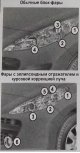
Replacing headlight bulbs
1 - direction indicators (PY 21 W with yellow bulb). 2 - parking lights (W 5 W). 3 - low beam headlights (H7-55W). 4 - high beam headlights (H1-55W). 5 - headlights with course correction (H7-55W). 6 - fog lights...
1 - direction indicators (PY 21 W with yellow bulb). 2 - parking lights (W 5 W). 3 - low beam headlights (H7-55W). 4 - high beam headlights (H1-55W). 5 - headlights with course correction (H7-55W). 6 - fog lights...

Replacement of a lamp in indexes of turns
Turn the bulb holder a quarter of a turn and remove it. Reinstallation is carried out in the reverse order. Note. Lamps with yellow bulbs (used in direction indicator lights and side indicators) should be replaced by...
Turn the bulb holder a quarter of a turn and remove it. Reinstallation is carried out in the reverse order. Note. Lamps with yellow bulbs (used in direction indicator lights and side indicators) should be replaced by...

Replacing the Low Beam Bulb
Remove the protective plastic cover by pulling on the latch tab. Disconnect the harness connector from the lamp. Squeeze the spring clips to release the lamp. Remove the lamp and replace it. Reinstallation is carried...
Remove the protective plastic cover by pulling on the latch tab. Disconnect the harness connector from the lamp. Squeeze the spring clips to release the lamp. Remove the lamp and replace it. Reinstallation is carried...

High Beam Bulb Replacement
Remove the protective plastic cover by pulling on the latch tab. Disconnect the harness connector from the lamp. Squeeze the spring clips to release the lamp. Remove the lamp and replace it. Reinstallation is carried...
Remove the protective plastic cover by pulling on the latch tab. Disconnect the harness connector from the lamp. Squeeze the spring clips to release the lamp. Remove the lamp and replace it. Reinstallation is carried...

Replacing the lamp of daytime running, parking lights
Remove the protective plastic cover by pulling on the latch tab. Disconnect the harness connector from the lamp. Turn the bulb holder a quarter of a turn and remove it. Remove the lamp and replace it. Reinstallation is...
Remove the protective plastic cover by pulling on the latch tab. Disconnect the harness connector from the lamp. Turn the bulb holder a quarter of a turn and remove it. Remove the lamp and replace it. Reinstallation is...

Replacing the side turn signal repeater assembly with a lamp
Pry off the repeater with a screwdriver, inserting it in the middle between it and the base of the mirror. Using a screwdriver as a lever, remove the repeater assembly. Disconnect the wiring connector from the repeater....
Pry off the repeater with a screwdriver, inserting it in the middle between it and the base of the mirror. Using a screwdriver as a lever, remove the repeater assembly. Disconnect the wiring connector from the repeater....

Replacing the rear lights
Rear lights (hatchback) 1 - brake lights (P21W). 2 - parking lights (R5 W). 3 - fog lights (P21W). 4 - direction indicators (PY 21 W with yellow bulb). 5 - reversing lights (P21W). Note. Lamps with yellow bulbs (used in...
Rear lights (hatchback) 1 - brake lights (P21W). 2 - parking lights (R5 W). 3 - fog lights (P21W). 4 - direction indicators (PY 21 W with yellow bulb). 5 - reversing lights (P21W). Note. Lamps with yellow bulbs (used in...
Vehicle handling and tires
The type of tyre, size, tire pressure and speed class determine the behavior of the car on the road. When changing tires, make sure all four wheels are fitted with tires of the same type, size, and preferably from the...
The type of tyre, size, tire pressure and speed class determine the behavior of the car on the road. When changing tires, make sure all four wheels are fitted with tires of the same type, size, and preferably from the...
Reinstallation of wheels
To improve vehicle handling and to achieve even tire wear, it is recommended to swap the front and rear tires regularly. The first change should be made after 5,000 km, then at intervals of 10,000 km. In this case, the...
To improve vehicle handling and to achieve even tire wear, it is recommended to swap the front and rear tires regularly. The first change should be made after 5,000 km, then at intervals of 10,000 km. In this case, the...

Tires with tread wear indicator
The tread wear indicator is a narrow protrusion located across the tread track. The sidewall of the tire is labeled «TWI» («Tread Wear Indicator»). When the tire tread height drops to 1.6 mm, it is equal to the wear...
The tread wear indicator is a narrow protrusion located across the tread track. The sidewall of the tire is labeled «TWI» («Tread Wear Indicator»). When the tire tread height drops to 1.6 mm, it is equal to the wear...
Tread pattern height
Operation on icy, snowy roads at low temperatures places higher demands on tires than in summer. Therefore, it is not recommended to use winter tires with a residual tread depth below 4 mm.
Operation on icy, snowy roads at low temperatures places higher demands on tires than in summer. Therefore, it is not recommended to use winter tires with a residual tread depth below 4 mm.
Tire pressure check
Note. Check tire pressure regularly. Tire pressure drops over time. At the time of operation, the tires heat up after several kilometers of run, while the pressure rises. Therefore, do not let the air out of the tires...
Note. Check tire pressure regularly. Tire pressure drops over time. At the time of operation, the tires heat up after several kilometers of run, while the pressure rises. Therefore, do not let the air out of the tires...

Spare wheel and car tool
The tool kit is located under the luggage compartment floor. Open the luggage compartment. Raise the floor covering. Secure it by hooking its cord to the shelf holder hook. Remove the plastic box. Unlock and remove...
The tool kit is located under the luggage compartment floor. Open the luggage compartment. Raise the floor covering. Secure it by hooking its cord to the shelf holder hook. Remove the plastic box. Unlock and remove...
Wheels with decorative caps
Before removing the wheel, remove the decorative cap from it by prying it with a wheelbrace 1 near the air valve. After mounting the wheel in place, install a decorative cap on it, aligning the mark on it with the air...
Before removing the wheel, remove the decorative cap from it by prying it with a wheelbrace 1 near the air valve. After mounting the wheel in place, install a decorative cap on it, aligning the mark on it with the air...

Wheel removal
Remove the decorative caps from all wheel bolts using a puller 3. Put the adapter 4 on the wheelbrace 1 to unscrew the secret bot. Loosen the other bolts with the wheelbrace 1. Install the jack 2 under one of the two...
Remove the decorative caps from all wheel bolts using a puller 3. Put the adapter 4 on the wheelbrace 1 to unscrew the secret bot. Loosen the other bolts with the wheelbrace 1. Install the jack 2 under one of the two...

Wheel installation
Install the wheel on the hub using the centering rod 4. Tighten the bolts by hand until tight. Pre-tighten the security bolt using the wheelbrace 1 with adapter 5. Pre-tighten the remaining bolts using the wheelbrace 1....
Install the wheel on the hub using the centering rod 4. Tighten the bolts by hand until tight. Pre-tighten the security bolt using the wheelbrace 1 with adapter 5. Pre-tighten the remaining bolts using the wheelbrace 1....

Towing a car
The towing eye is located under the floor in the luggage compartment. Front Open the cover in the front bumper by pressing it on the left. Screw in the towing ring until it stops. Install the tow bar. Turn on the hazard...
The towing eye is located under the floor in the luggage compartment. Front Open the cover in the front bumper by pressing it on the left. Screw in the towing ring until it stops. Install the tow bar. Turn on the hazard...

Key with electronic immobilizer
The keys allow you to unlock, independently of each other, the door lock, fuel filler cap, glove box, operate the front passenger airbag switch, and turn on the ignition. To open the key, press button 1. To fold the...
The keys allow you to unlock, independently of each other, the door lock, fuel filler cap, glove box, operate the front passenger airbag switch, and turn on the ignition. To open the key, press button 1. To fold the...
Unlocking the car
Selective unlocking of locks using the remote control The first time you press the button «A» only the driver's door is unlocked. Pressing the same button again unlocks the other doors and the tailgate. Selective...
Selective unlocking of locks using the remote control The first time you press the button «A» only the driver's door is unlocked. Pressing the same button again unlocks the other doors and the tailgate. Selective...
Locking car locks
Locking locks with the super lock function Click on the button «With», to lock all car locks. If you hold the button for more than 2 seconds, then simultaneously with locking, the door windows automatically rise....
Locking locks with the super lock function Click on the button «With», to lock all car locks. If you hold the button for more than 2 seconds, then simultaneously with locking, the door windows automatically rise....
Finding a car in the parking lot
Click on the button «With», to quickly find a car in the parking lot. At the same time, the ceiling lamps and dipped beam headlights will light up, and the direction indicator lights will flash for several seconds.
Click on the button «With», to quickly find a car in the parking lot. At the same time, the ceiling lamps and dipped beam headlights will light up, and the direction indicator lights will flash for several seconds.
Anti-theft protection
Attention. It is forbidden to make any changes to the electronic anti-theft system of the car, as this may disable it. Electronic immobilizer An integrated circuit with an individual code is built into the key case,...
Attention. It is forbidden to make any changes to the electronic anti-theft system of the car, as this may disable it. Electronic immobilizer An integrated circuit with an individual code is built into the key case,...

Initializing the remote control and replacing the battery
Initialization Unlocking and locking the car locks is not possible after disconnecting the battery, replacing the battery or in case of malfunctions of the remote control. For its further work it is necessary to carry...
Initialization Unlocking and locking the car locks is not possible after disconnecting the battery, replacing the battery or in case of malfunctions of the remote control. For its further work it is necessary to carry...

Security alarm
The alarm system provides control of the perimeter and space of the passenger compartment and is triggered when an unauthorized entry into the car is attempted. System activation Turn off the ignition and get out of the...
The alarm system provides control of the perimeter and space of the passenger compartment and is triggered when an unauthorized entry into the car is attempted. System activation Turn off the ignition and get out of the...

Opening doors
Opening doors from outside Unlock the locks with the remote control or key, then pull the door handle. Opening the doors from the salon Pull the front door handle to open it; this unlocks all doors. Pull the rear door...
Opening doors from outside Unlock the locks with the remote control or key, then pull the door handle. Opening the doors from the salon Pull the front door handle to open it; this unlocks all doors. Pull the rear door...

Emergency locking and unlocking
Locking the right front and rear doors Insert the key into the lock located at the end of the door and turn it 1/8 of a turn. Unlocking the right front and rear doors Pull the inner handle of the lock drive.
Locking the right front and rear doors Insert the key into the lock located at the end of the door and turn it 1/8 of a turn. Unlocking the right front and rear doors Pull the inner handle of the lock drive.

Central locking
The keys allow, when locking the driver's door lock, to fully lock the locks, as well as unlock the side doors, the tailgate and fold the outside rear-view mirrors using the central electric lock. If one of the doors or...
The keys allow, when locking the driver's door lock, to fully lock the locks, as well as unlock the side doors, the tailgate and fold the outside rear-view mirrors using the central electric lock. If one of the doors or...

Tailgate
Opening Unlock all vehicle locks with the remote control or key, pull the handle and raise the tailgate. Closing Lower the tailgate by pulling its special handle located on the inside. Note. If the selective unlocking...
Opening Unlock all vehicle locks with the remote control or key, pull the handle and raise the tailgate. Closing Lower the tailgate by pulling its special handle located on the inside. Note. If the selective unlocking...

Window lift care
The power windows of all vehicle doors can be controlled using the buttons located on the driver's door. The rest of the doors are controlled by individual keys for each door. Note. The power windows can also be used...
The power windows of all vehicle doors can be controlled using the buttons located on the driver's door. The rest of the doors are controlled by individual keys for each door. Note. The power windows can also be used...

Dimensions and identification data of the car Peugeot 207
The dimensions of the Peugeot 207 car are shown in the figure (dimensions are given in mm). Dimensions marked with * are for a five-door vehicle. Identification data of the Peugeot 207 car is contained on plates and...
The dimensions of the Peugeot 207 car are shown in the figure (dimensions are given in mm). Dimensions marked with * are for a five-door vehicle. Identification data of the Peugeot 207 car is contained on plates and...
This section is available on russian, bulgarian, belarusian, ukrainian, serbian, croatian, romanian, polish, slovak, hungarian
See similar information for other Peugeot models
➨ General information: Weekly checks Peugeot Partner I (1996-2008)
Link to this section in different formats
TEXTHTMLBB Code
- General information
- Car care
- Governing bodies
- Driving and operation
- Power unit
- Engine characteristics
- Engine repair
- Cooling system
- Lubrication system
- Ignition system
- Control system (gasoline)
- Fuel system (gasoline)
- Control system (diesel)
- Transmission
- Clutch
- Mechanical gearbox
- Automatic gearbox
- Drive shafts
- Chassis, running gear
- Car suspension
- Steering
- Brake system
- Body and interior
- Exterior (external elements)
- Interior (internal elements)
- Heating and air conditioning
- Electrical equipment
- Equipment and devices
- Headlights and lighting
- Power devices
- Electrical circuits
- General information
- User manual
- Maintenance
- Power unit
- Gasoline engines
- Diesel engines
- Diesel power system
- Engine management system
- Transmission
- Clutch
- Mechanical gearbox
- Automatic gearbox
- Drive shafts
- Chassis, running gear
- Front suspension
- Rear suspension
- Steering
- Brake system
- Body and interior
- Body elements
- Doors, locks and windows
- Electrical equipment
- Equipment and devices
- Electrical circuits