



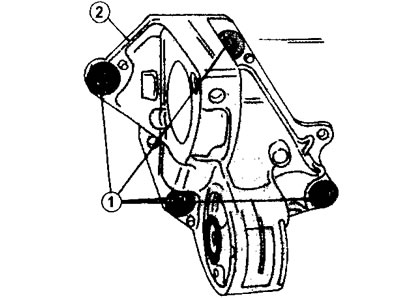
18.1 Disconnect the engine support 2 by unscrewing the four mounting bolts 1
2. Disconnect the turbocharger oil return line.
3. Remove the oil filter mounted on the side of the engine using a filter wrench (see illustration 17.3). Unscrew the connecting sleeve 3 and remove the oil radiator 2, as well as the oil pressure regulator 1 (see illustration).
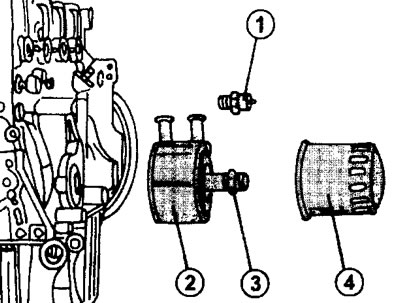
18.3 Unscrew the connecting sleeve 3 and remove the oil radiator 2, as well as the oil pressure regulator 1, 4 - oil filter
The tightening torque of the coupling sleeve is 58 Nm.
4. Remove the engine oil level indicator (dipstick).
5. Disconnect the air intake box 2, made of plastic, attached to the engine. To do this, unscrew five bolts 1, including three that secure the upper part and two bolts that secure the lower part (see illustration).
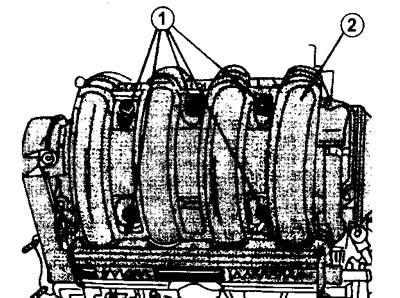
18.5 Disconnect the air intake box 2 secured to the engine by unscrewing the five bolts 1
Remove the box.
6. Disconnect and remove the intake manifold. Before doing this, remove the clamps at the bottom and top of the EGR connecting pipe and disconnect the pipe. After this, unscrew the 6 intake manifold mounting nuts. Remove the manifold gasket (see illustration).
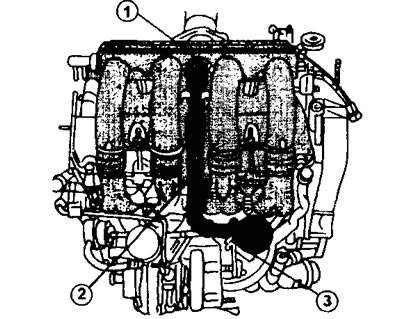
18.6 Remove the clamps at the bottom and top of the EGR connecting pipe and disconnect the pipe.
1 and 3 - clamping clamps
2 - exhaust gas recirculation system pipe
7. Unscrew the mounting bolts and remove the pressure and driven clutch discs. To prevent the flywheel from turning, secure it with a brake shoe by installing it on the ring gear (see illustration 17.5). If this shoe is missing, secure the flywheel with a screwdriver. Considering that the flywheel is fixed with a shoe, you can unscrew the bolt securing the belt pulley to the crankshaft. After this, remove the belt pulley from the crankshaft, using a three-jaw puller if necessary.
8. Remove the timing belt guard (see illustration).
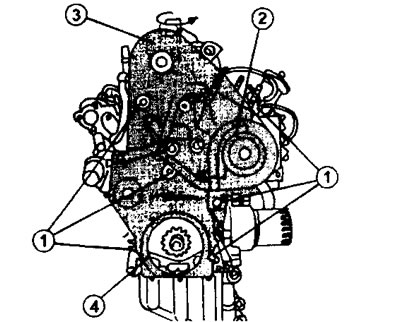
18.8 Remove the timing belt guard. To release the cover, rotate the top fastener a quarter turn
1 - casing mounting bolts
2 - side cover
3 - top cover
4 - bottom cover
To release the cover, rotate the top fastener a quarter turn.
9. Remove the four bolts securing the right engine mount bracket and detach the bracket. The following work concerns the removal of the timing belt. The crankshaft, camshaft and fuel injection pump drive gear must be secured against turning to avoid disturbing the timing mechanism settings.
10. Turn the crankshaft until the holes on the camshaft gear and the high-pressure fuel pump align with the holes on the engine intended for installing the stop bolts (see illustration).
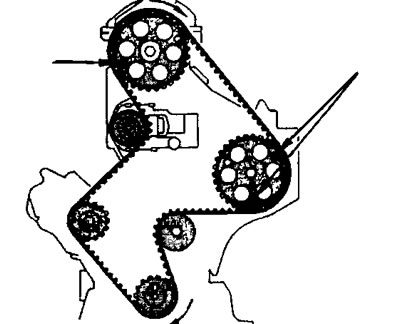
18.10 Turn the crankshaft until the holes on the camshaft gear and the high-pressure fuel pump align with the holes on the engine intended for installing the stop bolts
This operation is unnecessary if the engine is to be completely rebuilt.
The crankshaft is also fixed from turning (see illustration 17.77). If the engine is disassembled, then the need to fix the crankshaft also disappears.
11. Unscrew nut 1 of tension roller 2, nut 3 and bolt 4. To unscrew bolt 4, you need a 5 mm socket wrench, and to hold the adjusting eccentric 5 of the tensioner, you need a 10 mm wrench (see illustration).
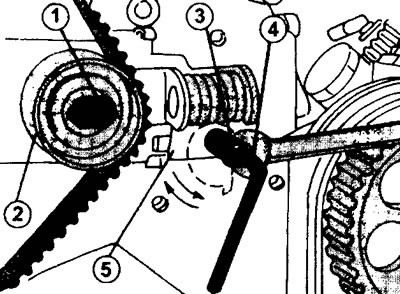
18.11 Unscrew nut 1 of tension roller 2, nut 3 and bolt 4. To unscrew bolt 4, you need a 5 mm socket wrench, and to hold the adjusting eccentric 5 of the tensioner, you need a 10 mm wrench
12. Turn the eccentric to the right to loosen the toothed belt, and press the tension roller outward and tighten nut 1 (see illustration 18.11). On a dismantled engine, this operation is not particularly difficult. If the timing belt is removed without removing the engine from the engine compartment, then access to nut 1 is possible only through the corresponding hole on the engine support bracket.
13. Use a marker to mark the direction of rotation of the timing belt if it is to be reinstalled later. After this, remove the belt from the corresponding gears, acting in order.
14. Disconnect all hoses and lines from the engine.
15. Disconnect the accelerator cable from the fuel injection pump and the high-pressure fuel lines. The fuel lines are fastened together in pairs with the appropriate clamp (see illustration).
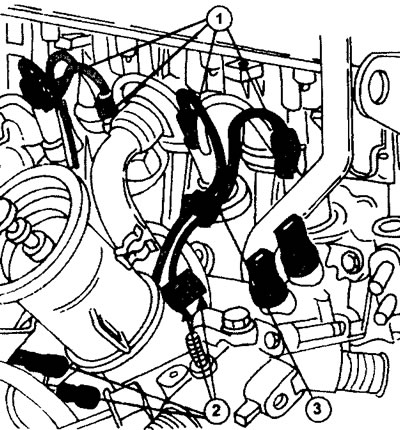
18.15 Disconnect the high-pressure fuel lines by unscrewing union nuts 1 and 2. The fuel lines are fastened together in pairs with a corresponding clamp
16. Remove 11 bolts and cylinder head (see the relevant chapter).
17. Unscrew the 6 turbocharger mounting bolts and remove it together with the sealing gasket. The gasket must be replaced with a new one.
18. Unscrew the 5 water pump mounting bolts and remove the pump.
19. Remove the timing belt tension roller.
20. Remove the timing gear from the crankshaft using two pry bars or an appropriate puller.
21. Secure the camshaft gear appropriately against turning and remove the gear. The fuel injection pump drive gear is removed in a similar manner (see illustration).
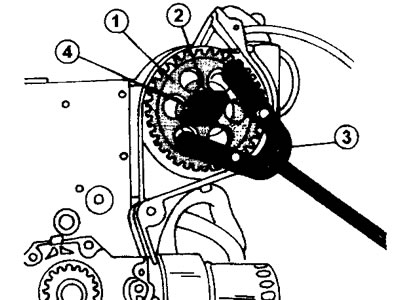
18.21 Lock the fuel injection pump gear from turning and, after unscrewing the mounting bolts, remove it.
1 - fuel injection pump gear
2 - gear fastening nut
3 - stop for holding the gear from turning
4 - gear puller
22. Remove the high-pressure fuel pump, having first unscrewed the 3 bracket mounting bolts.
23. Loosen the 8 flywheel mounting bolts in a crosswise pattern and remove the flywheel. Be careful not to let the flywheel fall.
24. Turn the engine over with the crankcase facing up and remove the oil pan. On a vehicle without air conditioning, to remove the oil pan, you need to unscrew 19 bolts on the outside of the pan and four socket head bolts in the corner. If present, unscrew the oil level indicator sensor secured with two bolts.
Caution! When turning the engine over, residual oil may leak out.
If the car is equipped with air conditioning, then to remove the oil pan you need to unscrew 20 bolts, loosening them evenly. In addition, it is necessary to unscrew one pan mounting bolt located on the side, as well as two air conditioning compressor suspension bolts (see illustration 17.0). The oil pan gasket is missing. At the same time, also unscrew the oil level indicator sensor. It also attaches without a sealing gasket. Mark the mounting position of the oil pan mounting bolts and store the bolts separately.
25. Remove the side cover (bearing shield), installed in front of the oil pump. A seal is pressed into the cover. To remove the cover, you need to unscrew the six mounting bolts (see illustration 17.23). Also remove the shield sealing gasket. The cover itself is installed on centering pins and therefore should be removed quite carefully.
26. Remove the three oil pump mounting bolts. Remove the drive chain from the oil pump sprocket (see illustration 17.25).
27. Remove the oil pump drive sprocket from the crankshaft, remove the key and remove the chain (see illustration 17.25).
Further disassembly of the engine is identical to disassembly of the 1.9 liter engine (see the relevant chapter).