



Table of contents: Disassembling a 1.9-liter engine 🠇 Assembling a 1.9-liter engine 🠇
Before performing work related to engine disassembly, the engine surface should be thoroughly cleaned. Before this, all openings on the engine should be covered with a clean rag to prevent dirt from getting inside.
It is important to remember that before disassembling the engine, all removed parts must be properly marked so that they can be installed correctly if they are reinstalled. This especially applies to pistons, valves, bearing caps and bearing shells. When removing these parts, they should be placed in such a way as to avoid confusion.
Do not make marks or inscriptions on the bearing cap surfaces or sealing surfaces with a scriber or sharp object. There is paint or a marker for this. The valves can be installed in a cardboard box by punching holes in the bottom of the box and marking each valve with the corresponding number (see illustration 3.0).
Many parts are made of aluminum and should be handled properly. If you need a hammer to separate them, use a rubber, plastic or leather one.
Mount the engine on a suitable mounting stand. If you don't have such a stand, install the engine on a workbench, securing it on the sides to prevent it from tipping over. In this case, maximum care must be taken to avoid damaging the intake manifold.
If you don't have a workbench, you can use wooden blocks, cut and laid in such a way as to provide access to both the lower and upper parts of the engine mounted on them.
The removed cylinder head is clamped in a vice together with the plate, which is attached to the studs of the intake manifold.
Disassembling a 1.9-liter engine
If the engine is being disassembled for the purpose of a complete overhaul, then it is necessary to have a number of appropriate tools available. In addition to the set of keys required for such work (regular and overhead), in addition to the replacement socket heads, we recommend having an oil filter wrench, piston ring pliers, a piston installation mandrel, a micrometer for taking measurements, a two- or three-jaw puller, a torque wrench, a steel ruler, a bore gauge for measuring the inner diameter of the cylinder bore, and an indicator for measuring the axial displacement of the crankshaft.
1. Disconnect the engine mount by unscrewing the four mounting bolts.
2. Disconnect the turbocharger oil return line.
3. Remove the oil filter attached to the side of the engine using a filter wrench (see illustration).
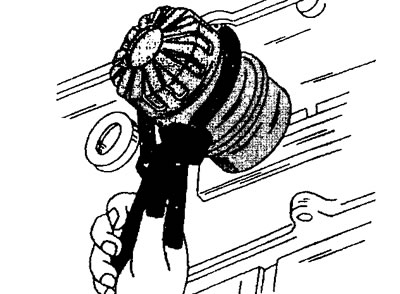
17.3 Remove the oil filter from the side of the engine using a filter wrench
4. Remove the engine oil level indicator (dipstick).
5. Unscrew the mounting bolts and remove the pressure and driven clutch discs. To prevent the flywheel from turning, secure it with a brake shoe by installing it on the ring gear (see illustration).
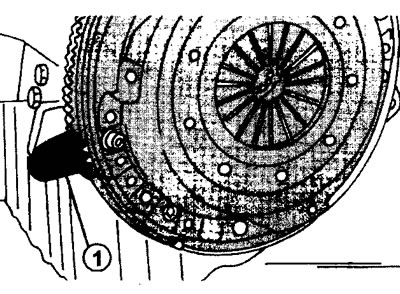
17.5 Fixing the flywheel from turning when removing the pressure and driven clutch disc using a brake shoe 1
If this shoe is missing, secure the flywheel with a screwdriver. Unscrew the six clutch disc mounting bolts in a crosswise pattern.
6. Remove the driven disk from the flywheel. Do not touch the driven disk with oily fingers.
7. Remove, if installed, the heater radiator, the fuel filter together with the base, the oil intake together with the hoses connected to it, the thermostat housing cover and take out the thermostat (see illustration).
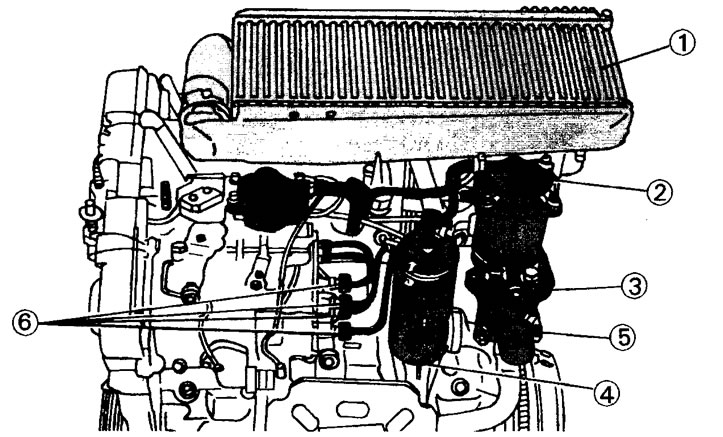
17.7 Remove the parts adjacent to the fuel injection pump
1 - heater radiator
2 - fuel filter
3 - coolant outlet pipe
4 - oil intake
5 - thermostat housing cover
6 - union nuts for fastening high-pressure fuel lines
8. Disconnect the coolant outlet pipe, unscrew the union nuts of the high-pressure fuel lines and disconnect the fuel lines (see illustration 17.7). Close the fuel line openings to prevent dirt from getting in.
9. Loosen the mounting bolts and remove the generator and power steering pump mounted on this side of the engine (if any), cover for hanging units, idle speed increase cable.
10. Remove the exhaust manifold, vacuum pump, intake manifold inlet pipe, air intake hose and coolant inlet pipe (see illustration).
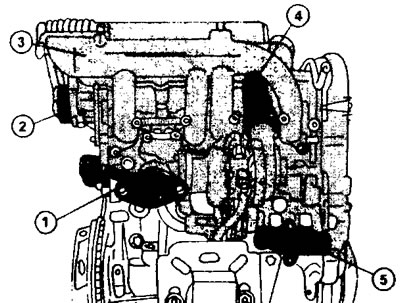
17.10 Parts removed from the engine from the exhaust manifold side.
1 - exhaust manifold
2 - vacuum pump
3 - intake manifold inlet pipe
4 - air intake sleeve
5 - coolant inlet pipe
11. Remove the oil pan. To do this, turn the engine so that the crankcase is on top and unscrew the 23 mounting bolts, loosening them evenly (see illustration).
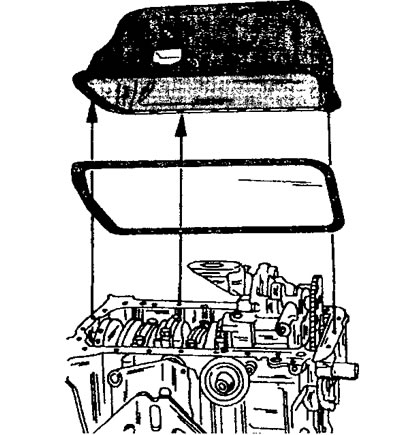
17.11 Removing the oil pump
Mark the mounting position of the tray mounting bolts and store them separately.
12. Remove the oil pan gasket.
Important! The above oil pan removal procedure applies to engines with a sheet metal oil pan. Car engines with air conditioning have oil pans made of aluminum. In this case, the pallet mount is slightly different from that indicated above. And although in this case it is necessary to unscrew 23 mounting bolts, only 20 bolts are the same length. Two are a different size and one is completely different from all of them (see illustration 17.0).
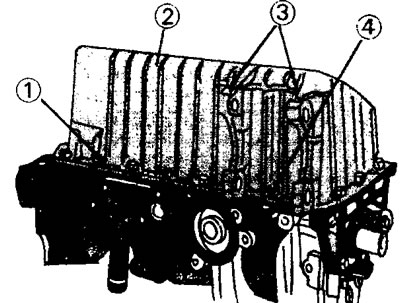
17.0 Aluminum oil pan mount (cars with air conditioning).
1 - 20 bolts, 22 mm long
2 - oil pan
3 - 2 bolts, 40 mm long
4 - 1 bolt, 20 mm long
13. Unscrew, holding the flywheel from turning (see illustration 17.5).
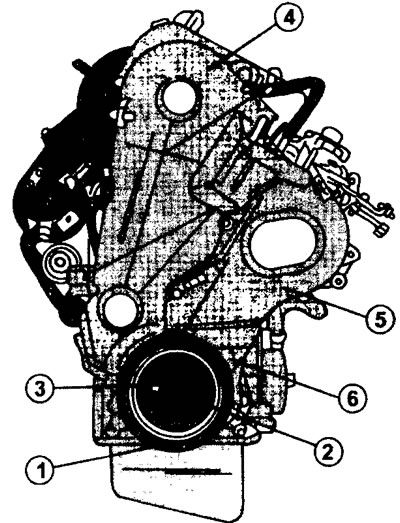
17.15 Front part of the engine, assembled.
1 - belt pulley
2 - belt pulley mounting bolt
3 - gear
4 - upper part of the toothed belt protective cover
5 - side part of the toothed belt protective cover
6 - lower protective panel
bolt securing the belt pulley to the crankshaft. After this, unscrew the flywheel mounting bolts and disconnect it. If necessary, tap the flywheel with a plastic hammer. There is no need to indicate the flywheel mounting position because it can only be installed in one position.
14. Remove the belt pulley from the crankshaft using two pry bars. If possible, you can use a puller, screwing its bolts into the holes on the pulley.
15. Remove both parts of the timing belt guard. Use a screwdriver to loosen the protective cover fastening clamp. Also remove the lower protective panel (see illustrations 17.15 and 17.15a).
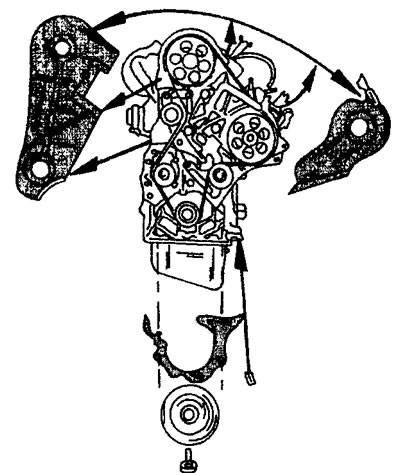
17.15a Front of the engine. The arrows indicate the parts to be dismantled
16. Prepare three M8x1.25 bolts, 40 mm long. Insert one of them into hole 1 on the camshaft gear, and the remaining two into holes 2 and 3 on the fuel injection pump drive gear (see illustration).
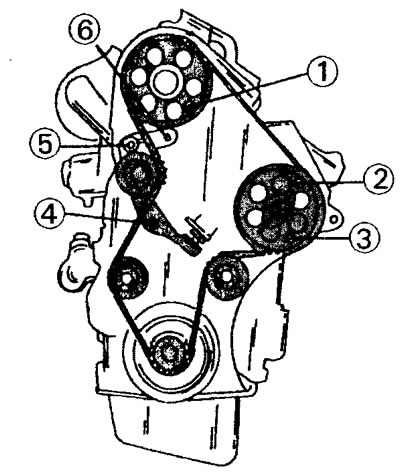
17.16 Fixing the gas distribution mechanism.
1 - hole 1 for installing bolt M8x1.25
2 - hole 2 for installing bolt M8x1.25
3 - hole 3 for installing bolt M8x1.25
4 - belt tensioner bolt
5 - belt tensioner nut
6 - hole for a square
This ensures that the gas distribution mechanism is fixed. However, if the engine needs to be completely disassembled, then the above mentioned work is unnecessary. Bolts are inserted only in cases where it is necessary to avoid displacement of the valve timing adjustment.
17. Unscrew nut 4 and loosen bolt 5 of the toothed belt tensioner (see illustration 17.16). Install the square key (size 9.52 mm) into hole 6 under the square to compress the spring of the automatic toothed belt tensioner (see illustration 17.17).
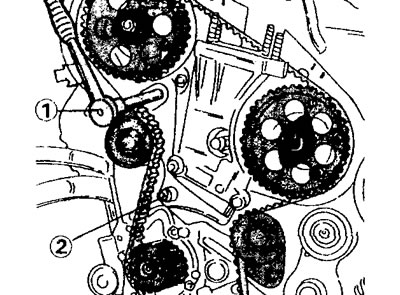
17.17 Unscrew nut 2 and loosen the timing belt tensioner bolt (it is closed with a ratchet 1). Insert a ratchet wrench 1 with a square head into the square head hole to compress the automatic timing belt tensioner spring
A 3/8-inch tetrahedron is included in the end attachment kit. Tighten bolt 5 again to secure the tensioner in its new position (see illustration 17.16).
18. Carefully remove the timing belt from both gears.
19. Loosen the cylinder head mounting bolts and remove the head (see the relevant chapter).
20. Remove the timing belt gear from the crankshaft. Use two pry bars if necessary.
21. Unscrew bolts 2 and 3 and remove tensioner 4 (see illustration).
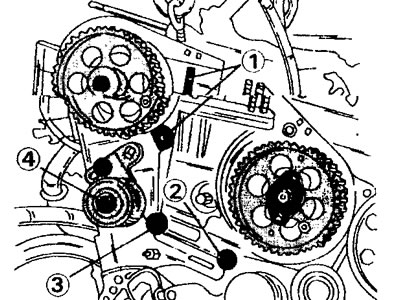
17.21 Remove tensioner 4 by unscrewing bolts 1, 2 and 3
In workshops, a special device is used to hold the tensioner spring and plunger.
22. Unscrew the two bolts 1 and remove the centrally located tension roller 2 of the toothed belt (see illustration).
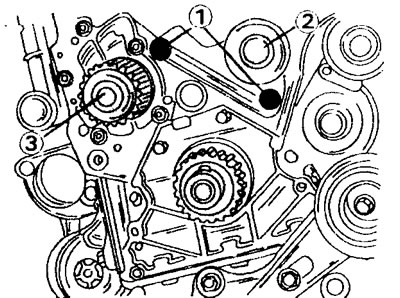
17.22 Unscrew the two mounting bolts and remove the centrally located toothed belt tension roller.
1 - mounting bolts
2 - tension roller
3 - water pump
This will allow you to unscrew the mounting bolts and remove the water pump 3.
[Original published on the portal: Peugeotbook.ru]
23. Remove the side cover (bearing shield), installed in front of the oil pump. A seal is pressed into the cover. To remove the cover, you need to unscrew six mounting bolts (see illustration).
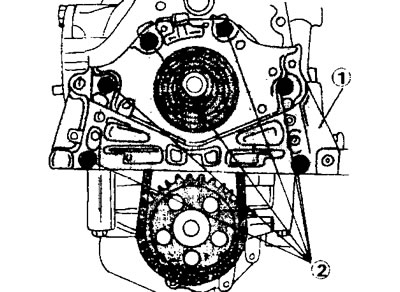
17.23 Remove the side cover 1 (bearing shield), installed in front of the oil pump. To remove the cover, you need to unscrew six bolts 2
The mounting position of the bolts must be noted because they vary in length. The cover itself is installed on centering pins and therefore should be removed quite carefully.
24. Remove the three oil pump mounting bolts on the bottom of the engine. If there is a spacer gasket, remove it by pushing it to the side in the direction of the arrow (see illustration).
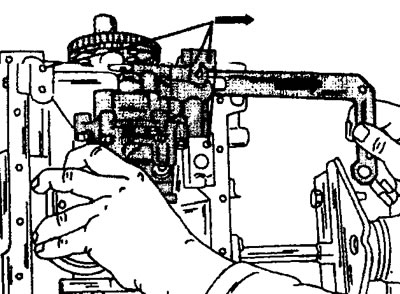
17.24 Remove the three oil pump mounting bolts (see arrow). If there is a spacer gasket, remove it by pushing it to the side in the direction of the arrow
25. Remove the drive chain from the oil pump sprocket (see illustration).
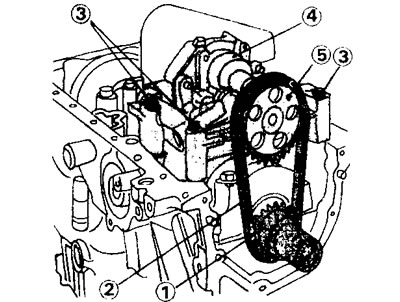
17.25 Oil pump before its dismantling
1 - oil pump drive sprocket on the crankshaft
2 - drive chain
3 - oil pump mounting bolts
4 - oil pump
5 - driven sprocket of the oil pump
26. Remove the oil pump drive sprocket from the crankshaft, remove the key and remove the chain.
27. Remove the timing belt gear from the camshaft, as well as the fuel injection pump drive gear.
28. Remove the fuel injection pump and disconnect the fuel lines. In order to remove the fuel injection pump, it is necessary to disconnect the support on the rear side of the fuel injection pump, and then unscrew the three mounting bolts.
29. Unscrew the connecting rod bearing mounting nuts and remove the covers. Remove the pistons along with the connecting rods and store them properly. Make sure the markings on the caps and connecting rods are clearly visible. Otherwise, mark them additionally with paint (see illustration).
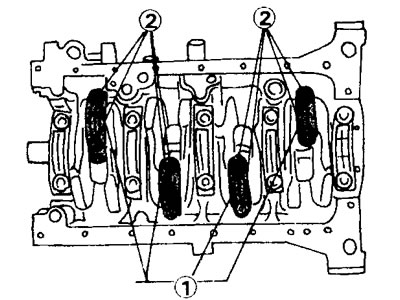
17.29 Unscrew the connecting rod bearing fastening nuts 1 and remove the covers by unscrewing the eight nuts 2
30. Mark the main bearing caps with numbers 1 through 5 (cap No. 1 should be located near the flywheel) and remove them. Place the main bearing shells and caps together.
31. Remove the crankshaft oil seal from the flywheel side. The seal must be replaced with a new one.
32. Remove the crankshaft and the upper halves of the bearing shells.
33. Mark and remove the thrust half rings for adjusting the axial runout of the crankshaft.
Disassembly of pistons and connecting rods is carried out in the order given in the relevant chapter.
Assembling a 1.9-liter engine
The procedure for assembling gasoline engines is generally applicable to diesel engines as well (see the relevant chapter).
34. Assemble the pistons and connecting rods in accordance with the instructions in the relevant chapter.
35. Install the connecting rod bearing shells in accordance with the markings (see illustration),
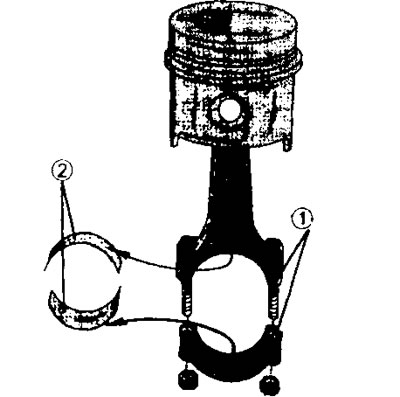
17.35 Piston assembly with connecting rod. On the connecting rod and on the bearing cap there are corresponding marks 1, 2 - liners installed as shown by the arrows. There is an arrow on the bottom of the piston, which should also be followed during assembly
if they are not replaced but reinstalled. The guide projections of the bearing shells must fit into the holes in the connecting rods.
36. Insert the main bearing shells with lubrication grooves into the engine crankcase beds. The guide protrusions of the liners must fit into the corresponding recesses.
37. Install oil jets at the bottom of the cylinder block, if the engine is equipped with them.
38. Install bearing No. 2 on each side (the counting is carried out from the flywheel side) both half rings for adjusting the axial play of the crankshaft. The lubrication grooves on both half rings must face outward, towards the sliding surface of the crankshaft. Lubricate the thrust washers thoroughly with engine oil.
39. Carefully install the crankshaft into the bearings. The journal surfaces must be well lubricated with engine oil. To do this, use an oiler and rub the oil in with your finger. Do not use a brush for this.
40. Install bearing caps No. 2, 3, 4 and 5 with inserted liners in the order they were before removal. There should be thrust half rings in the bearing cap No. 2. The bearing caps are numbered and the cap numbers must face the oil filter. Do not install the flywheel side bearing cap yet (see illustration).
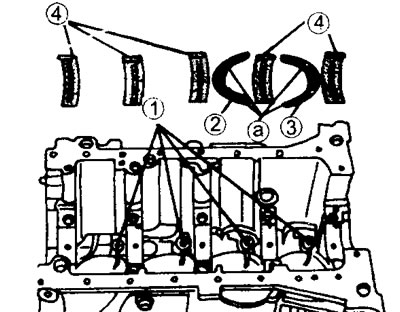
17.40 Engine crankcase. Make sure the thrust washers are installed properly.
1 - oil nozzles
2 - thrust half ring for adjusting the axial movement of the crankshaft, installed on bearing No. 2
3 - thrust half ring for adjusting the axial movement of the crankshaft, installed on bearing No. 2
4 - main bearing shells with grooves
41. Check the axial movement of the crankshaft.
42. Install a pointer-type indicator with a suitable holder on the end of the engine so that the measuring rod touches the end of the crankshaft (see illustration).
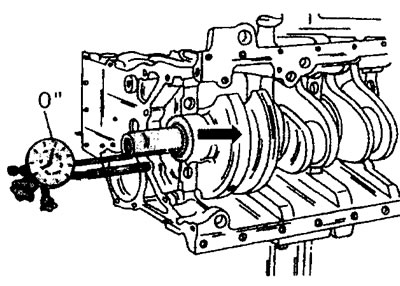
17.42 Checking the axial movement of the crankshaft
If the holder is magnetic, the indicator can be secured to the shaft, and the measuring rod should rest against the ground surface of the cylinder block.
43. Use a screwdriver to push the crankshaft towards the flywheel and set the indicator arrow to "0".
44. Press the crankshaft from the flywheel side towards the timing belt. The axial displacement value recorded by the indicator should be between 0.07 and 0.32 mm. If the result exceeds 0.32 mm, oversize thrust washers must be installed (increased thickness). In this case, it is necessary to install both half rings of the same thickness so that the crankshaft does not shift. In addition to half rings with a nominal thickness of 2.30 mm, there are half rings with a thickness of 2.35, 2.40, 2.45 and 2.50 mm.
To install the rear bearing cover, you need a special device for mounting the side seals of the cover.
45. Apply sealing compound to the surface of the crankcase that contacts the bearing cap (see arrows in the illustration).
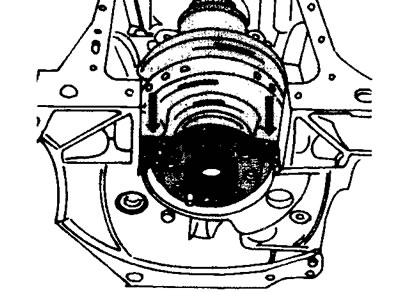
17.45 Apply sealing compound to the surface of the crankcase that contacts the bearing cover
46. Screw both guide strips 1 to the fixture. Do not tighten the bolts too tightly (see illustration).
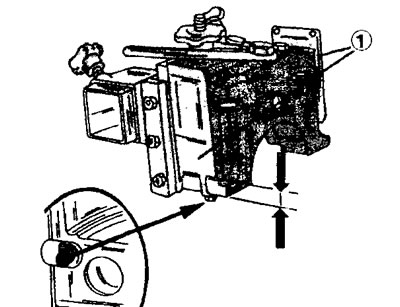
17.46 Screw both guide strips 1 to the fixture. The guides press the side seals into the grooves. The bottom of the seal should protrude as shown in the illustration
47. Use a tool to secure the two rubber seals on both sides of the rear bearing cover. The seals are precisely matched to length and do not require subsequent trimming. Secure the holder with one bolt to the bearing cap and lubricate the guides with engine oil.
48. Compress the guide strips with your hand and insert them all together at a slight angle into the cylinder block until the cover is seated in place. To do this, you need to press on the device after inserting it into the block.
49. Install both bearing cap bolts and tighten them hand tight.
50. Disconnect the tool from the cover and remove it together with the guide strips from the cylinder block.
51. Tighten the bearing cap mounting bolts in order, working from the middle outwards, to a torque of 70 Nm.
52. Replace the two bolts in the crankshaft flange and insert a screwdriver between them. You can use bolts to secure the flywheel. Turn the crankshaft to check its movement and make sure that it is not jammed anywhere. And only after this check can the engine assembly continue.
53. Lubricate the outside of the new oil seal with oil and press it into the hole in the cylinder block on the flywheel side. The seal can also be hammered in by installing a metal plate on it. But in this case, the plate must fit tightly against the surface of the seal. When driving the seal, be careful not to damage it.
54. Lay out the assembled pistons and connecting rods in the order of installation. Attach a mandrel to the piston of the first cylinder for installing it in the cylinder and insert it into the well-lubricated with engine oil cylinder hole, following the corresponding marking (see. illustration).
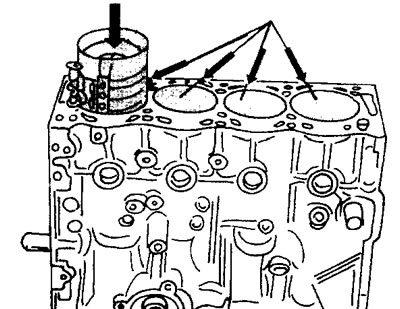
17.54 Installing pistons. Attach a mandrel to the piston to install it into the cylinder and insert it into the cylinder bore, which is well lubricated with engine oil
At the same time, move the connecting rod so that it sits on the crank pin. When reinstalling the old connecting rod bearings, do not mix them up. After installing the piston and connecting rod, make sure that the combustion chamber cavity in the piston is positioned correctly. This means that the arrow on the piston pin should point towards the side where the timing belt is located. Install the piston of the fourth cylinder in the same way.
55. Insert the bearing shells of both installed connecting rods, observing their markings. Lubricate the bearing surfaces thoroughly with engine oil. Bearing mounting nuts must be replaced with new ones. Pre-tighten the bearing cap to 20 Nm and then tighten it further by 70° using a protractor.
56. Turn the crankshaft until the journals of the two remaining pistons are in the lower position. Install the remaining two pistons together with the connecting rods. After installing them, check the free play of the crankshaft and make sure that it does not jam anywhere.
Before installing the oil pump, place the chain on the driven sprocket and then secure the oil pump. If a spacer gasket is installed, insert it from the oil filter side between the pump and the cylinder block, i.e. in the reverse order to that shown in illustrations 17.24. The oil pump mounting bolts vary in length (see illustration).
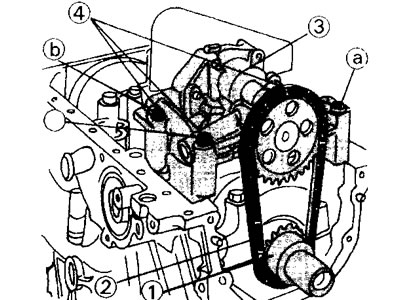
17.56 The oil pump mounting bolts are of different lengths.
1 - drive sprocket on the crankshaft
2 - drive chain
3 - oil pump
4 - oil pump mounting bolts: a - 80 mm long bolt, b - 70 mm long bolt, c - 65 mm long bolt
Their tightening torque is 18 Nm.
57. Install and secure the side cover (bearing shield), having updated the gasket. The cover is secured with six bolts of varying lengths (see illustration 17.23). Two of the top cover mounting bolts are 35 mm long, the others are 18 mm long. Tighten all bolts to a torque of 12 Nm.
58. Press the oil seal flush with a suitable drift into the bearing shield, placing the oil seal on the crankshaft. The mandrel must fit snugly against the entire surface of the seal (see illustration).
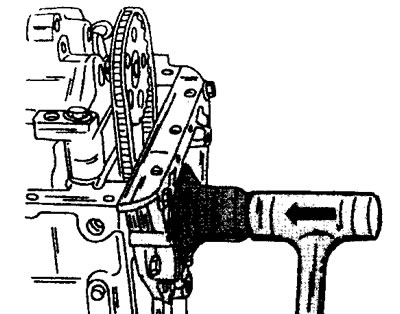
17.58 Using a suitable drift, press the oil seal flush into the bearing shield, placing the oil seal on the crankshaft. The mandrel must fit snugly against the entire surface of the seal
59. Install the new oil pan gasket onto the crankcase. If the engine has a sheet metal oil pan, secure it with 23 bolts, screwing them in according to the marks made when removing the pan. Tighten the bolts evenly to a torque of 16 Nm (see illustration).
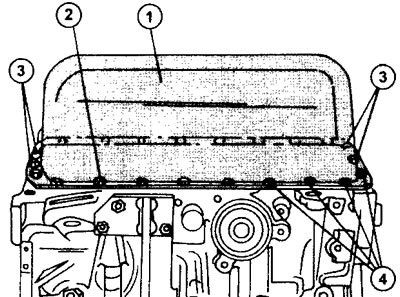
17.59 Fastening of oil pan from sheet iron.
1 - oil pan
2 - bolt 20 mm long
3 - bolts 16 mm long
4 - bolts 20 mm long
The aluminum oil pan is installed on the crankcase using a dowel pin. In this case, a gasket is not needed, but the mating surfaces are lubricated with a sealing compound. The pan mounting bolts are screwed in in accordance with the marks made before removal and tightened to a torque of 16 Nm (see illustration 17.0).
60. Fasten the flywheel to the crankshaft. To do this, rotate the flywheel until the mounting holes are aligned. The flywheel mounting bolts must be replaced with new ones. Lubricate the bolt threads with protective paste. Before tightening the mounting bolts, the flywheel must be secured against turning (see illustration 17.5). Tighten the flywheel mounting bolts evenly to 50 Nm.
61. Install the pressure and driven clutch discs on the flywheel. The long side of the driven disc hub must face outward. Install the pressure plate only after aligning the marks made with a punch before removal (if the same clutch parts are installed). While holding the flywheel from turning, tighten the mounting bolts in a cross pattern to a torque of 14 Nm (see illustration).
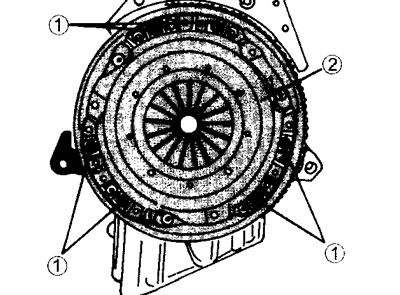
17.61 Fastening the pressure and driven clutch discs.
1 - mounting bolts
2 - clutch pressure plate
Make sure that the centering rod can be easily inserted and removed from the hole into which the input shaft of the gearbox will subsequently be inserted.
62. Install the high pressure fuel pump. Do not tighten the pump mounting nuts or its rear support yet.
Cylinder head gaskets are available in different thicknesses. The thickness of the cylinder head gasket to be installed depends on the height of the piston protrusion above the cylinder block surface. To determine the required gasket thickness, the pistons must be sequentially set to the TDC position and the protrusion of each piston above the cylinder block surface must be measured. Cylinder head gaskets have notches on the outside. Due to the fact that changes have been made to the gasket markings since the production of this engine, it is not possible to indicate the only correct designation of the required gasket. In addition, the designation of the gaskets was also constantly changing.
63. Place the dial indicator on the magnetic holder on a well-cleaned surface of the cylinder block and press the measuring pin to the surface of the block near the outside of the piston. In this position, reset the indicator (see illustration).
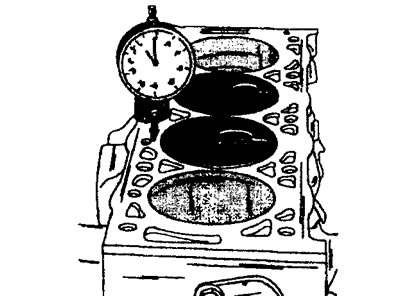
17.63 Measuring the height of the cylinder piston protrusion
64. Move the measuring pin as close to the middle of the piston as possible without removing the device itself from the surface of the cylinder block. Read and write down the resulting value (see illustration).
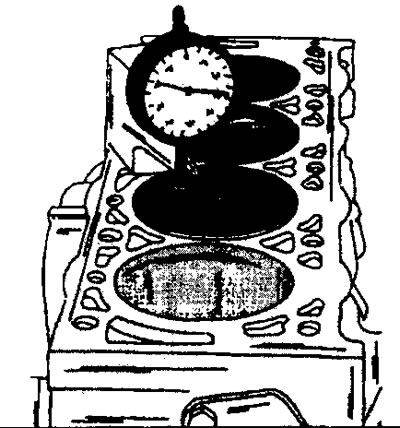
17.64 Move the measuring pin as close to the middle of the piston as possible without removing the device itself from the surface of the cylinder block
It corresponds to the height of the piston protrusion.
Measure the protrusion of the remaining pistons in an identical manner and record the obtained values. The maximum protrusion value is decisive when selecting a cylinder head gasket. At the same time, the difference between the values obtained during measurements on any two pistons should not exceed 0.12 mm.
The gasket is selected as follows. If the piston protrusion is within the range of 0.54-0.77 mm, then a gasket should be installed that has three notches at point A and two at point B (see illustration 17.0a). The thickness of such a gasket is 1.54 mm.
If the piston protrusion is within the range of 0.77-0.82 mm, then a gasket must be installed that has three notches both at point A and at point B (see illustration 17.64a).
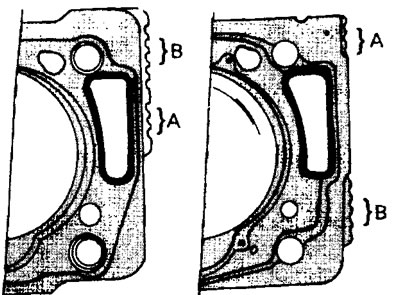
17.64a Cylinder head gasket options. Point A indicates the engine type, and point B indicates the thickness. Notches A and B can be located either next to each other or at a certain distance from each other
The thickness of such a gasket is 1.64 mm.
After determining the piston protrusion height, rotate the crankshaft so that all pistons are approximately in the center of the cylinder bores. Only after this can further assembly of the engine be continued.
65. Make sure that the centering pin 1 is installed on the cylinder block (see illustration)
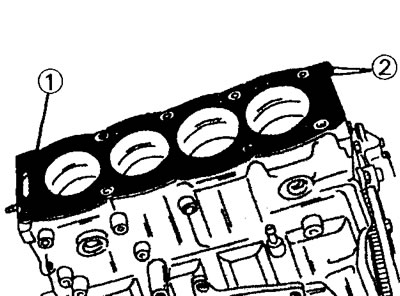
17.65 Install centering pin 1 to install the cylinder head. The notches on the cylinder head gasket must face side 2
and install the cylinder head (see the relevant chapter). Adjust the valve clearance (see the relevant chapter).
66. Install the water pump, replacing the old gasket with a new one. Tighten the water pump mounting bolts to 15 Nm.
67. Screw both thermostat switches into the holes on the thermostat housing.
68. Install two new gaskets on the thermostat and install it into the housing. Secure the fully assembled thermostat housing to the cylinder block, installing a new gasket.
69. Remove the gear from the camshaft installed for adjusting the valve clearance and pack the camshaft seals, lightly lubricating their working surface with engine oil.
70. Install the camshaft gear. Tighten the pinion mounting bolt to 45 Nm. While tightening the bolt, hold the camshaft from turning. To do this, you can insert a rod into the hole on the gear and secure it in the cylinder head.
71. Tighten the fuel injection pump mounting bolts.
72. Turn the crankshaft, camshaft and fuel injection pump shaft so that the keys on these shafts are positioned as shown in (illustrations 17.72).
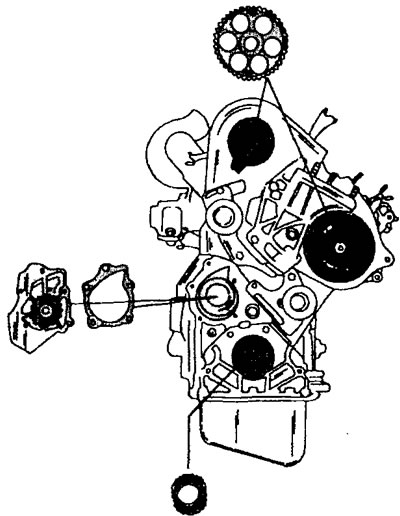
17.72 The arrows show the position of the keys on the shafts
73. Install the drive gear on the injection pump shaft and secure it with a bolt, screwing it into the hole in the center of the gear. Tighten the bolt to a torque of 50 Nm, holding the gear from turning.
74. Install the timing gear on the crankshaft and, without displacing the key, tap it onto the shaft using a piece of pipe.
75. Insert one of the M8x40 mm bolts used during engine disassembly into hole 1 on the camshaft gear (see illustration 17.16). In this case, the bolt enters the hole in the cylinder head, thereby fixing the gear from turning when laying the timing belt.
76. Fix the fuel injection pump drive gear in the same way. The bolts are installed in holes 2 and 3 (see illustration 17.16).
77. Secure the crankshaft from turning. To do this, you need an 8mm thick metal rod. The rod is inserted from the back of the cylinder block and fits into a hole in the flywheel, locking it in the desired position (see illustration).
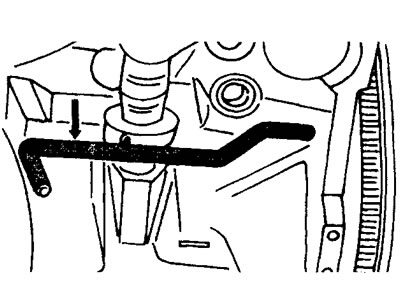
17.77 Secure the crankshaft from turning using a rod that is inserted from the rear of the cylinder block and goes into the hole in the flywheel, locking it in the desired position
78. Install the timing belt. First place the belt on the crankshaft gear, then guide it through the guide roller in the center to the fuel injection pump drive gear, the camshaft gear, to the tension roller and finally to the water pump gear. Make sure the belt teeth are in tight engagement with the teeth of all gears.
79. Tighten the timing belt (see the relevant chapter).
80. Adjust the injection timing of the high-pressure fuel pump (see the relevant chapter).
81. Install the belt pulley on the crankshaft. Lubricate the pulley mounting bolt threads with Loctite protective lubricant, insert the bolt, and tighten it to 40 Nm, then turn it an additional 60°. Hold the crankshaft in place by securing the flywheel.
82. Screw in the glow plugs and tighten them to a torque of 22 Nm. Attach the current-supply busbar to the four contact pins of the glow plugs and secure with nuts, tightening them to a torque of 4 Nm.
83. Screw in the injectors (tightening torque 90 Nm) and connect the high-pressure fuel lines to them by screwing on the union nuts with a torque of 20 Nm.
84. Install the timing belt guards. Tighten the latch at the junction of the casings using a screwdriver.
85. Install the oil filter and tighten it to a torque of 14 Nm. Before doing this, thoroughly lubricate the filter's rubber ring with engine oil.
The installation of the remaining parts is carried out in the reverse order of disassembly. The tightening torque for the exhaust manifold nuts is 20 Nm, for the intake manifold - 23 Nm.