



Table of contents: XUD diesel engines with a capacity…🠇 Engine XUD9TF/L (D8B) 🠇 Engine XUD9TF/Y (DHX) 🠇 Engine XUD11BTE/L3 🠇 Removal the engine 🠇 Installation 🠇
XUD diesel engines with a capacity of 1.9 and 2.1 liters
All engines are four-cylinder and have a pre-chamber or manifold injection system. The 1.9L (XUD9) or XUD11 engine is installed in the engine compartment perpendicular to the direction of travel. There are several types of 1.9 liter engines:
Engine XUD9TF/L (D8B)
This engine is equipped with a turbocharger and exhaust gas recirculation system. Its power output is 67.5 kW at 4000 rpm. It is equipped with a Bosch fuel injection system and a distributor-type fuel injection pump.
Engine XUD9TF/Y (DHX)
This engine is equipped with a turbocharger, exhaust gas recirculation, and an oxidation catalyst, producing 66 kW at 4,000 rpm. It features a Bosch fuel injection system and a distributor-type fuel injection pump.
Engine XUD11BTE/L3
This engine has a displacement of 2088 cc and a power output of 110 hp (80 kW). It is designated XUDl IBTE. L3 denotes the exhaust gas aftertreatment level. This engine has three valves per cylinder and is equipped with the EPIC fuel injection system developed by Lucas. Valve clearance is automatically adjusted using hydraulic tappets.
The cylinder block is cast from grey cast iron, and the cylinder head is made from a light metal alloy. The engine has a single camshaft, which is driven by a toothed belt from the crankshaft. The cylinder head is drilled for valve seat rings, valve guides, and also for pre-chambers for fuel injection.
Removal the engine
Despite some differences inherent in different types of engines, the work of removing and installing an engine is considered as a whole.
The power unit is removed from the engine compartment using a hoist, beam or crane. In workshops, when removing the power unit, they also use a lift onto which the engine is lowered. To remove the engine, the front of the car must be placed on jacks and the front elements must be removed. Depending on the car model, there may be minor differences in engine removal, but in general, the engine removal procedure is as follows.
1. Remove the wheel caps.
2. Apply the parking brake and loosen the front wheel hub nuts (see illustration 2.2). Do not unscrew the nuts completely. The car must be standing on its wheels
3. Disconnect both terminals from the battery terminals.
4. Drain the coolant and, if necessary, the transmission fluid.
5. Remove the front trim (see illustration 2.5).
6. Remove the air filter.
7. Remove the radiator grille together with the radiator fan and the radiator itself (see illustration 2.7).
Car manufacturers are increasingly using special connections for hoses, and for this reason it may be the case that the lower radiator hose is connected in just this way. The procedure for removing a hose with such a connection is indicated in the relevant chapter (see "Cooling system"). Therefore, if necessary, please familiarize yourself with the provisions of the specified chapter. The heater hoses can also be connected in a special way.
8. First remove the locking clip of such a connection. After this, use a screwdriver to push the leash to the right and simultaneously disconnect both hoses in turn (see illustrations 2.8 and 2.8a).
9. Remove the boost air radiator (intercooler). If the car has air conditioning, then release the compressor and evaporator and then remove them (see illustration 2.9). Do not open the air conditioning system. First, loosen the evaporator, heat shields and compressor, and then remove them.
10. Disconnect the frame cross member (see illustration 2.10).
11. Loosen the mounting bolts and remove the power steering pump and reservoir (see illustration 2.10).
Caution! Do not open the power steering system. Be careful not to let power steering fluid come into contact with paintwork.
12. Remove the ABS control unit located on the left side of the engine compartment (see illustration 2.10).
13. Disconnect all hoses, wires and pipelines connected to the power unit. Before doing this, mark them for subsequent installation.
14. Remove the wheel mounting bolts.
15. Place the front of the vehicle on jack stands.
16. Disconnect the gear shift mechanism from the gearbox, working from underneath the vehicle. At the same time, disconnect the flexible shaft of the speedometer from the gearbox and remove the clamp securing the exhaust pipe to the body.
17. Disconnect and remove the following parts:
- coolant expansion tank;
- exhaust gas recirculation system switching valve;
- heater hoses secured with a special connection (see illustration).
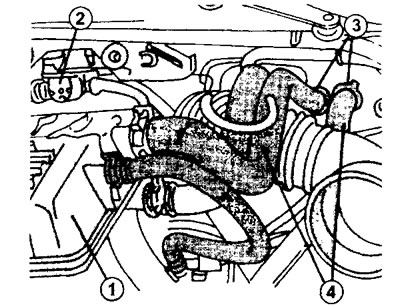
16.17 Disconnect and remove the following parts:
1 - expansion tank for coolant
2-switching valve of the exhaust gas recirculation system
3 - heater hoses
18. Disconnect the wheel drive axle shafts (see the relevant chapter).
19. Unscrew bolts 2 and 5 (see illustration 2.19) and remove the front engine mount bracket 3.
20. Disconnect all wires from the gearbox (starter wire and reverse light switch wire).
21. Attach the hooks of a hoist or other lifting device to the engine eyes and lift the power unit slightly.
22. Release the right and left engine and gearbox mounts. To do this, simply disconnect the brackets, and the support cushions remain fixed to the body (see illustration 2.22).
23. Make sure that everything that is attached to the engine is disconnected. After this, lift the power unit and remove it from the engine compartment. The power unit must be removed from the engine compartment at a certain angle and therefore must be turned around. Be careful not to let the power unit come into contact with any wires or pipes.
(Data published on the website: PEUGEOTBOOK.ru)
24. Place the power unit on suitable supports, such as wooden blocks, and secure it against tipping.
25. Inspect the power unit and make sure that it has no external damage or areas with oil or coolant leaks.
26. Clean the engine surface. At the same time, cover all parts that may be damaged during cleaning.
Installation
Installation of the power unit is carried out in the reverse order of removal.