



Table of contents: A 🠇 B 🠇 IN 🠇 G 🠇 D 🠇 Z 🠇 AND 🠇 TO 🠇 L 🠇 M 🠇 ABOUT 🠇 P 🠇 R 🠇 WITH 🠇 T 🠇 U 🠇 F 🠇 X 🠇 C 🠇 Sh 🠇 SCH 🠇 E 🠇
A
ABS (Anti-lock braking system)
A system, usually electronically controlled, that prevents wheels from locking during braking by reducing the brake fluid pressure at the locked wheels.
Emergency brake
A braking system independent of the main hydraulic braking system that can be used to slow or stop the vehicle when the main brakes fail, and to hold the vehicle stationary when the brake pedal is released. Typically has a lever that is mechanically linked to the front or rear brakes via cables and levers. Also known as the handbrake or parking brake.
Adsorber
Fuel vapor recovery system element designed to prevent fuel vapors from escaping into the atmosphere: contains activated charcoal granules to retain fuel vapors from the engine fuel supply system.
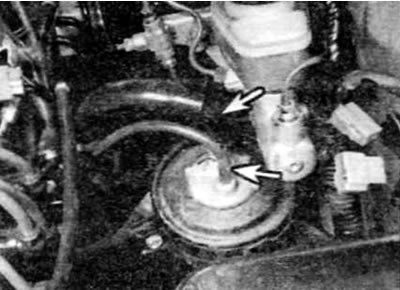
Adsorber
Anti-seize compound
A coating that reduces the risk of sticking of connections that are exposed to high temperatures, such as exhaust manifold bolts and nuts.
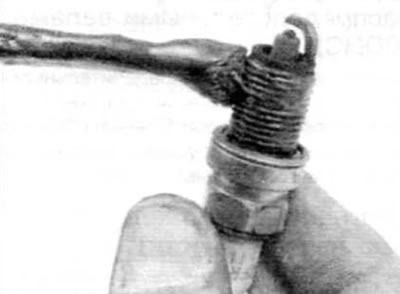
Anti-seize compound
Antifreeze
Substance (usually ethylene glycol), which, when mixed with water, is used in the vehicle's cooling system to prevent the coolant from freezing in winter. Antifreeze also contains chemical additives to prevent corrosion and rust formation, which tend to clog the radiator and coolant passages and reduce the efficiency of the cooling system.
Asbestos
A natural fibrous mineral with high thermal resistance, commonly used in brake lining materials. Asbestos is hazardous to health. Dust generated by brake operation must not be inhaled or swallowed.
B
Drum brake
The brake is a metal drum located inside the wheel. When the brake pedal is pressed, the curved brake shoes are pressed against the inside of the drum to slow or stop the vehicle.
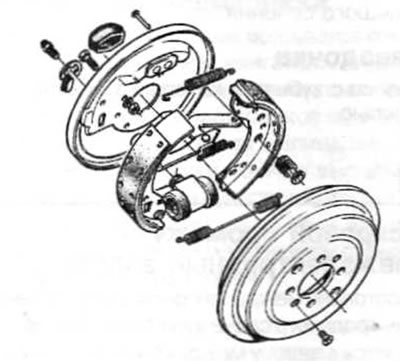
Drum brake assembly
Beating
Radial or axial movement of the rim or end of a rotating part relative to a fixed point due to inaccuracy in its manufacture or improper fit on the shaft.
Electronic control unit (control unit)
A computer that controls, for example, the ignition system, the fuel injection system, or the anti-lock brake system.
IN
Drive shaft
Any shaft that transmits torque. Sometimes this is the name given to the drive axle shaft in front-wheel drive vehicles.
Drive axle shaft
A shaft extending from each side of the differential. which transmits torque from the main gear to the drive wheels. Also called drive shaft or axle shaft.
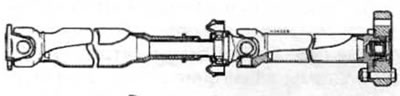
Drive axle shaft
Air release valve
A valve or shut-off screw on a wheel brake cylinder, caliper, or other hydraulic component that is opened to allow air to escape from the hydraulic system. Sometimes called an "air release nipple".
Phillips screw
A type of screw that has a head with a Phillips recess instead of a longitudinal one. It requires a screwdriver of the appropriate type.
Air filter
A metal or plastic housing containing a filter element that cleans the air entering the engine from dust and dirt.
Volt (V)
A unit of measurement of voltage in an electrical circuit. A voltage of 1 volt is formed at the ends of a 1 ohm resistance when a current of 1 ampere flows through it.
Exhaust manifold
A pipe with multiple channels through which exhaust gases leave the engine's combustion chambers and enter the exhaust pipe.
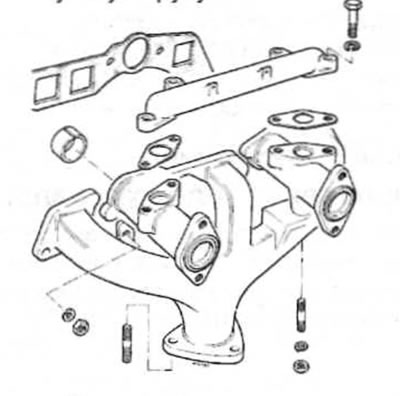
Exhaust manifold
Viscosity
A quantity that characterizes the resistance of a liquid to flow.
G
Generator
An element of a vehicle's electrical equipment that converts mechanical energy into electrical energy. Driven by the crankshaft via a belt drive. Used to recharge the battery, operate the ignition system and electrical devices.
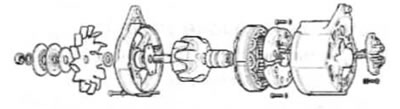
Generator (bitmap image)
Sealant
A liquid or paste to prevent leakage in a connection. Sometimes used in combination with a gasket.
Hydraulic tappet
A tappet that uses hydraulic pressure from the engine's lubrication system to maintain zero clearance (constant contact) with camshaft and valve stem. Automatically adapts to changes in valve stem length as it heats up. Hydraulic tappets reduce valve noise.
D
Overhead valve (OHV) engine
An engine with valves located in the cylinder head, but with the camshaft located in the engine block.
Overhead camshaft (OHC) engine
An engine with the camshaft(s) located at the top of the cylinder head(s).
Double overhead camshaft (DOHC) engine
An engine with two camshafts located in the upper part of the cylinder head. Typically one shaft is used for the intake valves and one for the exhaust valves.
Diagnostic code (fault code)
Digital code. generated by the electronic engine control system when a malfunction occurs. This code can be read with a diagnostic tool and used to identify the area of the system where the fault may be present.
Disc brake
A brake that includes a rotating disc against which brake pads are pressed. When friction occurs, the energy of a moving vehicle is converted into heat.
Z
Plug
A metal piece in the shape of a disk or plate that covers the hole in a casting through which the core is removed. In cast engine body parts, such plugs also act as safety elements, reducing the likelihood of damage when the coolant freezes.
Gap
The distance between two parts. For example, between the piston and the cylinder, between the bearing and the journal, etc.
Starting from an external source
Starting a car engine with a discharged or weak battery from an external battery by connecting the batteries with large-gauge wires.
Star
A wheel with teeth that mesh with a chain.
AND
Spark gap (interelectrode gap)
The distance between the central and ground electrodes in a spark plug. Also refers to the gap between contacts in the breaker assembly in contact ignition.
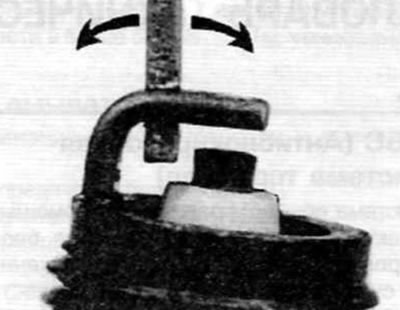
Adjusting the spark plug gap
Plain bearing clearance gauge (Plastigage)
A thin plastic thread that comes in various sizes and is used to measure gaps. For example, to measure the clearance in a plain bearing, you need to lay a thread along the bearing journal. Assemble and disassemble the bearing: the width of the crushed strip will indicate the size of the gap between the journal and the bearing.
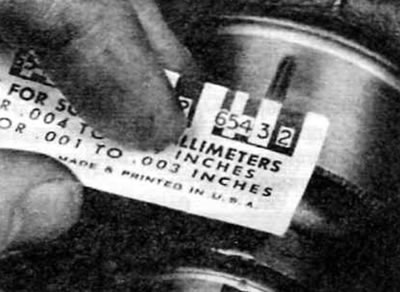
Plain bearing clearance gauge
TO
Carburetor
A device that mixes fuel and air in the proper proportions to produce the required power from a spark-ignition internal combustion engine.
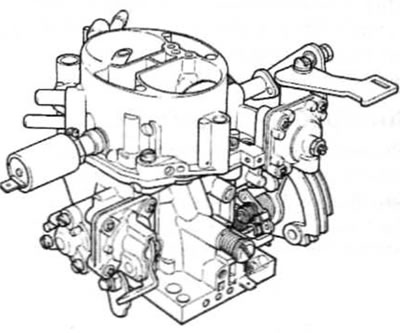
Carburetor
Cardan shaft
A long, hollow tube with universal joints at the ends that transmits torque from the transmission to the differential on rear-wheel drive, front-engine vehicles.
Cardan joint
Double articulated joint for transmitting rotation at a certain angle. A universal joint consists of two U-shaped forks and a cross-shaped joint called a cross.
Crankshaft housing
The lower part of the engine block in which the crankshaft rotates.
Catalytic converter
A device in the exhaust system, similar in appearance to a muffler, that converts some particularly harmful components of the exhaust gases into less harmful ones.
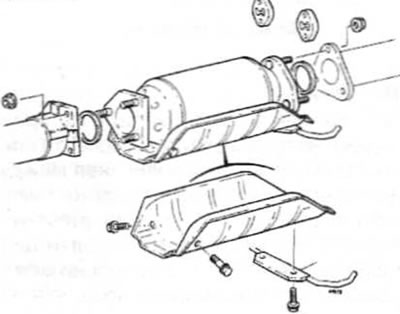
Catalytic converter
Oxygen sensor
A device installed in the engine exhaust manifold that detects the oxygen content of the exhaust gases and converts this information into an electrical current. Also known as a lambda probe.
Valve
A device through which a flow of liquid, gas, or bulk material passes. The flow through the valve can be controlled by a movable part that opens, closes, or partially blocks one or more passages.
The moving part of such a device is also called a valve.
Load-sensing pressure relief valve
A control valve in the brake hydraulic system that operates like a pressure regulator but also takes into account the load on the rear axle.
Exhaust gas recirculation valve
Valve for passing exhaust gases into the intake manifold.
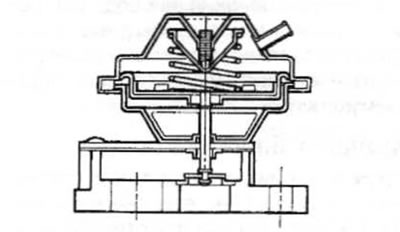
Exhaust gas recirculation valve
Valve clearance
Clearance between valve stop (end of the valve stem) and a valve lever or pushrod. Valve clearance is measured when the valve is closed.
Allen's Key
Hex key for loosening bolts with a hexagonal recess in the head.
Crankshaft
The main shaft of the engine, located along the entire length of the engine crankcase and having cranks to which the connecting rods are attached.
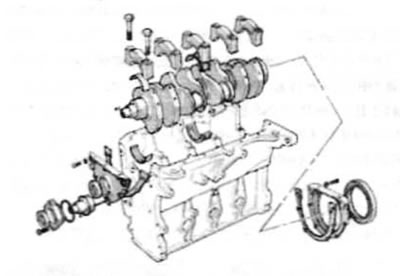
Crankshaft assembly
Compression
A decrease in volume and an increase in pressure and temperature of a gas caused by its compression.
Lock-nut
A nut that secures another nut, usually used for adjustment, or other threaded element in the desired position. For example, a nut for fixing the adjusting nut on the valve lever.
Main bearings
Bearings in which the crankshaft rotates in the engine crankcase. In an in-line engine, the number of main bearings is usually one more than the number of cylinders. Main bearings are usually made in the form of bores in the crankcase, into which liners are placed, coated on the inside with an antifriction material with a low coefficient of friction.
Rocker arm
A double-arm lever swinging on an axle or a journal. In an overhead valve engine, the rocker arm converts the upward movement of the tappet into the downward movement of the valve stem to open the valve.
Castle nut
An elongated nut with through slots on the upper part to secure the nut to a bolt or stud to prevent it from loosening. For example, on the ball joint pin.
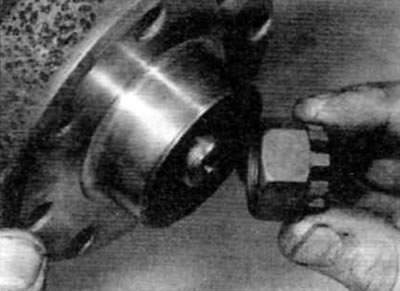
Castle nut
"Crocodile"
Long spring metal clamp with teeth. Used for temporary connection to the power grid.
L
Headlight lamp
An older headlight design that combines the reflector, lens, and filament into a hermetically sealed unit. When the filaments burn out or cracks appear on the lens, the entire unit is replaced.
M
Flywheel
A massive disk in which the energy of impulses during working strokes in the cylinders is accumulated. On cars, the flywheel is attached to the crankshaft to smooth out uneven rotation.
Bridge
The unit that connects two wheels of a vehicle. A bridge is also called a beam that connects two wheels of a car. The bridge that transmits torque is called the driving bridge.
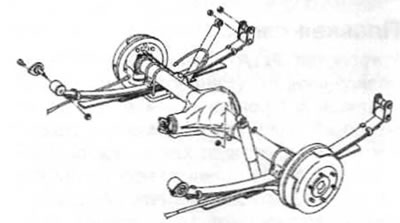
Bridge assemblage
Multimeter
An electrical test instrument capable of measuring voltage, current and resistance. Also known as a "tester".
Fan clutch
Hydraulic transmission that allows maintaining the required fan speed at variable engine speed.
ABOUT
Nitrogen oxides
The main toxic pollutant emitted by gasoline and diesel engines at high temperatures.
Ohm
Unit of electrical resistance. A resistance of 1 Ohm, when a current of 1 Ampere passes through it, creates a voltage drop of 1 Volt.
Article based on material from the website [PeugeotBook.ru]
Ohmmeter
A measuring instrument for determining electrical resistance.
Ignition timing
The angle through which the crankshaft must rotate to bring the piston to top dead center, usually expressed as a number of degrees, at the moment when ignition of the mixture occurs.
Axial clearance
A parameter characterizing the possibility of relative movement of two elements in the axial direction. In reference to a crankshaft, the distance the crankshaft can move forward and backward in the cylinder block.
Wheel axle
The shaft on which the wheel rotates or which rotates with the wheel.
Folding washer
A washer designed to prevent spontaneous loosening or loosening of nuts securing components and parts by bending a special tongue of the washer onto the edge of the nut.
P
Partition
An element of the car body that separates the engine compartment from the passenger compartment.
Fusible link
A circuit protection device consisting of a conductor surrounded by heat-resistant insulation. The conductor has a diameter smaller than the wire being protected, so it acts as the weakest link in the circuit. Unlike a blown fuse, a broken fusible link must be cut from the wire to be replaced.
Fuse box
An electrical device that protects a circuit from accidental overload. A typical fuse contains a low-melting wire that is sized to melt at a specified current (amperes) and disconnect the circuit being protected.
Airbag
An inflatable cushion hidden in the steering wheel hub (on the driver's side) or in the front panel or glove compartment (from the passenger side). In a frontal collision, the airbags inflate, protecting the driver and front passenger from impact with the steering wheel or windshield.
Clutch release bearing
A thrust bearing in the clutch that moves axially under the action of the clutch pedal and acts on the release levers or on the petals of the diaphragm spring to disengage the clutch. Also called a release bearing.
Plain bearing
A unit that ensures easy rotation of the shaft in the housing and does not allow their relative radial displacement. Typically made in the form of a cylindrical bore in the housing, into which a bushing or liner made of antifriction material with a low coefficient of friction is inserted. A plain bearing usually requires good pressure lubrication. An example is engine crankshaft bearings.
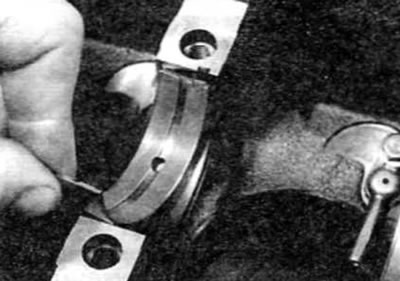
Plain bearing
Half shaft
The rotating shaft that transmits torque from the final drive to the drive wheel is usually installed in the rear drive axle.
Cylinder firing order
The order in which the mixture is ignited in the engine cylinders, starting with the first cylinder.
Drive shaft
This is usually the name given to the drive axle shaft in front-wheel drive vehicles.
Longitudinal tilt of the wheel steering axis
Wheel alignment angle, which determines the tilt of the wheel's turning axis in the longitudinal plane. The angle is considered positive when the top of the wheel's pivot axis is tilted backward.
Bleeding the brakes
Procedure for releasing air from the brake hydraulic system.
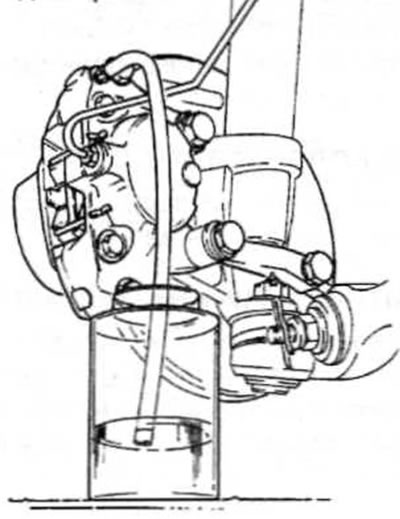
Bleeding the brakes
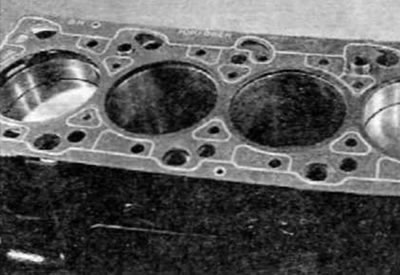
Pad
Any thin piece made of soft material (usually cork, cardboard, asbestos, or soft metal), installed between two metal surfaces to ensure a good seal. For example, a cylinder head gasket is installed at the joint between the block and the cylinder head.
Pad
Spring ring
Ring-shaped clamp for preventing longitudinal movement of cylindrical parts and shafts. The inner spring ring is installed in a groove in the housing, the outer spring ring is inserted into a groove on the outer surface of the cylindrical shaft.
R
Radiator
A heat exchange device that provides heat transfer from liquid to air. designed to reduce the temperature of the liquid in the cooling system of an internal combustion engine.
Camshaft
A rotating shaft containing a series of cams that operate the engine's valve mechanisms. The camshaft can have a toothed, chain or belt drive.
Adjusting shim (washer)
A thin spacer piece used to adjust axial clearance or relative position between two parts. Adjustment is made by changing the thickness of the gasket.
Rack and pinion steering mechanism
A steering system in which the steering shaft has a pinion at the end that meshes with a rack and pinion. When you turn the steering wheel, the pinion gear rotates and moves the rack to the left or right. This movement is transmitted through the steering rods to the steered wheels.
Engine tuning
The process of fine-tuning the engine's performance, including replacing certain parts, to achieve the best possible performance.
Pressure regulator
A hydraulic control valve that limits the pressure in the rear brakes during emergency braking to prevent wheel lockup. Also called a pressure relief valve.
Starter interlock relay
On vehicles with an automatic transmission, a switch that prevents starting unless the transmission is in position N (neutral) or P (parking gear).
Timing belt
A toothed belt that rotates the camshaft. A belt break while the engine is running can cause serious consequences.
Auxiliary drive belt(s)
A belt drive designed to drive auxiliary components such as the alternator, coolant pump, power steering pump, air conditioning compressor, etc., from the crankshaft pulley.
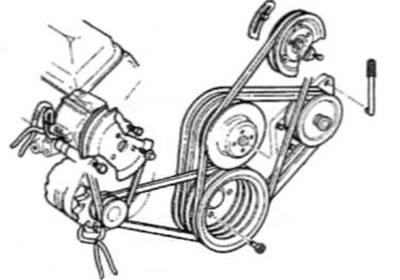
Auxiliary unit drive
Rotor
The rotating part of any device (for example, a generator).
A turbocharger rotor is an assembly that includes a compressor wheel, shaft, and turbine wheel.
The distributor rotor is the rotating part that alternately connects the center electrode on the distributor cap to the high-voltage spark plug wires and directs the high voltage from the ignition coil winding to the correct spark plug.
WITH
Welding
Joining two parts by heating and melting the metal in the welding zone.
Free play
Move before the action starts. the "free movement" in a linkage or assembly, between the start of force application and the actual movement. For example, the distance the brake pedal travels before the piston in the master cylinder begins to move.
Serpentine drive
An engine accessory drive that uses one wide, long belt that wraps around all the pulleys instead of several short belts. Typically, an automatic tensioner is used in this case.
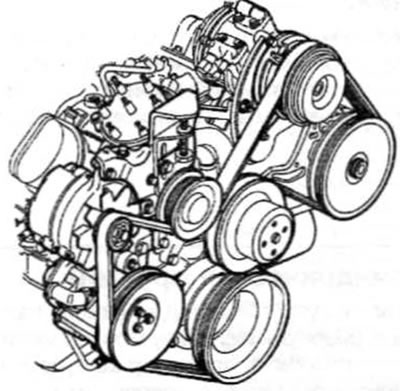
Serpentine drive
Engine management system
A computer that controls fuel injection and ignition.
Compression ratio
The ratio of the cylinder volume when the piston is at bottom dead center. to the cylinder volume when the piston is at top dead center.
MacPherson strut
A type of front suspension system invented by Earl MacPherson at Ford in England. In its original form, the lower control arm was formed by a simple horizontal link to the anti-roll bar. A long strut is installed between the body and the steering knuckle, combining a coil spring and a shock absorber into one unit. Many modern so-called MacPherson struts use a conventional A-arm as the lower support and do not rely on an anti-roll bar
Support
The stationary part of a disc brake that encloses the disc and guides the brake pads. The caliper also contains the working hydraulic cylinders of the brake system with pistons that press the brake pads against the disc during braking.
Electrical wiring diagram
A drawing showing the components and wires of a vehicle's electrical system using standardized symbols.
Wheel alignment
The difference in distance between the end surfaces of the wheels at the front and rear. If this distance is greater at the rear than at the front, the toe-in is called positive, if the opposite is true, it is negative (or discrepancy). Typically toe-in is important for the front (controlled) on rear-wheel drive vehicles, a slight positive toe-in is necessary to compensate for the forces tending to push the wheels apart so that the front wheels are parallel when driving. On front wheel drive vehicles, a small offset is usually installed.
T
Thermostat
A temperature-controlled valve that regulates the flow of coolant between the cylinder block and the radiator to maintain optimum engine temperature. A thermostat is also used in some air purifiers that regulate the temperature.
Pusher
A cylindrical element that transmits movement from the camshaft cam to the valve stem either directly or through a rocker arm (valve lever).
Brake lining
A part made of a friction material with a high coefficient of friction. The brake lining is glued or riveted to a steel base, together with which it forms the brake shoe.
Brake shoe
A component of a disc or drum brake that is pressed against the surface of a disc or drum connected to a wheel and is designed to reduce speed or stop the vehicle. A brake shoe usually has a base made of steel and corresponding in shape to the element being stopped (flat for a disc brake and crescent-shaped for a drum brake), to which a friction lining is glued or riveted.
Brake drum
The brake component that rotates with the wheel and is acted upon by the brake shoes to stop the vehicle.
Brake disc
The brake component that rotates with the wheel and is acted upon by the brake shoes to stop the vehicle.
Tracer
Stripes of a different color applied to the insulation of a wire to distinguish that wire from another with insulation of the same color.
Turbocharger
A device with a gas turbine and a centrifugal compressor, which is driven by exhaust gases and is designed to increase the air pressure in the intake manifold. Typically used to increase engine power while maintaining cylinder displacement.
U
Impact puller
A special puller that screws into or clips onto a part, such as a shaft or bearing. The puller rod has a massive blank that can slide along the rod. At the free end of the rod there is a stop into which the blank hits, releasing the part being removed.
Pointer
An instrument/display on the instrument panel used to monitor the engine's condition.
Sealing ring
A type of seal made from a special rubber-like material. When assembling the unit, to ensure a reliable seal, the ring is placed in a groove in which it is compressed by the attached part.
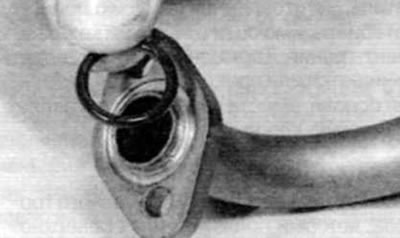
Sealing ring
F
Air filter element
The main element of the air filter, usually made of porous paper, through which all air entering the engine passes. Requires replacement at regular intervals.
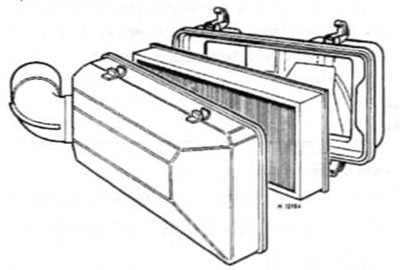
Air filter
X
Coolant
Any substance used to remove heat in an air conditioning system. For many years, R-12 was the most common refrigerant; however, manufacturers have recently begun using the less toxic R-134a, which is less harmful to the ozone layer.
Honing
An abrasive tool for correcting small deviations in the roundness of holes or differences in the diameters of engine cylinders, brake cylinders, etc. i
C
Coil spring
A coil made of elastic steel, available in various sizes. It is used in many vehicle components, for example as an elastic element in the suspension and in the valve mechanism.
Sh
Ball bearing
A unit that ensures easy rotation of the shaft in the housing and its fixation relative to the housing in the radial and axial directions. The bearing consists of an inner and outer ring with steel balls between them. Made of special hardened steel.
Constant velocity joint
A type of universal joint that does not experience speed variations due to changes in torque transmission angle.
Connecting rod bearing
A bearing that connects the lower end of the connecting rod to the crankshaft of the engine. Usually made in the form of a plain bearing.
Calipers
A precise measuring instrument that allows you to measure internal and external dimensions. Not as accurate as a micrometer, but more convenient.
SCH
Feeler gauge
A thin strip or blade of hard steel that has a certain thickness. Used to determine gaps between parts.
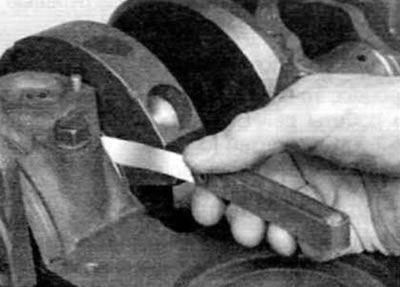
Feeler gauge
E
Electronic fuel injection (EFI)
A computer-controlled fuel delivery system that distributes fuel to injectors located in each intake port of the engine.