



Table of contents: Steering 🠇 Front and rear suspension and wheel…🠇 Springs and shock absorbers 🠇 Drive shafts 🠇 Brake system 🠇 Fuel system and exhaust system 🠇 Wheels and tires 🠇 Car body corrosion 🠇
Raise the front and rear of the car with jacks and securely place them on supports. Position the supports so that they do not touch the suspension elements. Make sure the wheels are clear of the ground and that the steering wheel can be turned from lock to lock to the right and left.
Steering
- Ask your assistant to turn the steering wheel all the way to one side and then to the other. Make sure of that. that the steering operates smoothly and no part of the steering gear, including the wheel or tire, rubs against any hose or line of the brake system or against any part of the body.
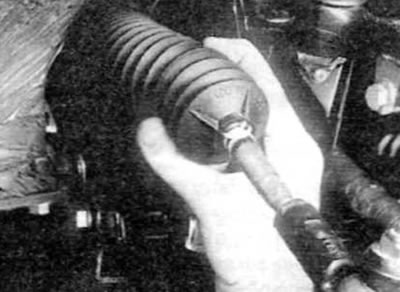
- Inspect the steering rack boots for cracks, grease leaks, or loose clamps. If power steering is installed, additionally check for damage to its hoses, lines or connections. Make sure that the steering does not bind throughout its entire range, that the cotter pins and clamps are present, and that there is no significant corrosion of the body within 30 cm from the attachment points of the steering components.
Front and rear suspension and wheel bearings
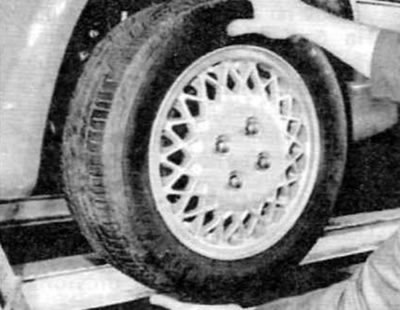
- Starting with the right front wheel of the car, grab it at the 3 and 9 o'clock positions and vigorously rock it. Check for play or loose wheel bearings, ball joints, rubber bushings, suspension mounts and connections.
- Now grab the wheel at the 12 and 6 o'clock positions and repeat the previous check. Spin the wheel and check that its bearings move easily and evenly.
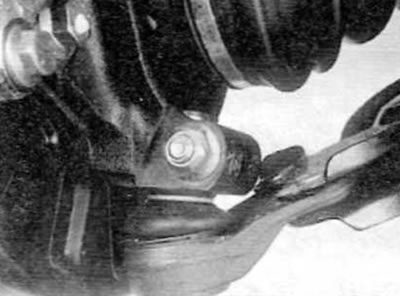
- If you suspect there is play in any connection, you can check it by pressing with a large screwdriver (or something similar) between this connection and its support. This will make it clear where the wear has occurred: in the connection sleeve, the mounting bolts or in the support (bolt holes often take on an elongated shape).
- Perform all of the above checks on the other front wheel, and then on both rear wheels.
Springs and shock absorbers
- Check the suspension struts for significant leaks, corrosion, or damage to the housing. Check the security of all attachment points.
- Check the position of the outer coils of the suspension springs in their supports, as well as the absence of cracks, breakages and corrosion of the springs.
- Inspect the shock absorbers and make sure there are no major leaks. Check the bushings and fasteners for wear and ensure there is no damage to the housings.
[You can find the original on the page: PeugeotBook.ru]
Drive shafts
- Turn each front wheel in turn and check the drive shaft joint boots for cracks or damage. Also make sure that the drive shafts are not bent or damaged.
Brake system
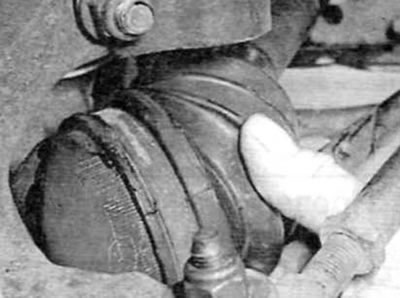
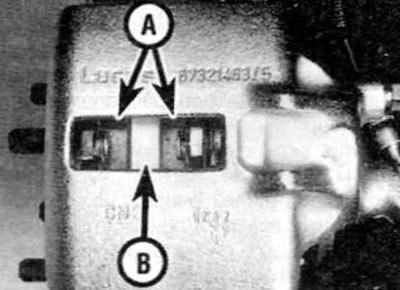
- If it can be done without disassembling, check the wear of the brake pads and the condition of the discs. Make sure that the brake lining material (A) is not worn to the limit and that the discs (B) are free of cracks, pitting, scoring and are not excessively worn.
- Inspect all hard brake lines under the vehicle and the flexible hose at the rear. Look for signs of significant corrosion, chafing, or poorly secured piping, as well as signs of pressure swelling, chafing, cracking, or wear on flexible hoses.
- Check for signs of fluid leakage on the brake calipers or brake shields. Repair or replace leaking components.
- Turn each wheel slowly while having your assistant press and release the brake pedal. Make sure all brakes work and the wheels can turn freely when the brake pedal is released.
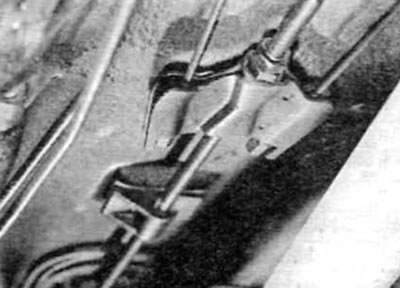
- Inspect the parking brake drive, make sure there are no frayed or broken cables, excessive corrosion, wear or loose fasteners. Check the braking of each wheel and make sure that when you release the brake, the rear wheels rotate freely without binding.
- Without special equipment, it is impossible to test the effectiveness of the brakes, but road tests can be carried out afterwards to check whether the car will move in a straight line when braking.
Fuel system and exhaust system
- Inspect the fuel tank (including the filler cap), fuel lines, hoses and connections. All elements must be securely fastened and must not show any signs of leakage.
- Inspect the exhaust system along its entire length, checking for damage. broken or missing fasteners, the reliability of pipe clamps and the condition of the system with respect to rust and corrosion.
Wheels and tires
- Inspect the sidewalls and tread of each tire in turn. Check for cuts, abrasions, bulges, tread separation, or areas where the cord or carcass is visible due to wear or damage. Also make sure the tire bead is seated correctly on the rim, the valve is in good condition and installed correctly, and the wheel is not deformed or damaged.
- Make sure of that. that the tires installed are of the required size for the given vehicle, their size and type on all wheels (or at least on the wheels of each bridge) the same and that the tires are inflated to the required pressure.
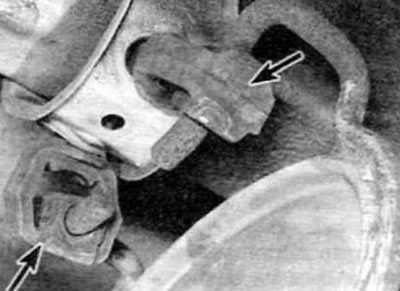
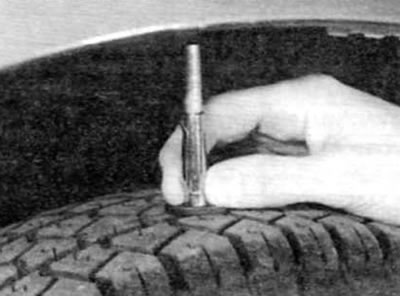
- Check the tread depth. At the time of preparation of this Manual for printing, a depth of at least 1.6 mm was permitted on an area occupying at least 3/4 of the tread width. Abnormal tread wear may indicate improper front wheel alignment.
Car body corrosion
- Check the condition of the entire vehicle body, paying attention to signs of corrosion of all load-bearing elements. These elements include all body box sections, side sills, cross members, pillars and all suspension, steering, braking and seat belt mounting elements. Any corrosion that significantly reduces the thickness of the metal in a load-bearing area will likely prevent the vehicle from passing inspection. If this type of corrosion is found, professional repairs will likely be required.
- Damage to the body or corrosion that has resulted in the formation of sharp or otherwise dangerous edges is also grounds for declaring the vehicle technically faulty.