
English Русский
Български
Беларускі
Український
Српски
Hrvatski
Română
Polski
Slovenský
Magyar
Bookmark Articles Sitemap Contacts
Company Hyundai Company Opel Company Skoda Company Kia Company Mitsubishi Company LADA Company Audi
PeugeotBook.ru


Series 100   Series 200   Series 300   400-500   Series 600   Crossovers   Others
 
Partner I (1996-2008) Peugeot 807 (2002-2014) Peugeot 806 (1994-2002) Peugeot J5 (1981-1993)

Checks performed from the driver's seat (Peugeot Partner I)

  • Main
  • Пежо
  • Partner I (1996-2008)
  • General information
  • Introduction to the guide
  • Checks performed from the driver's seat
0
Table of contents: Parking brake 🠇 Foot brake 🠇 Steering wheel and steering column 🠇 Windshield, rearview mirrors and sun…🠇 Seat belts and seats 🠇 Doors 🠇

Parking brake


  • Check the operation of the parking brake. Too much lever travel (number of ratchet clicks) indicates incorrect adjustment of the brake or its cables.
  • Make sure that the parking brake does not release when the lever is lightly tapped from the side. Check the reliability of the lever fastening.
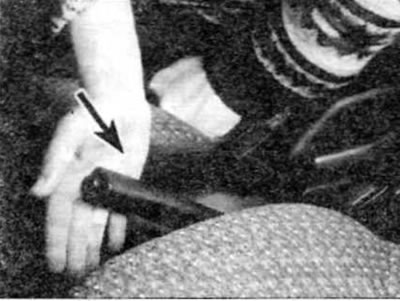
Make sure that the parking brake does not release when the lever is lightly tapped from the side.…


Foot brake


  • Press the brake pedal and make sure that the pedal does not "creep" to the floor, which would indicate a faulty master cylinder. Release the pedal, wait a few seconds, and then press the pedal again. If the pedal has already dropped almost to the floor before strong resistance appears, then the brakes need to be adjusted or repaired. If the pedal is "soft", there is air in the hydraulic system that needs to be removed.
  • Make sure the pedal is securely fastened and in good condition. Also check for any signs of leakage on the pedal, floor, or carpets, which, if present, would indicate faulty seals in the master cylinder.
  • Check the brake booster (if it is installed), to do this, press the pedal several times and then hold it down to start the engine. Once the engine starts, the pedal should move down slightly. If this is not the case, there may be a defect in the vacuum hose or in the amplifier itself.

[Text taken from the website: Peugeotbook.ru]
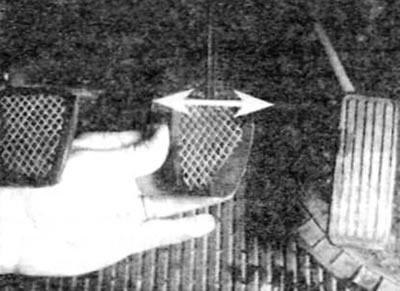


Check the brake booster (if it is installed), to do this, press the pedal several times and then…


Steering wheel and steering column


  • Inspect the steering wheel for cracks and loose hub fastenings. spokes or rim.
  • Rock the steering wheel from side to side and then up and down. Make sure it doesn't move loosely on the speaker. which would indicate wear or loosening of the tightening nut of its fastening. Continue to pump the wheel in the same way as before, but turn it slightly to the right and left.
  • Make sure the steering wheel does not wobble on the steering column or exhibit any unusual movement that would indicate wear in the column bearings or joints.
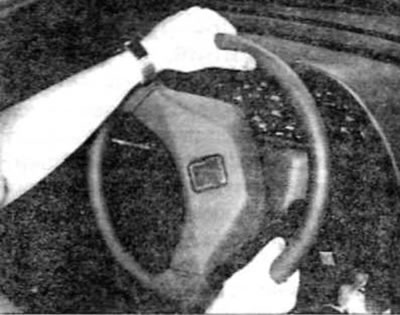
Make sure the steering wheel does not wobble on the steering column or exhibit any unusual movement…


Windshield, rearview mirrors and sun visor


  • There should be no cracks or other visible damage on the windshield within the driver's field of vision. The presence of small chips resulting from impacts with stones is allowed. Rear view mirrors must be securely fastened, not damaged and must be easily adjusted.
  • The driver's side sun visor must be securely held in the raised position.
The driver's side sun visor must be securely held in the raised position.


Seat belts and seats


Note: The checks described below apply to all seat belts, both front and rear. □ Inspect the webbing of all seat belts (including rear seat belts, if installed) for cuts, serious wear or damage. Fasten and unfasten each belt several times to test the buckles. Check the retraction device, if equipped. Check the security of all seat belt anchorages that can be accessed from inside the vehicle.

  • Seat belts whose pretensioners have already been deployed have a special indicator on the seat belt buckle cable. This in itself is not a reason for recognizing the vehicle as having failed the inspection.
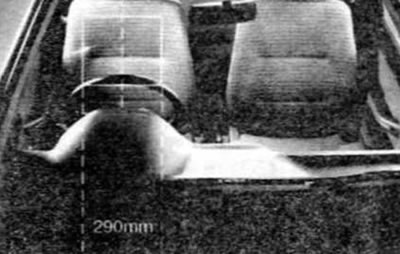
  • The front seats themselves must also be securely fastened, and the backrests must be securely locked in an upright position.
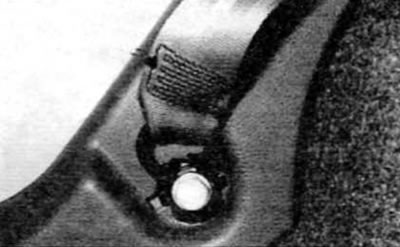
The front seats themselves must also be securely fastened, and the backrests must be securely…


Doors


  • Both front doors must open and close from the outside and inside and, when closed, must be securely locked.
This article is available at russian, bulgarian, belarusian, ukrainian, serbian, croatian, romanian, polish, slovak, hungarian
Article reviewed by editor: Nikonova Veronica
Share information:
Previous
Partner I: Introduction to the guide
Next

Checking the technical condition of the vehicle
Tools and accessories
Disconnecting the battery
General tips for carrying out repairs
Lifting and installing the car on supports
Checks performed with the vehicle on the ground
Checks performed on a raised vehicle with wheels rotating freely
Checking the composition of exhaust gases
Dictionary of technical terms
See similar information for other Peugeot models

➨ Checks carried out from the driver's seat Peugeot 106 (1991-2003)
➨ Seat belts Peugeot 207 (2006-2014)
➨ Seat belts — description and maintenance Peugeot 305 (1977-1989)
➨ Seat belts — description and adjustment Peugeot 405 (1987-1997)
Link to this article in different formats
Comments and feedback from visitors
No comments yet


Add two numbers 18 + 30


Partner I (1996-2008) 
  • General information
  • Introduction to the guide
  • Faults en route
  • Weekly checks
  • User manual
  • Maintenance (petrol)
  • Maintenance (diesel)
  • Power unit
  • Petrol engines
  • Diesel engines «XUD»
  • Diesel engines «DW»
  • Overhaul of petrol engines
  • Overhaul of diesel engines
  • Cooling and heating
  • Power and exhaust (petrol)
  • Power and exhaust (XUD diesels)
  • Power and exhaust (DW diesels)
  • Emission reduction
  • Starting and charging system
  • Transmission
  • Clutch
  • Mechanical gearbox
  • Drive shafts
  • Chassis, running gear
  • Brake system
  • Car suspension
  • Steering
  • Body and interior
  • Exterior (external elements)
  • Interior (internal elements)
  • Doors, locks and windows
  • Electrical equipment
  • Equipment and devices
  • Electrical circuits
Peugeot 807 (2002-2014) 
  • General information
  • Operating instructions
  • Maintenance
  • Troubleshooting
  • Power unit
  • Gasoline engines
  • Diesel engines
  • Cooling and heating
  • Fuel injection (petrol)
  • Fuel system (diesel)
  • Fuel system
  • Exhaust system
  • Ignition system
  • Transmission
  • Clutch
  • Manual gearbox
  • Automatic gearbox
  • Chassis, running gear
  • Brake system
  • Car suspension
  • Steering system
  • Body and interior
  • Exterior (external elements)
  • Interior (internal elements)
  • Electrical equipment
  • Power devices
  • Electrical circuits
Peugeot 806 (1994-2002) 
  • General information
  • User manual
  • Maintenance
  • Power unit
  • Petrol engines
  • Diesel engines
  • Lubrication system
  • Cooling system
  • Fuel injection (petrol)
  • Fuel system (diesel)
  • Ignition and exhaust systems
  • ECM Bosch Motronic MP 3.2
  • ECM Magneti-Marelli (MM)
  • Transmission
  • Clutch
  • Mechanical gearbox
  • Chassis, running gear
  • Brake system
  • Car suspension
  • Steering
  • Electrical equipment
  • Equipment and devices
  • Electrical circuits
Peugeot J5 (1981-1993) 
  • General information
  • Introduction to manual
  • Specifications
  • Gasoline engine
  • Engine repair
  • Lubrication system
  • Cooling system
  • Fuel system
  • Ignition system
  • Diesel engine
  • Engine repair (DB9)
  • Lubrication system (DB9)
  • Cooling system (DB9)
  • Fuel injection (DB9)
  • Engine repair (U25)
  • Lubrication system (U25)
  • Cooling system (U25)
  • Fuel injection (U25)
  • Transmission
  • Clutch
  • Gearbox
  • Drive shafts
  • Chassis, running gear
  • Steering system
  • Car suspension
  • Brake system
  • Electrical equipment
  • Power devices
  • Electrical circuits
PeugeotBook.ru © 2018–2026 | Mobile version | Sitemap: EN BG BY UA RS HR RO PL SK HU | Write message | Site search | Add to bookmarks | Peugeot owners
106 (1991-2003) | 206 (1998-2012) | 207 (2006-2014) | 305 (1977-1989) | 306 (1993-2002) | 307 (2001-2008) | 405 (1987-1997) | 406 (1995-2004) | 605 (1989-2000) | Partner-I (1996-2008) | Eurovans-807 (2002-2014) | Eurovans-806 (1994-2002) | J5 (1981-1993) |
Cookies are used to ensure the correct display of pages on the site.