
English Русский
Български
Беларускі
Український
Српски
Hrvatski
Română
Polski
Slovenský
Magyar
Bookmark Articles Sitemap Contacts
Company Hyundai Company Opel Company Skoda Company Kia Company Mitsubishi Company LADA Company Audi
PeugeotBook.ru


Series 100   Series 200   Series 300   400-500   Series 600   Crossovers   Others
 
Partner I (1996-2008) Peugeot 807 (2002-2014) Peugeot 806 (1994-2002) Peugeot J5 (1981-1993)

Tie rod ends — replacement (Peugeot Eurovans 806)

  • Main
  • Пежо
  • Peugeot 806 (1994-2002)
  • Chassis, running gear
  • Steering
  • Tie rod ends — replacement
0
The tie rod ends can be replaced without removing the steering gear. This is usually necessary when the tips are worn out. However, we recommend removing the steering gear when replacing the tie rod ends.

If the steering gear is being replaced, then both tie rod ends must be replaced, as well as the inner tie rod joints.

1. Secure the removed tie rod in a vice.

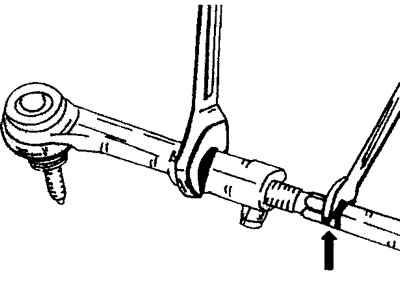
2. Place a wrench on the tie rod to prevent it from turning, and use a second wrench to loosen the tie rod end (see illustration).
11.2 Place a wrench on the tie rod to prevent it from turning, and use a second wrench to loosen…

11.2 Place a wrench on the tie rod to prevent it from turning, and use a second wrench to loosen the tie rod end


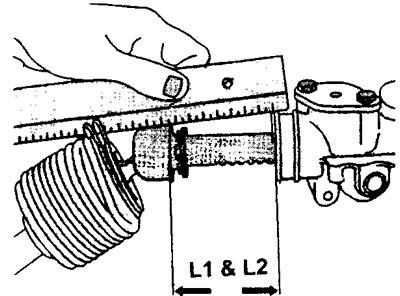
3. Unscrew the tie rod end, counting the number of turns required to completely disconnect the end. Write down these values for the left and right tips.

To disconnect the inner hinge, you need to remove the corrugated cover and then unscrew the hinge from the toothed rack. In workshops they use a special key for this. If you are doing the work yourself, you can use an adjustable gas wrench or pliers. The fit of the inner hinge is quite tight and after dismantling it must be replaced with a new one.


4. Disconnect the tie rod. Before unscrewing the inner joint of the tie rod, knock out the stopper that secures the joint (see illustration).
11.4 Before unscrewing the inner joint of the tie rod, knock out the stopper that secures the joint

11.4 Before unscrewing the inner joint of the tie rod, knock out the stopper that secures the joint


5. Attach the new tie rod with the new inner joint to the rack and tighten the joint as much as possible using an adjustable wrench or pliers.

6. Lock the inner hinge. To do this, hammer the bar on the ball joint housing into the groove on the toothed rack (see illustration 11.4). The bar must not be crushed.

7. Screw on the tie rod ends, observing the number of turns required to unscrew the corresponding end.

8. Check the wheel alignment angles and adjust the camber and toe-in if necessary.
This article is available at russian, bulgarian, belarusian, ukrainian, serbian, croatian, romanian, polish, slovak, hungarian
Article reviewed by editor: Shirokov Arseny
Share information:
Previous
Peugeot 806: Steering
Next

Neutral position of the steering gear
Steering gear — installation and repair
Steering gear — removal
Wheel alignment angles
Steering wheel — removal and installation
Power steering — draining and filling fluid, bleeding air
Link to this article in different formats
Comments and feedback from visitors
No comments yet


Add two numbers 14 + 15


Partner I (1996-2008) 
  • General information
  • Introduction to the guide
  • Faults en route
  • Weekly checks
  • User manual
  • Maintenance (petrol)
  • Maintenance (diesel)
  • Power unit
  • Petrol engines
  • Diesel engines «XUD»
  • Diesel engines «DW»
  • Overhaul of petrol engines
  • Overhaul of diesel engines
  • Cooling and heating
  • Power and exhaust (petrol)
  • Power and exhaust (XUD diesels)
  • Power and exhaust (DW diesels)
  • Emission reduction
  • Starting and charging system
  • Transmission
  • Clutch
  • Mechanical gearbox
  • Drive shafts
  • Chassis, running gear
  • Brake system
  • Car suspension
  • Steering
  • Body and interior
  • Exterior (external elements)
  • Interior (internal elements)
  • Doors, locks and windows
  • Electrical equipment
  • Equipment and devices
  • Electrical circuits
Peugeot 807 (2002-2014) 
  • General information
  • Operating instructions
  • Maintenance
  • Troubleshooting
  • Power unit
  • Gasoline engines
  • Diesel engines
  • Cooling and heating
  • Fuel injection (petrol)
  • Fuel system (diesel)
  • Fuel system
  • Exhaust system
  • Ignition system
  • Transmission
  • Clutch
  • Manual gearbox
  • Automatic gearbox
  • Chassis, running gear
  • Brake system
  • Car suspension
  • Steering system
  • Body and interior
  • Exterior (external elements)
  • Interior (internal elements)
  • Electrical equipment
  • Power devices
  • Electrical circuits
Peugeot 806 (1994-2002) 
  • General information
  • User manual
  • Maintenance
  • Power unit
  • Petrol engines
  • Diesel engines
  • Lubrication system
  • Cooling system
  • Fuel injection (petrol)
  • Fuel system (diesel)
  • Ignition and exhaust systems
  • ECM Bosch Motronic MP 3.2
  • ECM Magneti-Marelli (MM)
  • Transmission
  • Clutch
  • Mechanical gearbox
  • Chassis, running gear
  • Brake system
  • Car suspension
  • Steering
  • Electrical equipment
  • Equipment and devices
  • Electrical circuits
Peugeot J5 (1981-1993) 
  • General information
  • Introduction to manual
  • Specifications
  • Gasoline engine
  • Engine repair
  • Lubrication system
  • Cooling system
  • Fuel system
  • Ignition system
  • Diesel engine
  • Engine repair (DB9)
  • Lubrication system (DB9)
  • Cooling system (DB9)
  • Fuel injection (DB9)
  • Engine repair (U25)
  • Lubrication system (U25)
  • Cooling system (U25)
  • Fuel injection (U25)
  • Transmission
  • Clutch
  • Gearbox
  • Drive shafts
  • Chassis, running gear
  • Steering system
  • Car suspension
  • Brake system
  • Electrical equipment
  • Power devices
  • Electrical circuits
PeugeotBook.ru © 2018–2026 | Mobile version | Sitemap: EN BG BY UA RS HR RO PL SK HU | Write message | Site search | Add to bookmarks | Peugeot owners
106 (1991-2003) | 206 (1998-2012) | 207 (2006-2014) | 305 (1977-1989) | 306 (1993-2002) | 307 (2001-2008) | 405 (1987-1997) | 406 (1995-2004) | 605 (1989-2000) | Partner-I (1996-2008) | Eurovans-807 (2002-2014) | Eurovans-806 (1994-2002) | J5 (1981-1993) |
Cookies are used to ensure the correct display of pages on the site.