



Table of contents: Cars with gasoline engines 🠇 Diesel Engine Cars 🠇
The fuel filter should be changed at 60,000 kilometers (diesel engines - 30,000 km) regardless of whether it is in good working order or not. When removing the fuel filter, all safety precautions regarding work with flammable substances must be observed. When disconnecting the hoses, the pressure in the fuel system must be released.
Cars with gasoline engines
35. Remove the hose clamps from the fuel filter. The hoses are secured with clamping clamps at the factory. When replacing the fuel filter, you can install more conventional clamping clamps tightened with a screw.
36. Disconnect the fuel hoses from the filter. There are arrows on the filter housing indicating the direction of fuel flow.
37. Remove the old fuel filter and install a new one. After installing the fuel filter, start the engine and make sure the fuel hoses are tightly secured.
Caution! The fuel system is under pressure, which means that when removing the fuel pump, fuel filter, fuel injectors, fuel rail and pressure regulator, or disconnecting hoses, it is necessary to release the pressure to avoid fuel spillage.
Diesel Engine Cars
The fuel filter element is replaced according to the mileage or maintenance intervals. In addition to the appropriate replacement of the replaceable filter element, condensate must be drained from the fuel filter housing regularly.
38. Disconnect the negative (-) battery terminal.
39. Remove the air filter.
40. Place a container under the fuel filter to collect the fuel.
41. Unscrew the plug 1 of the ventilation hole near the fuel filter cover (see illustration).
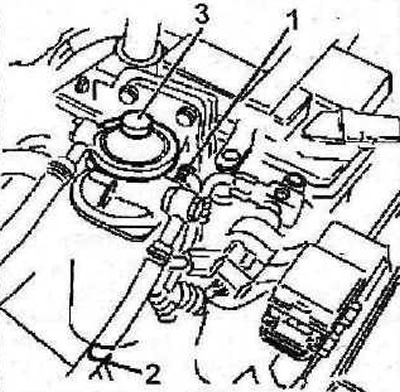
5.41 Unscrew the plug 1 of the ventilation hole near the fuel filter cover. Vehicles with a DK5ATE diesel engine
42. Unscrew plug 2 of the drain hole on the filter housing and drain the condensate into a container provided (see illustration 5.41).
43. Unscrew the fuel filter cover mounting bolts and remove the cover.
44. Remove the filter element from the filter housing together with the sealing ring.
45. Clean the fuel filter housing and install a new replaceable filter element.
46. Close the filter housing with the lid and tighten the lid mounting bolts.
47. Screw in the drain plug into the bottom of the fuel filter housing.
48. Replace the air filter and connect the negative (-) cable terminal to the battery.
49. Remove air from the fuel system.
Attention: Air must be removed from the fuel system in cases where the system has been opened.
To remove air, unscrew the condensate drain plug
50. Bleed the system by pressing the manual fuel priming lever approximately 20 times until clean fuel, without air bubbles, comes out of the filter.
51. Screw in the drain plug, start the engine and let it idle until the engine operation stabilizes.
52. Turn off the engine and then start it again. Leave the engine idling and do not press the accelerator pedal to ensure that all air has been removed from the fuel system.
Attention! If the filter replacement was performed in a workshop, then a tester can be connected to the diagnostic connector and the fault codes can be read.