



If the car is to be completely parked on jack stands, then first you should jack up the front and place it on jack stands. Place chocks (bricks) under the rear wheels or apply the parking brake.
When jacking up a vehicle from the side, the jack is installed at the point shown in Illustration 2.0.
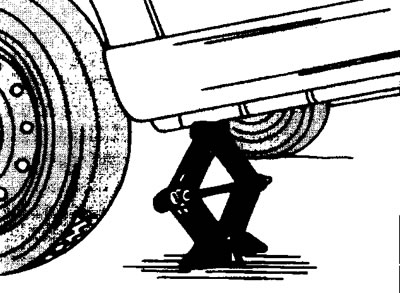
2.0 Jacking up a car from the side using a parallelogram jack
When jacking up the front of the vehicle, the jack should be positioned under the crossbar at the point shown in Illustration 2.0a.
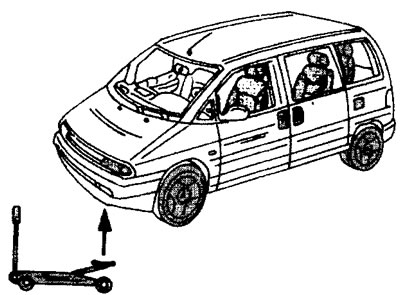
2.0a Jacking up the front of the car using a garage jack. The jack's support head should rest against the center of the front suspension cross member
Jacking up the rear of a car can be tricky because the jack can't simply be positioned under the middle of the rear suspension crossmember. Jacking up the rear part is done using an auxiliary rack (see illustration 2.0b).
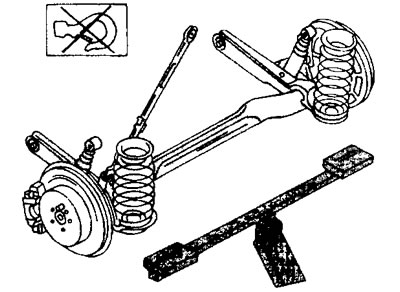
2.0b Jacking up the rear of the car. The jack is installed not under the rear suspension cross member, but under the auxiliary rail, the supports of which are inserted under the lower stops of the springs
The rack supports are inserted under the lower stops of the suspension springs, and the car is lifted using a jack installed in the middle of the auxiliary rack. Once the vehicle has been raised to a sufficient height, trestles are installed underneath it.
When lifting the front end, the support trestles are installed in the same place as the jack when jacking up the car from the side.
Caution! Never place a vehicle on jack stands by lifting it first from one side and then from the other. To fully support the vehicle, first jack it up from the front (or rear), and then from the rear (front). Place chocks under the wheels that will be on the ground while jacking.
When jacking up a car, it is important to do so on a solid surface to prevent the ground from settling under the jack.