



1. Clean the exposed ends of the bolts with a wire brush before removing their nuts to remove any accumulated dirt and rust. After cleaning the bolt, treat the threaded connection with a rust converter. If it is necessary to unscrew the bolt from the welded nut (usually on the body), then it is recommended to process the threads on the back side of the nut, if possible. Often, the bolts of such connections break when unscrewed, or the welded nut breaks off.
Bolts or screws with a screwdriver head are usually difficult to remove. The screwdriver slips out, breaking the slot. In these cases, you can use the following technique.
2. Insert the screwdriver into the hollow cylindrical rod and fix them on the screw head, and then hit the screwdriver with a hammer. Typically the bolt will loosen and can be removed fairly easily.
Difficulties also arise when unscrewing bolts with a head for a hexagonal socket wrench or with heads for a multi-sided wrench (usually 12-sided) key. Before starting work, thoroughly clean the hole for the socket wrench (for example, with a small screwdriver). You can use a suitable replacement socket insert, or you can loosen the seat of such a bolt by hitting a wrench or socket insert with a hammer. Sometimes it's best to use a socket wrench bent at an angle. In this case, to increase the applied force, you can put a ring wrench on the socket wrench.
Small socket head bolts can be removed with a clamshell pliers (grifter). The same applies to socket head bolts that have a broken internal hexagon (see illustration 3.0a).
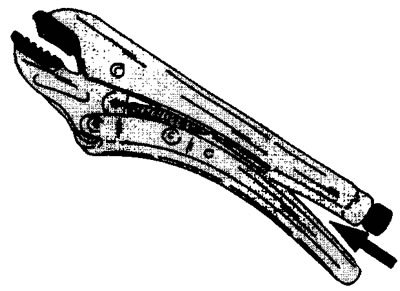
3.0a Small socket head bolts can be removed with a clamshell pliers (grifter). The same applies to socket head bolts that have a broken internal hexagon
It is often necessary to remove bolts whose heads have been damaged as a result of using a larger wrench. The same damage often occurs with nuts. You can unscrew such bolts or loosen nuts using the already mentioned pliers with a grab grip. Nuts can also be broken or cut. If there is enough space, you can use a nut puller to remove the nut with the damaged hex. The damaged nut is clamped in the puller and the puller bolt is tightened until the nut crumbles (see illustration 3.0b).
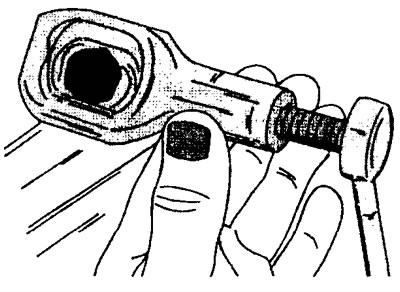
3.06. Puller for damaged nuts. The damaged nut is clamped in the puller and the puller bolt is tightened until the nut crumbles
The advantage of using a puller is that the bolt threads are not damaged.
The term "self-locking nut" is often found in the text, meaning that such a nut locks itself when installed. However, when unscrewed, it loses this property. Therefore, such nuts must be replaced with new ones.
It often happens that when unscrewing a bolt, its head twists. The remaining portion of the bolt can be removed by drilling a hole in it and inserting a left-hand threaded tapping pin into it. When tightened, it cuts into the damaged bolt and unscrews it. These self-tapping rollers are sold in auto parts stores (see illustration 3.0b).
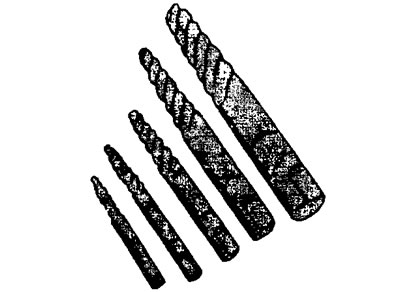
3.0v. Self-tapping rollers with left-hand thread for unscrewing bolts
A damaged bolt can be removed by drilling it with a drill of almost the same diameter (a little less). After this, the thread of the bolt hole should be renewed.
The studs can be unscrewed using two nuts locked against each other. When unscrewing the stud, the key is placed on the inner nut, and when screwing it in, on the outer nut (see illustration 3.0g).
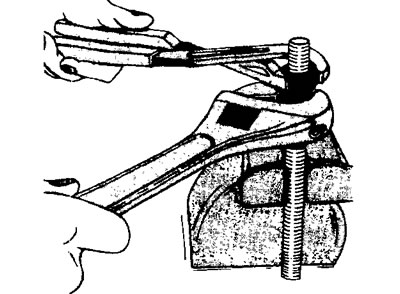
3.0g Unscrewing a stud using two nuts locked against each other
Thread cutting
Threads on light metal wear out quite quickly. If the thread is only slightly worn, it can be renewed by slightly widening the hole. Otherwise, a threaded sleeve is installed and the threads are then cut. This work should be entrusted to a workshop. To cut threads, appropriate taps are used; the cutting process itself consists of three passes: preliminary cutting, fitting, and final cutting. When performing this stage, use the appropriate taps. For preliminary cutting of threads, a tap with one ring on the rod is used, for fitting - a tap with two rings, and for final cutting - a tap without rings or with three rings on the rod.
Each tap is used exclusively for its own operation with a constant supply of oil. The hole is cut gradually. In this case, the tap is moved forward, and after a while it is unscrewed back a little. This is necessary to prevent the tap from breaking due to it becoming jammed by metal shavings.
Tightening torques
This manual contains the tightening torques specified by the manufacturer. It's possible that a tightening torque of, for example, 47 Nm could be rounded up and implemented as 50 Nm. However, we recommend following the vehicle manufacturer's instructions. To maintain the required tightening torques, a torque wrench and interchangeable socket heads are required. In some cases, access to a nut or bolt is so difficult that using a torque wrench is not possible. In such and similar cases, experience is needed to allow you to tighten at the right moment intuitively.
For the most common threaded connections (bolts and nuts) generally accepted tightening torques apply:
| Thread diameter (mm) | Tightening torque (Nm) |
| 6 | 10 |
| 8 | 25 |
| 10 | 49 |
| 12 | 85 |
| 14 | 135 |
Application of lubricants and sealants
Each manufacturer recommends using lubricants from specific companies, which were selected during the creation of the vehicle. For this reason, the text contains names of lubricants recommended by the manufacturer.
Loctite is often mentioned. This liquid adhesive is applied to the threads of nuts and bolts and is designed to protect them and prevent them from loosening. There are similar products from other manufacturers that can be used after prior consultation upon purchase.
If the text contains an indication of the need to apply a sealing compound (sealant), it is recommended to consult with the workshop about what composition is needed and for what parts. The main purpose of the sealing compound is to seal the engine. However, in one case, its use is necessary to prevent oil leaks, and in another - to seal the cooling system.