



Table of contents: Coolant temperature gauge (1) 🠇 High coolant temperature indicator…🠇 Self-diagnosis indicator light (3) 🠇 Fuel reserve indicator light (4) 🠇 Fuel gauge (5) 🠇 Engine oil level indicator (6) 🠇 STOP light (7) 🠇 Oil pressure warning light (8) 🠇 Handbrake and very low brake fluid…🠇 Fuel filter water presence indicator…🠇 Battery charging indicator light (11) 🠇 Front brake pad wear indicator light…🠇 Coolant level indicator light (13) 🠇 ABS Anti-Lock Wheel System Indicator…🠇
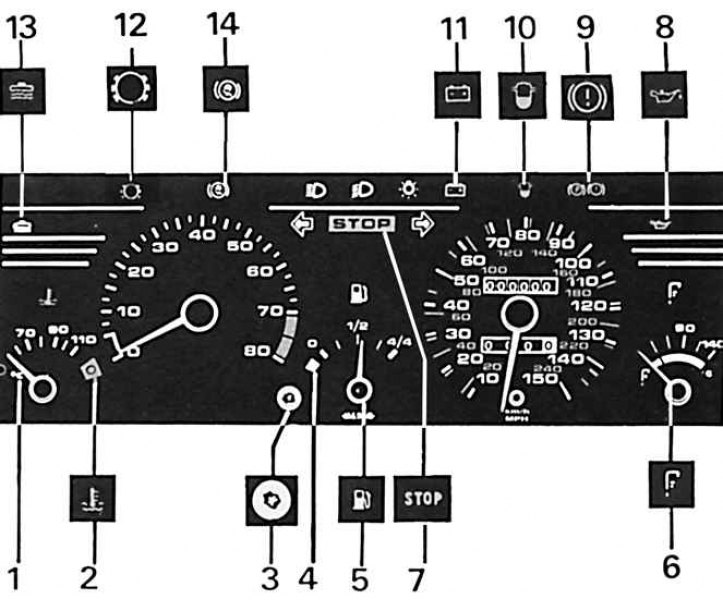
Coolant temperature gauge (1)
The average coolant temperature during driving is between 80° and 90°C. During city driving, in traffic jams, the coolant temperature often exceeds 90°C, which causes the cooling fan to turn on. If the temperature exceeds 110°C, a special control lamp turns on.
High coolant temperature indicator light (2)
If this light comes on while driving at the same time as the STOP light, you should stop immediately and check the coolant level after the engine has cooled down. If the indicator light comes on again, you should check the coolant pump, cooling fan, and the tightness of the cooling system.
Self-diagnosis indicator light (3)
Flashing of the indicator light indicates a malfunction with the fuel injection system or ignition system. In this case, you should immediately contact a service station to fix the malfunction.
Fuel reserve indicator light (4)
This light comes on if there is less than 6 dm³ of fuel left in the fuel tank.
Fuel gauge (5)
The gauge scale is divided into 4 parts of the fuel tank volume. Its volume is 70 dm³.
Engine oil level indicator (6)
The engine should not be running for several minutes, the car should be on a flat surface, and the ignition should be on. The oil level is normal if the arrow is in the middle on the right line. If the arrow is on the left line, then oil must be added to the system.
When the engine is running, the needle is at rest.
STOP light (7)
This light comes on simultaneously with the control lights:
- engine oil pressure;
- high coolant temperature;
- anti-lock braking system (ABS) and brake fluid level.
When this light comes on, it signals the need to stop the vehicle immediately.
Oil pressure warning light (8)
The oil pressure indicator light on the instrument panel starts to glow when the ignition is turned on and should go out after the engine starts. If this light comes on while driving at the same time as the STOP light, you should stop immediately and check the oil level. If the level is normal, but the light still glows, you should contact a repair shop.
Handbrake and very low brake fluid level indicator light (9)
When this light comes on, it indicates:
- with the handbrake applied;
- the brake fluid level in the reservoir is too low. In this case, you should check the brake fluid level, top it up and contact a service station to determine the cause of the decrease in brake fluid.
Fuel filter water presence indicator light (10)
If this light comes on, you need to remove water from the fuel filter as quickly as possible.
Battery charging indicator light (11)
This light comes on when the ignition is turned on and should go out after the engine starts. If the battery charge indicator light comes on while driving, it indicates a fault in the charging system. You should immediately turn off the engine and check the tension of the alternator drive belt and the fastening of the battery clamps. If everything is normal, but the light remains on, seek assistance from your nearest service station.
Front brake pad wear indicator light (12)
You can find the original on the resource Peugeotbook.ru
If this light comes on, you need to replace the brake pads as soon as possible.
Coolant level indicator light (13)
If this light comes on, you should top up the coolant. If you frequently need to top up the coolant, you should check the tightness of the cooling system.
ABS Anti-Lock Wheel System Indicator Light (14)
The operation of this system is controlled by three indicator lights:
- STOP (7);
- brake fluid level (9);
- ABS systems (14).
There are three possible cases:
a. All three lights come on at the same time, indicating that the ABS system is not functioning (there is no braking assistance, the brake pedal has a long stroke and requires increased force to press it)in this case, you must immediately seek help from the nearest service station (you need to drive very slowly).
b. If lamp 10 does not light or flashes a minute after starting the engine, this indicates a malfunction in the ABS system. The causes of the malfunction should be immediately eliminated at a service station.
with. Light 10 does not go out or lights up. You should turn the ignition off and on again. If this light continues to light, you should proceed as in case b.