English Русский
Български
Беларускі
Український
Српски
Hrvatski
Română
Polski
Slovenský
Magyar
Bookmark Articles Sitemap Contacts
Company Hyundai Company Opel Company Skoda Company Kia Company Mitsubishi Company LADA Company Audi
PeugeotBook.ru


Series 100   Series 200   Series 300   400-500   Series 600   Crossovers   Others
 
Peugeot 405 (1987-1997) Peugeot 406 (1995-2004)

Radiator — removal, inspection and installation (Peugeot 405)

  • Main
  • 40X
  • Peugeot 405 (1987-1997)
  • Power unit
  • Cooling and lubrication system
  • Radiator — removal, inspection and installation
0
Table of contents: Removal 🠇 Examination 🠇 Installation 🠇

Removal


1. Disconnect the negative cable from the battery.

2. If present, disconnect the connector from the coolant level sensor located on the right side of the radiator.

3. If present, disconnect the connector from the radiator fan switch located on the left side of the radiator.

4. Drain the coolant from the cooling system.
4. Drain the coolant from the cooling system.

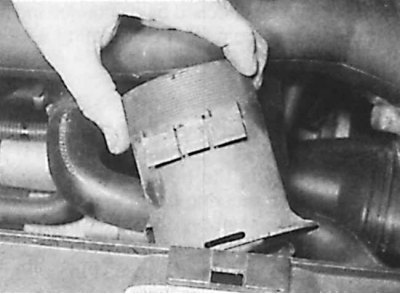
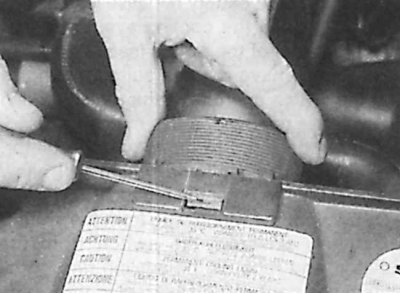
5. Disconnect the mounting clamp (drawing on the left) air supply pipe and remove the air supply pipe located above the radiator (drawing on the right).

6. If available, disconnect the connector and vacuum hose from the MAP sensor located at the top of the radiator, then unscrew the two bolts securing the sensor mounting bracket and remove the sensor.


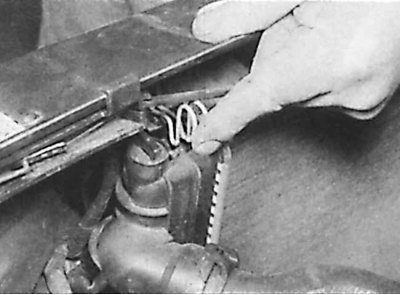
7. Disconnect the upper radiator hose from the left front end of the radiator.
7. Disconnect the upper radiator hose from the left front end of the radiator.


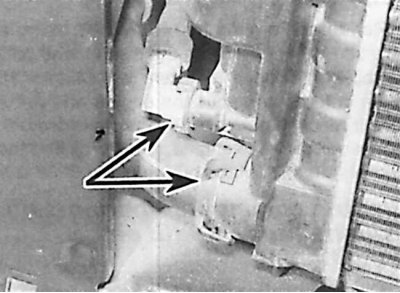
8. Disconnect the lower radiator hose from the right side of the radiator. On some models, to access the lower radiator hoses (indicated by arrows) it is necessary to remove the radiator grille.
8. Disconnect the lower radiator hose from the right side of the radiator. On some models, to…


9. Remove the two brackets securing the top of the radiator and tilt the radiator back.
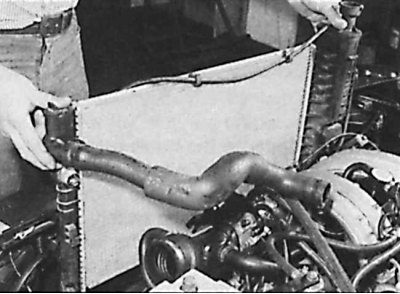
9. Remove the two brackets securing the top of the radiator and tilt the radiator back.


10. Carefully remove the radiator so as not to damage the radiator fins. Be careful not to lose the lower rubber support of the radiator.


Examination


1. If the radiator was removed due to a decrease in throughput, flush it with a stream of water in both directions. Blow the radiator out with compressed air from the outside.

2. If the radiator is leaking, do not try to weld or solder the leak, as this will damage the plastic parts of the radiator.

3. Minor radiator leaks can be repaired using radiator sealant.

4. Check the condition of the lower rubber radiator mounts and replace them if necessary.

Installation


Installation is carried out in the reverse order of removal, taking into account the following points:
  • check that the lower tabs on the radiator are correctly installed in the front cross member;
  • when connecting hoses to the radiator, use new O-rings in the connectors;
  • finally, fill the cooling system.
This article is available at russian, bulgarian, belarusian, ukrainian, serbian, croatian, romanian, polish, slovak, hungarian
Article reviewed by editor: Shirokov Arseny
Share information:
Previous
Peugeot 405: Cooling and lubrication system
Next

Cooling system hoses
Cooling system — design description
Checking oil pressure
Oil radiator — removal and installation
Oil pump — removal, inspection and installation
Thermostat — Removal, Checking and Installation
Radiator cooling fan — removal, inspection and installation
Coolant pump — removal and installation
Draining the coolant
Filling the coolant and bleeding the system
See similar information for other Peugeot models

➨ Radiator — removal, inspection and refitting Peugeot 106 (1991-2003)
➨ Removal and installation lower radiator hoses with quick-release… Peugeot 207 (2006-2014)
➨ Radiator — removal and installation Peugeot 305 (1977-1989)
➨ Radiator — removal and installation Peugeot 605 (1989-2000)
➨ Oil radiator Peugeot 806 (1994-2002)
Link to this article in different formats
Comments and feedback from visitors
No comments yet


Add two numbers 23 + 25


Peugeot 406 (1995-2004) 
  • General information
  • User manual
  • Maintenance (gasoline)
  • Maintenance (diesel)
  • Power unit
  • Gasoline engines
  • Diesel engines
  • Engine overhaul
  • Cooling and heating
  • Fuel system (gasoline)
  • Fuel system (diesel)
  • Engine electrical equipment
  • Transmission
  • Clutch and drive shafts
  • Mechanical gearbox
  • Automatic gearbox
  • Chassis, running gear
  • Brake system
  • Car suspension
  • Steering
  • Body and interior
  • Exterior (external elements)
  • Interior (internal elements)
  • Doors, locks and windows
  • Electrical equipment
  • Equipment and devices
  • Electrical circuits
Peugeot 405 (1987-1997) 
  • General information
  • User manual
  • Maintenance
  • Power unit
  • Petrol engines 1.4 l
  • Petrol engines 1.6-2.0 l
  • Diesel engines
  • Ignition system
  • Fuel system (carburetor)
  • Single point fuel injection
  • Multipoint fuel injection
  • Cooling and lubrication system
  • Exhaust system
  • Transmission
  • Clutch
  • Manual gearbox MA
  • Manual gearbox BE
  • Automatic gearbox
  • Drive shafts
  • Chassis, running gear
  • Steering
  • Front suspension
  • Rear suspension
  • Brake system
  • Body and interior
  • Exterior (external elements)
  • Interior (internal elements)
  • Doors, locks and windows
  • Electrical equipment
  • Equipment and devices
  • Electrical circuits
PeugeotBook.ru © 2018–2026 | Mobile version | Sitemap: EN BG BY UA RS HR RO PL SK HU | Write message | Site search | Add to bookmarks | Peugeot owners
106 (1991-2003) | 206 (1998-2012) | 207 (2006-2014) | 305 (1977-1989) | 306 (1993-2002) | 307 (2001-2008) | 405 (1987-1997) | 406 (1995-2004) | 605 (1989-2000) | Partner-I (1996-2008) | Eurovans-807 (2002-2014) | Eurovans-806 (1994-2002) | J5 (1981-1993) |
Cookies are used to ensure the correct display of pages on the site.