
English Русский
Български
Беларускі
Український
Српски
Hrvatski
Română
Polski
Slovenský
Magyar
Bookmark Articles Sitemap Contacts
Company Hyundai Company Opel Company Skoda Company Kia Company Mitsubishi Company LADA Company Audi
PeugeotBook.ru


Series 100   Series 200   Series 300   400-500   Series 600   Crossovers   Others
 
Peugeot 405 (1987-1997) Peugeot 406 (1995-2004)

Cooling system — design description (Peugeot 405)

  • Main
  • 40X
  • Peugeot 405 (1987-1997)
  • Power unit
  • Cooling and lubrication system
  • Cooling system — design description
0

Cooling system


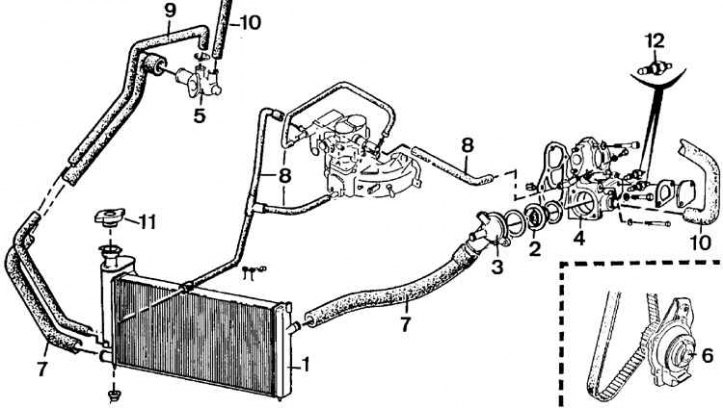
1 – radiator; 2 – thermostat; 3 – thermostat housing; 4 – pipeline connection body; 5 – separating…

1 – radiator; 2 – thermostat; 3 – thermostat housing; 4 – pipeline connection body; 5 – separating element; 6 – coolant pump; 7 – cooling system pipelines; 8 – intake manifold heating pipes; 9; 10 – heating pipelines; 11 – Coolant filler plug; 12 – temperature sensor


The cooling system is a closed-loop, pressurized system that includes a water pump driven by a toothed belt, an aluminum radiator with a composite expansion tank, an electric cooling fan, a thermostat, a heating system, hoses and switches.

The system works as follows: Cold coolant from the base of the radiator passes through a hose to the pump and is pumped through the main channels of the cylinder block and oil coolers (if any). After cooling the engine cylinders, combustion chambers and valve seats, the coolant reaches the back of the thermostat, which is initially closed. The coolant also passes through the heating system and returns through the cylinder block to the pump.

When the engine is cold, the coolant circulates only through the engine block, cylinder head, and heating system. When the coolant reaches a predetermined temperature, the thermostat opens and coolant flows through the upper hose to the radiator. As the coolant circulates through the radiator, it is cooled by the air flow when the car is moving or by the radiator fan when the car is parked with the engine running. Once it reaches the base of the radiator, the coolant is cooled and the cycle repeats.


The electric cooling fan is controlled by a thermal switch. At a certain coolant temperature, the thermal sensor switches on the fan.

Caution! When opening the expansion tank cap on a hot engine, be careful as hot fumes may escape and cause severe burns.


Caution! Avoid contact of coolant with clothing and body paintwork, otherwise rinse the surface with plenty of water.
This article is available at russian, bulgarian, belarusian, ukrainian, serbian, croatian, romanian, polish, slovak, hungarian
Article reviewed by editor: Shirokov Arseny
Share information:
Previous
Peugeot 405: Cooling and lubrication system
Next

Checking oil pressure
Oil radiator — removal and installation
Oil pump — removal, inspection and installation
Oil pan — removal and installation
Removal and installation the coolant pump (diesel)
Cooling system hoses
Radiator — removal, inspection and installation
Thermostat — Removal, Checking and Installation
Radiator cooling fan — removal, inspection and installation
Coolant pump — removal and installation
See similar information for other Peugeot models

➨ Cooling system electrical switches — testing, removal and… Peugeot 106 (1991-2003)
➨ Cooling system test data (all engines) Peugeot 207 (2006-2014)
➨ Cooling system — design description Peugeot 307 (2001-2008)
➨ Cooling system — bleeding Peugeot 605 (1989-2000)
➨ Checking the cooling system Peugeot 806 (1994-2002)
Link to this article in different formats
Comments and feedback from visitors
No comments yet


Add two numbers 18 + 15


Peugeot 406 (1995-2004) 
  • General information
  • User manual
  • Maintenance (gasoline)
  • Maintenance (diesel)
  • Power unit
  • Gasoline engines
  • Diesel engines
  • Engine overhaul
  • Cooling and heating
  • Fuel system (gasoline)
  • Fuel system (diesel)
  • Engine electrical equipment
  • Transmission
  • Clutch and drive shafts
  • Mechanical gearbox
  • Automatic gearbox
  • Chassis, running gear
  • Brake system
  • Car suspension
  • Steering
  • Body and interior
  • Exterior (external elements)
  • Interior (internal elements)
  • Doors, locks and windows
  • Electrical equipment
  • Equipment and devices
  • Electrical circuits
Peugeot 405 (1987-1997) 
  • General information
  • User manual
  • Maintenance
  • Power unit
  • Petrol engines 1.4 l
  • Petrol engines 1.6-2.0 l
  • Diesel engines
  • Ignition system
  • Fuel system (carburetor)
  • Single point fuel injection
  • Multipoint fuel injection
  • Cooling and lubrication system
  • Exhaust system
  • Transmission
  • Clutch
  • Manual gearbox MA
  • Manual gearbox BE
  • Automatic gearbox
  • Drive shafts
  • Chassis, running gear
  • Steering
  • Front suspension
  • Rear suspension
  • Brake system
  • Body and interior
  • Exterior (external elements)
  • Interior (internal elements)
  • Doors, locks and windows
  • Electrical equipment
  • Equipment and devices
  • Electrical circuits
PeugeotBook.ru © 2018–2026 | Mobile version | Sitemap: EN BG BY UA RS HR RO PL SK HU | Write message | Site search | Add to bookmarks | Peugeot owners
106 (1991-2003) | 206 (1998-2012) | 207 (2006-2014) | 305 (1977-1989) | 306 (1993-2002) | 307 (2001-2008) | 405 (1987-1997) | 406 (1995-2004) | 605 (1989-2000) | Partner-I (1996-2008) | Eurovans-807 (2002-2014) | Eurovans-806 (1994-2002) | J5 (1981-1993) |
Cookies are used to ensure the correct display of pages on the site.