
English Русский
Български
Беларускі
Український
Српски
Hrvatski
Română
Polski
Slovenský
Magyar
Bookmark Articles Sitemap Contacts
Company Hyundai Company Opel Company Skoda Company Kia Company Mitsubishi Company LADA Company Audi
PeugeotBook.ru


Series 100   Series 200   Series 300   400-500   Series 600   Crossovers   Others
 
Peugeot 605 (1989-2000)

Lower wishbone rear suspension — removal (Peugeot 605)

  • Main
  • 60X
  • Peugeot 605 (1989-2000)
  • Chassis, running gear
  • Car suspension
  • Lower wishbone rear suspension — removal
0
1. Jack up the rear of the car, place it on stands and remove the rear wheels.

2. Compress the suspension spring using tool 0915-0 (see illustrations 6.4).

3. Disconnect the anti-roll bar rod 5 from both its struts 6 (see illustration).
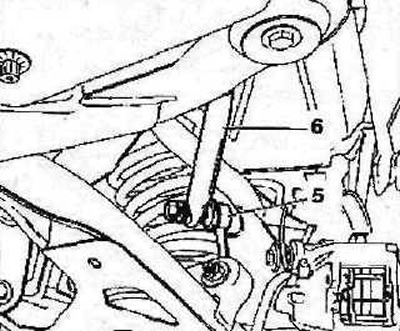
8.3 Disconnect the anti-roll bar rod 5 from both its struts 6

8.3 Disconnect the anti-roll bar rod 5 from both its struts 6


4. Unscrew the bolts 7 on both sides of the car and carefully lower the front part of the suspension arms (see illustration).
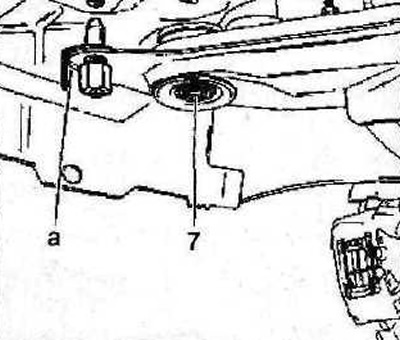
8.4 Unscrew the bolts 7 on both sides of the car and carefully lower the front part of the…

8.4 Unscrew the bolts 7 on both sides of the car and carefully lower the front part of the suspension arms


5. Drill out bolt 8 using drill 10 or cut it out using metal saw 9 (see illustration).
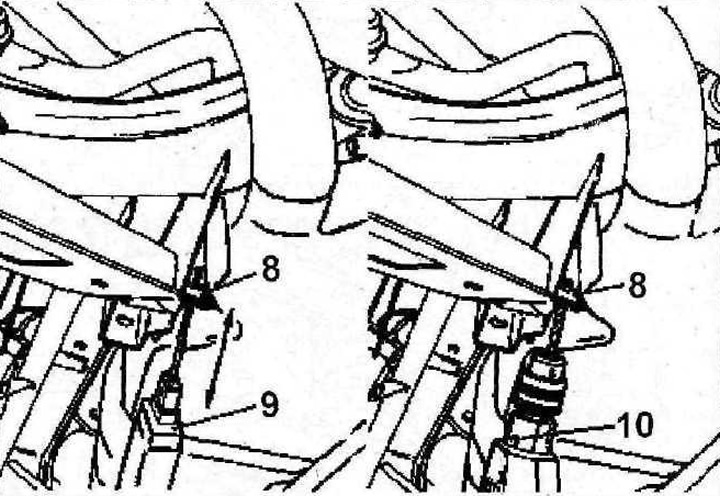
8.5 Drill out bolt 8 using a drill or cut it out with a metal saw 9

8.5 Drill out bolt 8 using a drill or cut it out with a metal saw 9


6. Disconnect brake hoses A and B from the brake pipes (see illustration). Plug the hose openings with suitable plugs.
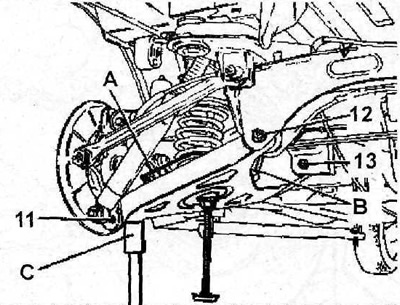


8.6 Disconnect brake hoses A and B from the brake pipes

8.6 Disconnect brake hoses A and B from the brake pipes


7. Jack up the transverse arm at point C (see illustration 8.6). to relieve the load on its mounting bolts.

8. Unscrew bolts 11, 12, 13 and remove the lower wishbone and rear suspension spring (see illustration 8.6).
This article is available at russian, bulgarian, belarusian, ukrainian, serbian, croatian, romanian, polish, slovak, hungarian
Article reviewed by editor: Nikonova Veronica
Share information:
Previous
Peugeot 605: Car suspension
Next

Upper Rear Suspension Arm — Removal and Installation
Rear wheel suspension — removal and installation
Front suspension anti-roll bar — removal and installation
Front Suspension Wishbone — Removal and Installation
Steering knuckle — removal and installation
Rear Lower Wishbone Installation
Rear shock absorber — removal and installation
Rear wheel hub — removal and installation
Drive shafts — removal
Drive shafts — installation
See similar information for other Peugeot models

➨ Rear suspension assembly — general Peugeot 106 (1991-2003)
➨ General characteristics and tightening torques of the rear… Peugeot 207 (2006-2014)
➨ Rear suspension strut — bulkhead Peugeot 305 (1977-1989)
➨ Lower arm rear suspension — removal and installation Peugeot 406 (1995-2004)
➨ Rear suspension — removal and installation Peugeot 806 (1994-2002)
Link to this article in different formats
Comments and feedback from visitors
No comments yet


Add two numbers 23 + 22


Peugeot 605 (1989-2000) 
  • General information
  • User manual
  • Maintenance
  • Troubleshooting
  • Power unit
  • Petrol engines «XU»
  • Petrol engines «ZPJ»
  • Petrol engines «ES9J4»
  • Diesel engines
  • Cooling and heating
  • Fuel system
  • Exhaust system
  • Transmission
  • Clutch
  • Mechanical gearbox
  • Automatic gearbox
  • Chassis, running gear
  • Brake system
  • Car suspension
  • Steering
  • Body and interior
  • Body elements
  • Electrical equipment
  • Power devices
  • Electrical circuits
PeugeotBook.ru © 2018–2026 | Mobile version | Sitemap: EN BG BY UA RS HR RO PL SK HU | Write message | Site search | Add to bookmarks | Peugeot owners
106 (1991-2003) | 206 (1998-2012) | 207 (2006-2014) | 305 (1977-1989) | 306 (1993-2002) | 307 (2001-2008) | 405 (1987-1997) | 406 (1995-2004) | 605 (1989-2000) | Partner-I (1996-2008) | Eurovans-807 (2002-2014) | Eurovans-806 (1994-2002) | J5 (1981-1993) |
Cookies are used to ensure the correct display of pages on the site.