
English Русский
Български
Беларускі
Український
Српски
Hrvatski
Română
Polski
Slovenský
Magyar
Bookmark Articles Sitemap Contacts
Company Hyundai Company Opel Company Skoda Company Kia Company Mitsubishi Company LADA Company Audi
PeugeotBook.ru


Series 100   Series 200   Series 300   400-500   Series 600   Crossovers   Others
 
Partner I (1996-2008) Peugeot 807 (2002-2014) Peugeot 806 (1994-2002) Peugeot J5 (1981-1993)

Tire condition and pressure (Peugeot Partner I)

  • Main
  • Пежо
  • Partner I (1996-2008)
  • General information
  • Weekly checks
  • Tire condition and pressure
0
Table of contents: Tread depth: visual inspection 🠇 Tread depth: manual inspection 🠇 Checking tire pressure 🠇
It is very important to keep your tires in good condition and properly inflated - a tire blowout at any speed is very dangerous. Tire wear depends on driving style: sharp braking and acceleration, cornering at speed - all this leads to rapid tire wear. As a rule, the front tires wear out faster than the rear ones. Swapping tires from front to rear and vice versa can result in more even wear. But keep in mind that at some point you will have to replace all your tires with new ones!

When inspecting your tires, remove any nails or stones that are lodged in the tread before they penetrate the tire and cause a puncture. If, when removing a nail, it turns out that it has already punctured the tire, leave it alone and mark the puncture site. Replace the wheel with a spare one and have the punctured tire repaired at a specialized workshop.

Inspect your tires regularly for cracks and bulges, especially on the sidewalls. Periodically remove the wheels and clean them from dirt on both sides. Inspect the wheel rims for rust or other damage. Alloy wheels are often damaged when parking due to impacts with curbs; steel wheels can bend too. If there is serious damage, the wheel will have to be replaced. When installing new tires, they must be balanced. Balancing must be repeated as the tires wear out, and also in the event of loss of balancing weights. Unbalanced wheels wear out quickly and contribute to wear of suspension and steering components. Wheel unbalance manifests itself as vibration at certain speeds, usually around 80 km/h. If the vibration is only felt on the steering wheel, it means that only the front wheels need balancing. If the entire car vibrates, it means that the rear wheels are also unbalanced. Wheel balancing is performed by many stations and workshops.


Tread depth: visual inspection
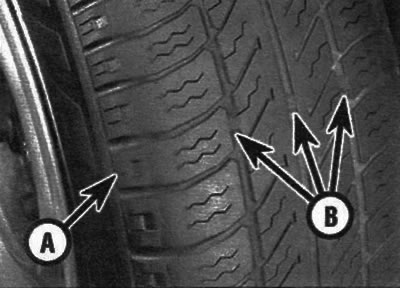


Branded tires feature indicator stripes (B) that become visible when the tread depth decreases to…

Branded tires feature indicator stripes (B) that become visible when the tread depth decreases to approximately 1.6 mm. The position of the indicator stripes is indicated by triangular marks on the tire sidewall (A).


Tread depth: manual inspection
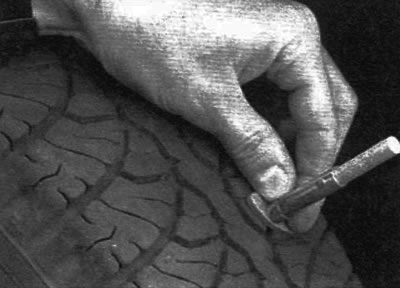


Alternatively, the tread depth can be measured with a simple and inexpensive device known as a…

Alternatively, the tread depth can be measured with a simple and inexpensive device known as a tread depth indicator.


Checking tire pressure
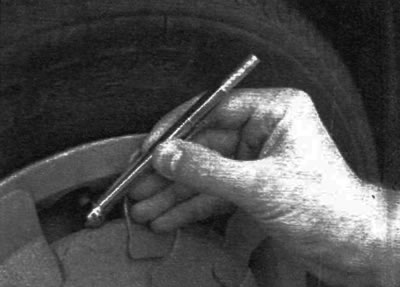


Check your tire pressure regularly.

Check your tire pressure regularly. When checking, the tires must be cold. Do not check the pressure immediately after a long ride, otherwise you will get an incorrect result.
This article is available at russian, bulgarian, belarusian, ukrainian, serbian, croatian, romanian, polish, slovak, hungarian
Article reviewed by editor: Nikonova Veronica
Share information:
Previous
Partner I: Weekly checks
Next

Electrical systems
Car battery
Windshield wipers
Brake fluid level in the brake hydraulic reservoir
Power steering fluid level in the reservoir
Types of tire wear
Lubricants and operating fluids
Choosing motor oil for your car
Tire pressure
See similar information for other Peugeot models

➨ Tyre condition and pressure Peugeot 106 (1991-2003)
➨ Checking tire pressure Peugeot 207 (2006-2014)
➨ Pressure testing of the cooling system Peugeot 305 (1977-1989)
➨ Tire pressure Peugeot 405 (1987-1997)
➨ Checking tire pressure and tread depth Peugeot 605 (1989-2000)
Link to this article in different formats
Comments and feedback from visitors
No comments yet


Add two numbers 44 + 43


Partner I (1996-2008) 
  • General information
  • Introduction to the guide
  • Faults en route
  • Weekly checks
  • User manual
  • Maintenance (petrol)
  • Maintenance (diesel)
  • Power unit
  • Petrol engines
  • Diesel engines «XUD»
  • Diesel engines «DW»
  • Overhaul of petrol engines
  • Overhaul of diesel engines
  • Cooling and heating
  • Power and exhaust (petrol)
  • Power and exhaust (XUD diesels)
  • Power and exhaust (DW diesels)
  • Emission reduction
  • Starting and charging system
  • Transmission
  • Clutch
  • Mechanical gearbox
  • Drive shafts
  • Chassis, running gear
  • Brake system
  • Car suspension
  • Steering
  • Body and interior
  • Exterior (external elements)
  • Interior (internal elements)
  • Doors, locks and windows
  • Electrical equipment
  • Equipment and devices
  • Electrical circuits
Peugeot 807 (2002-2014) 
  • General information
  • Operating instructions
  • Maintenance
  • Troubleshooting
  • Power unit
  • Gasoline engines
  • Diesel engines
  • Cooling and heating
  • Fuel injection (petrol)
  • Fuel system (diesel)
  • Fuel system
  • Exhaust system
  • Ignition system
  • Transmission
  • Clutch
  • Manual gearbox
  • Automatic gearbox
  • Chassis, running gear
  • Brake system
  • Car suspension
  • Steering system
  • Body and interior
  • Exterior (external elements)
  • Interior (internal elements)
  • Electrical equipment
  • Power devices
  • Electrical circuits
Peugeot 806 (1994-2002) 
  • General information
  • User manual
  • Maintenance
  • Power unit
  • Petrol engines
  • Diesel engines
  • Lubrication system
  • Cooling system
  • Fuel injection (petrol)
  • Fuel system (diesel)
  • Ignition and exhaust systems
  • ECM Bosch Motronic MP 3.2
  • ECM Magneti-Marelli (MM)
  • Transmission
  • Clutch
  • Mechanical gearbox
  • Chassis, running gear
  • Brake system
  • Car suspension
  • Steering
  • Electrical equipment
  • Equipment and devices
  • Electrical circuits
Peugeot J5 (1981-1993) 
  • General information
  • Introduction to manual
  • Specifications
  • Gasoline engine
  • Engine repair
  • Lubrication system
  • Cooling system
  • Fuel system
  • Ignition system
  • Diesel engine
  • Engine repair (DB9)
  • Lubrication system (DB9)
  • Cooling system (DB9)
  • Fuel injection (DB9)
  • Engine repair (U25)
  • Lubrication system (U25)
  • Cooling system (U25)
  • Fuel injection (U25)
  • Transmission
  • Clutch
  • Gearbox
  • Drive shafts
  • Chassis, running gear
  • Steering system
  • Car suspension
  • Brake system
  • Electrical equipment
  • Power devices
  • Electrical circuits
PeugeotBook.ru © 2018–2026 | Mobile version | Sitemap: EN BG BY UA RS HR RO PL SK HU | Write message | Site search | Add to bookmarks | Peugeot owners
106 (1991-2003) | 206 (1998-2012) | 207 (2006-2014) | 305 (1977-1989) | 306 (1993-2002) | 307 (2001-2008) | 405 (1987-1997) | 406 (1995-2004) | 605 (1989-2000) | Partner-I (1996-2008) | Eurovans-807 (2002-2014) | Eurovans-806 (1994-2002) | J5 (1981-1993) |
Cookies are used to ensure the correct display of pages on the site.