
English Русский
Български
Беларускі
Український
Српски
Hrvatski
Română
Polski
Slovenský
Magyar
Bookmark Articles Sitemap Contacts
Company Hyundai Company Opel Company Skoda Company Kia Company Mitsubishi Company LADA Company Audi
PeugeotBook.ru


Series 100   Series 200   Series 300   400-500   Series 600   Crossovers   Others
 
Peugeot 405 (1987-1997) Peugeot 406 (1995-2004)

Accelerator cable — removal, installation and adjustment (Peugeot 406)

  • Main
  • 40X
  • Peugeot 406 (1995-2004)
  • Power unit
  • Fuel system (gasoline)
  • Accelerator cable — removal, installation and adjustment
0
Table of contents: Removal 🠇 Installation 🠇 Adjustment 🠇

Removal


1. In the engine compartment, remove the accelerator cable from the cam on the throttle body, then…


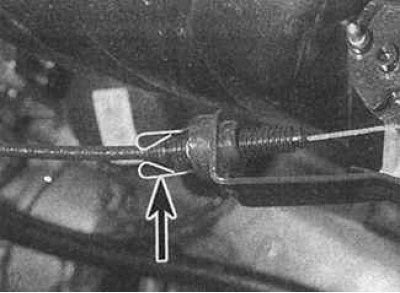
1. In the engine compartment, remove the accelerator cable from the cam on the throttle body, then remove the accelerator cable housing from the sealing rubber ring (the arrow indicates the clamp of the outer casing of the accelerator cable).

2. Release the accelerator cable along its entire length from the mounting brackets.

3. In the vehicle interior, open the immobilizer cover and turn the fuse box cover lock 90°.

4. Disconnect the electrical connector from the connector, unscrew the mounting screws and remove the lower panel from the driver's side.

5. Remove the retaining bracket and disconnect the accelerator cable from the top of the accelerator pedal.

6. Remove the accelerator cable housing from the clip on the pedal mounting bracket, then tie a long thin cord to the accelerator cable.

7. In the engine compartment, remove the ring that seals the accelerator cable from the bulkhead and remove the accelerator cable.

8. Untie the cord from the accelerator cable and leave it in the engine compartment. You will need the cord to tighten the new accelerator cable into place later.


Installation


1. Attach the cord to the new accelerator cable. Pull the cable inside the car and pull the accelerator cable through the bulkhead.

2. Untie the cord from the accelerator cable, install the cable housing into the pedal hanger retainer, and connect the accelerator cable to the pedal.

3. Check that the accelerator cable is securely attached to the pedal, then install the lower part of the panel.

4. In the engine compartment, check that the accelerator cable housing is correctly positioned in the sealing ring in the bulkhead, then position the entire length of the cable in the mounting brackets.

5. Slide the flat washer onto the cable housing and install it into the bracket and connect the accelerator cable to the throttle cam.

Adjustment


1. Remove the accelerator cable housing fastening clamp. Check that the throttle cam is in its original position and move the cable housing to take up the slack in the accelerator cable.

2. With the cable in the installed position, install the fastening clamp on the outer groove of the cable sheath in front of the rubber sealing ring and washer.

3. Once the clamp and cable are in place, there should be only a slight slack in the accelerator cable. While an assistant gently presses the accelerator pedal, check that the throttle cam rotates fully and returns to its original position.
This article is available at russian, bulgarian, belarusian, ukrainian, serbian, croatian, romanian, polish, slovak, hungarian
Article reviewed by editor: Vinogradov Robert
Share information:
Previous
Peugeot 406: Fuel system (gasoline)
Next

Air Filter and Intake Ports — Removal and Installation
Fuel system specifications
Fuel system of gasoline engines
Accelerator pedal — removal and installation
Fuel injection system
Relieving pressure in the fuel system
Fuel pump — removal and installation
Fuel tank — removal and installation
See similar information for other Peugeot models

➨ Accelerator cable — removal, refitting and adjustment Peugeot 106 (1991-2003)
➨ Headlight adjustment Peugeot 207 (2006-2014)
➨ Carburetor — accelerator pump (checking and adjustment) Peugeot 305 (1977-1989)
➨ High pressure fuel pump — removal, installation and adjustment Peugeot 605 (1989-2000)
➨ Accelerator cable — adjustment Peugeot 806 (1994-2002)
Link to this article in different formats
Comments and feedback from visitors
No comments yet


Add two numbers 36 + 22


Peugeot 406 (1995-2004) 
  • General information
  • User manual
  • Maintenance (gasoline)
  • Maintenance (diesel)
  • Power unit
  • Gasoline engines
  • Diesel engines
  • Engine overhaul
  • Cooling and heating
  • Fuel system (gasoline)
  • Fuel system (diesel)
  • Engine electrical equipment
  • Transmission
  • Clutch and drive shafts
  • Mechanical gearbox
  • Automatic gearbox
  • Chassis, running gear
  • Brake system
  • Car suspension
  • Steering
  • Body and interior
  • Exterior (external elements)
  • Interior (internal elements)
  • Doors, locks and windows
  • Electrical equipment
  • Equipment and devices
  • Electrical circuits
Peugeot 405 (1987-1997) 
  • General information
  • User manual
  • Maintenance
  • Power unit
  • Petrol engines 1.4 l
  • Petrol engines 1.6-2.0 l
  • Diesel engines
  • Ignition system
  • Fuel system (carburetor)
  • Single point fuel injection
  • Multipoint fuel injection
  • Cooling and lubrication system
  • Exhaust system
  • Transmission
  • Clutch
  • Manual gearbox MA
  • Manual gearbox BE
  • Automatic gearbox
  • Drive shafts
  • Chassis, running gear
  • Steering
  • Front suspension
  • Rear suspension
  • Brake system
  • Body and interior
  • Exterior (external elements)
  • Interior (internal elements)
  • Doors, locks and windows
  • Electrical equipment
  • Equipment and devices
  • Electrical circuits
PeugeotBook.ru © 2018–2026 | Mobile version | Sitemap: EN BG BY UA RS HR RO PL SK HU | Write message | Site search | Add to bookmarks | Peugeot owners
106 (1991-2003) | 206 (1998-2012) | 207 (2006-2014) | 305 (1977-1989) | 306 (1993-2002) | 307 (2001-2008) | 405 (1987-1997) | 406 (1995-2004) | 605 (1989-2000) | Partner-I (1996-2008) | Eurovans-807 (2002-2014) | Eurovans-806 (1994-2002) | J5 (1981-1993) |
Cookies are used to ensure the correct display of pages on the site.