



The hydraulic brake system is divided into two circuits (see illustration 1.0), which operate diagonally, which significantly increases the safety of driving a car. One circuit is formed by the brakes of the front right and rear left wheels, and the other by the brakes of the front left and rear right wheels. Under normal conditions, both circuits work together. However, if one of the hydraulic circuits fails, the car can be stopped using the other brake circuit. The pressure in both circuits is created by the main brake cylinder when the brake pedal is pressed.
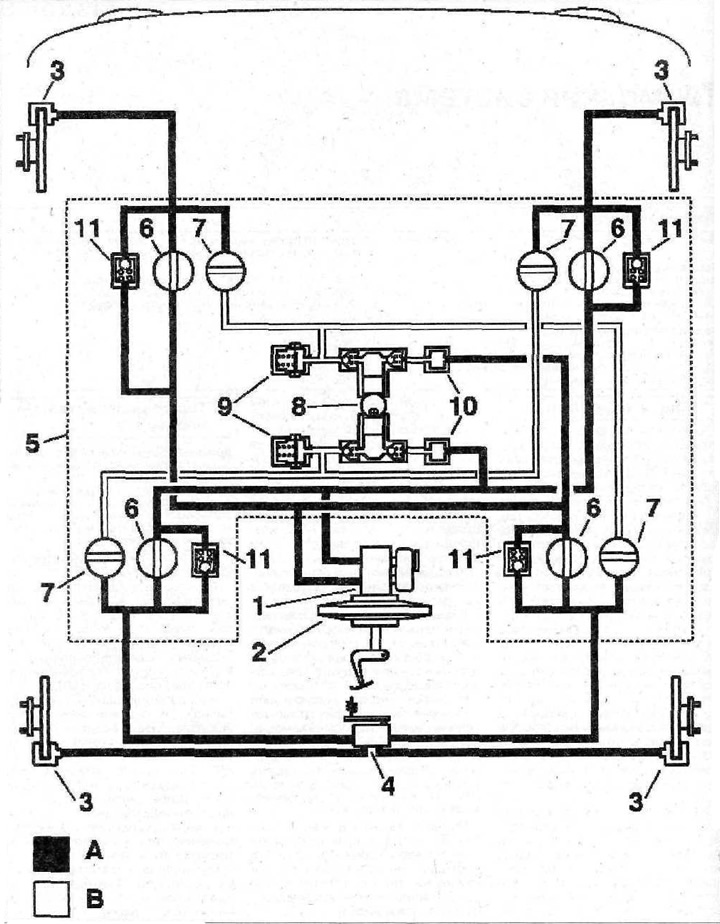
1.0 Brake system circuits
1 - master brake cylinder
2-vacuum booster brake drive
3 - brake caliper
4 - two-chamber brake fluid reservoir
5 - auxiliary systems (depending on the configuration)
6 - inlet solenoid valve
7 - exhaust solenoid valve
8 - modulator
9 - pressure accumulator
10 - vibration damper
11 - wheel cylinder
A - primary brake circuit
B - secondary brake circuit
The parking brake is mechanical and acts only on the rear wheels via a cable drive.
Source of the article is posted at: PeugeotBook.ru
When cleaning brakes, harmful dust from brake pads appears, as brake pad linings may contain asbestos, which is dangerous to health if it gets into the respiratory tract. Brake pads are produced by various companies, but it is recommended to use only certified products.
Depending on the model and its configuration, Peugeot 605 cars are equipped with an anti-lock braking system (ABS). Subsequent installation of an anti-lock braking system is not possible. The anti-lock braking system prevents the wheels from locking during sudden braking, so that the car remains controllable during full braking. If there is any malfunction in the ABS system, it is switched off. In this case, the ABS warning light on the instrument panel lights up, and the braking system operates in normal mode.
Depending on the model and equipment, Peugeot 605 cars can also be equipped with an anti-slip system, which regulates the slip of the drive wheels relative to the supporting surface. This means that when the drive wheels are detected to be spinning, they are deliberately braked.
Caution: When driving on wet roads, it is recommended to brake occasionally to remove a film of water, oil, dirt and resin from the brake disc, which reduces braking efficiency.
After driving in the rain, and especially when the streets are salted, it is necessary to dry the brakes by lightly pressing the brake pedal several times. This prevents premature corrosion of the discs.
Work on brakes requires cleanliness and certain skills. If you have no experience in repairing the brake system, it is recommended to entrust it to a workshop.