



Table of contents: Towing 🠇 Towing cars with automatic…🠇
The jack used to lift the vehicle must be suitable for the weight of the vehicle. When placing the vehicle on the jack stands, make sure that there are no objects or loads in the vehicle that affect the weight of the vehicle.
If the car is going to be completely on trestles, then first you should jack up the front and put it on trestles. You should put stops (bricks) under the rear wheels or tighten the parking brake.
When working under a vehicle, the latter, if it is not on a special lift, must rest on two or four stable stands/trestles.
Warning! It is prohibited to work under a vehicle that is not securely supported on trestles. Supporting a raised vehicle with a jack or lift alone does not provide sufficient safety. Danger to life!
1. Place the vehicle on the jacks only when unloaded. The jacks must stand on a level and solid surface.
2. Support the wheels with chocks to prevent the wheels from rolling forward or backward if the wheels remain on the ground when the vehicle is raised. Do not rely on the handbrake. It must be released for some work.
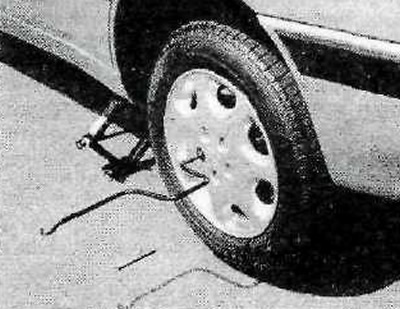
When jacking up a car from the side, the jack is installed at the points marked on the body skirt (see illustration 2.0).
When lifting the front end, the support trestles are installed in the same place as the jack when jacking up the car from the side.
Warning! Never place the vehicle on jack stands by lifting it first from one side and then from the other. In order to place the vehicle completely on jack stands, it is necessary to first jack it up from the front (or rear), and then from the rear (front). In this case, it is necessary to place stops under the wheels that will stand on the ground during jacking. Jacking up a car should be done on a solid surface to prevent the soil from sinking under the jack.
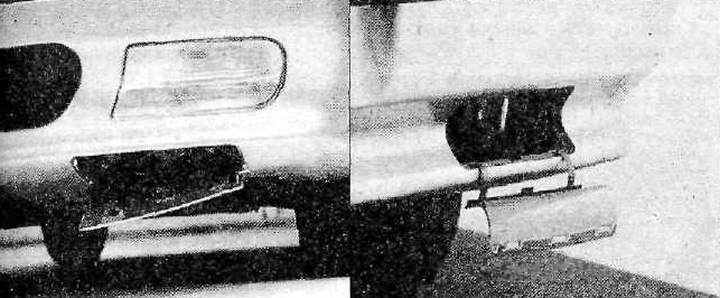
2.0a Remove the bumper cover that covers the towing hook
Towing
The towing hook is located on the bumper and is covered by a cover that must be removed (see illustration 2.0a).
Source available here: Peugeotbook.ru
It is recommended to use a towing rod. Its use eliminates the risk of collision between the towing and towed vehicles. The towing cable must have sufficient elasticity. Use only a cable made of synthetic fibers or with elastic intermediate links.
Towing cars with automatic transmission
Move the gearshift lever to the "N" position.
- The maximum permissible towing speed is 50 km/h.
- The maximum permissible towing distance is 50 km.
When towing a vehicle with a faulty gearbox, at a higher speed than the permitted speed, or for a distance of more than 50 kilometers, use the partial loading method or transport it on a tow truck (see illustration 2.0b). When the engine is not running, the pump that ensures the circulation of transmission oil does not function, and as a result, there is no lubrication of the gearbox parts.
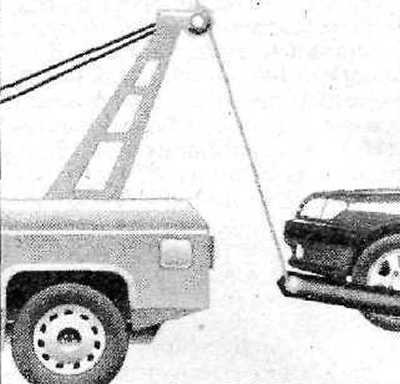
2.0b Towing a vehicle with the front wheels raised