



Warning! If the prescribed procedure is not followed, there is a risk of burns from acid released from the battery. In addition, there is a risk of injury and damage if the battery explodes. Damage to the electrical equipment of the vehicle is also possible.
The discharged battery must be properly connected to the vehicle's electrical system.
Caution! Starting the engine by pushing or towing is not recommended.
1. Check the electrolyte level in the discharged battery. If necessary, add distilled water.
2. Place the cars in such a way that their metal parts do not touch each other, otherwise voltage may occur when connecting the wire to the positive terminals of the batteries.
3. Apply the parking brake on both vehicles. Set the manual transmission to neutral and the automatic transmission to position "P" - "Park".
4. Disconnect all electrical consumers from the on-board network on both vehicles.
5. Connect the starting aid wires in the following sequence (see illustration):
a) connect red wire 2 to (+) of the battery of the vehicle whose engine needs to be started:
b) connect the other end of 1 red wire (+) to the positive terminal of the power battery:
c) connect the black wire to (-) 3 of the auxiliary battery, and the other end to a solid "ground" (-) 4 of the vehicle being started at a sufficient distance from its battery, fuel lines and brake hoses.
Caution! Do not connect the wire to the negative terminal of the battery of the vehicle being started.
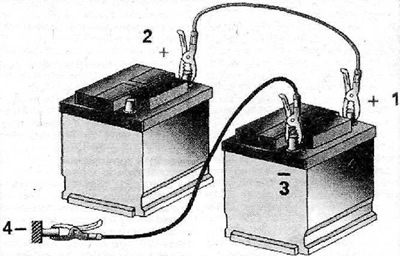
4.5 Connect the starting aid wires in the sequence shown
6. Protect wires from damage by rotating parts, such as radiator fan blades.
(View the original on the website www.PEUGEOTBOOK.ru)
7. Start the car engine with the power battery and let it idle for a few minutes.
8. Start the engine of the car with the discharged battery. Do not operate the starter for more than 15 seconds.
If the engine has started, leave both engines running at idle for at least two minutes to ensure stable engine operation before disconnecting the auxiliary battery cables.
Attention! Do not switch on the on-board network consumers before disconnecting the auxiliary wires.
9. Disconnect the auxiliary wires in the reverse order of connection. This means that the wire with black insulation should be disconnected first.