



The circulation of the coolant is controlled by a thermostat. Until the engine is warmed up, the coolant circulates only in the cooling jacket of the cylinder block and the heater radiator.
As the coolant temperature increases, the liquid cooling thermostat opens and directs the flow of coolant to the radiator.
The coolant is supplied to the cooling system by a water pump. In the radiator, the liquid is cooled by the oncoming air flow.
Additional cooling of the radiator is performed by an electric fan. As soon as the coolant temperature rises to approximately +90°C, the thermal switch switches on the electric fan for blowing the radiator via a relay. When the coolant temperature drops below +80°C, the fan switches off.
Expansion tank (see illustration 1.0) functions as a coolant reservoir. It accumulates the coolant that increases in volume when heated and releases it back into the circulation circuit after the engine has cooled.
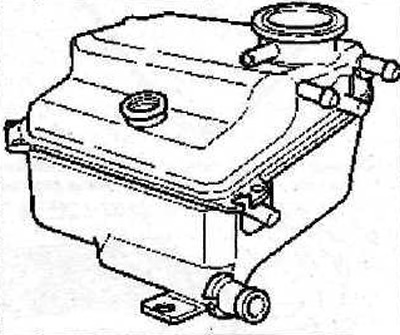
1.0 Expansion tank
Caution! The electric fan may automatically switch on due to heat accumulated in the engine compartment, even when the ignition is switched off. Risk of injury. Only carry out work near the electric fan when the engine has cooled down.
Caution! Do not allow coolant to come into contact with clothing or the paintwork of the vehicle body. Wash off any liquid that comes into contact with the vehicle with plenty of water. Replace all holders and clamps that are damaged or cut during disassembly with new ones during assembly.
Air intake for heating the cabin occurs through the air intake grille located under the windshield. Then the air is forced into the cabin by the fan. However, before entering the cabin, the air passes through the cabin air filter, and then is distributed to the deflectors by various flaps.
When the interior heating is turned on, the valve supplying hot coolant to the heater opens.
The air that enters through the air intake grille heats up when passing through the radiator plates of the heater and in this state is supplied to the car interior. The radiator of the heater is located in the air distribution casing and is heated by the hot coolant.
The heating system is based on regulating the temperature of the air supplied to the passenger compartment by increasing or decreasing, respectively, the proportion of hot and cold air in the total volume of air admitted to the passenger compartment using air dampers.
A multi-speed fan is used to enhance the heating of the passenger compartment. An additional resistor is installed to ensure the operation of the heater fan at different rotation speeds.
The air conditioner operates on the same principle as a refrigerator. The air conditioner compressor, driven by the crankshaft, compresses the gaseous refrigerant, which turns into a liquid state.
After this, the refrigerant enters the evaporator, where it again turns into a gaseous state, taking away heat and cooling the air. The air cooled by the evaporator is directed into the passenger compartment. From the evaporator radiator, the refrigerant again enters the compressor.
In order for the air conditioner to work flawlessly, it should be turned on for at least half an hour and in the cold season. Otherwise, the sealing gaskets of the refrigerant circulation circuit dry out; they become hard and lose their sealing properties, and the refrigerant, which acts as a lubricant for the gaskets, evaporates.
Attention! We recommend that any work on the air conditioner and its repair be entrusted to a specialized workshop. It is prohibited to open the refrigerant circulation system yourself - there is a risk of frostbite!