
English Русский
Български
Беларускі
Український
Српски
Hrvatski
Română
Polski
Slovenský
Magyar
Bookmark Articles Sitemap Contacts
Company Hyundai Company Opel Company Skoda Company Kia Company Mitsubishi Company LADA Company Audi
PeugeotBook.ru


Series 100   Series 200   Series 300   400-500   Series 600   Crossovers   Others
 
Partner I (1996-2008) Peugeot 807 (2002-2014) Peugeot 806 (1994-2002) Peugeot J5 (1981-1993)

Front brake disc — inspection, removal and installation (Peugeot Partner I)

  • Main
  • Пежо
  • Partner I (1996-2008)
  • Chassis, running gear
  • Brake system
  • Front brake disc — inspection, removal and installation
0
Table of contents: Inspection 🠇 Removal 🠇 Installation 🠇
Note: Before you begin, please read the warning at the beginning of this manual regarding the dangers and hazards of asbestos dust paragraph 4.


Inspection


Note: If either disc requires replacement, replace both discs at the same time. This will ensure consistent and consistent braking. New brake pads should also be installed.


1. Fully apply the parking brake. Raise the front of the vehicle and support it securely (see "Lifting and installing the car on supports"). Remove the corresponding front wheel.

2. Rotate the brake disc slowly so that both surfaces of the disc can be checked. If you want to get better access to the inner surface, remove the brake pads. Light scratches in the contact area with the brake pads are normal, but if serious scratches are found, the disc should be replaced.

3. There is nothing unusual about a strip of rust or dust from the brake pads around the perimeter of the disc; if necessary, these traces can be cleaned up. However, if due to increased wear a certain step has formed in the contact area with the brake pads, the thickness of the disc should be measured using a micrometer (figure 6.3). Measurements should be taken at several locations around the disc circumference, on the inner and outer diameters of the pad contact area. If the disc thickness at any point reaches the minimum specified value or is less, the disc should be replaced.
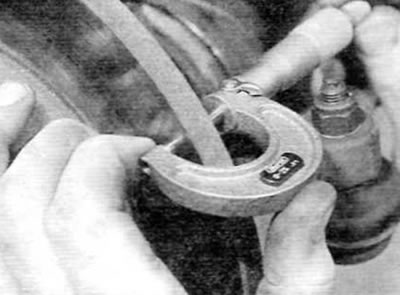
Figure 6.3. Measure the disc thickness with a micrometer

Figure 6.3. Measure the disc thickness with a micrometer


4. If you think the disc is warped, you can check its runout by following the steps below. Either use a dial indicator, which should be attached to any convenient fixed point, and slowly rotate the disc relative to it, or use a feeler gauge to measure the gap between the disc and a fixed element such as a brake caliper support bracket at several places around the circumference of the disc. If the results obtained correspond to or exceed the limit value, the disc has increased deformation and should be replaced. However, first it is worth checking the condition of the hub bearing (see chapter 1A or 1B and/or 10). Also try removing the disc and reinstalling it, after rotating it 180° relative to the hub. If the runout is still excessive, the disc should be replaced.
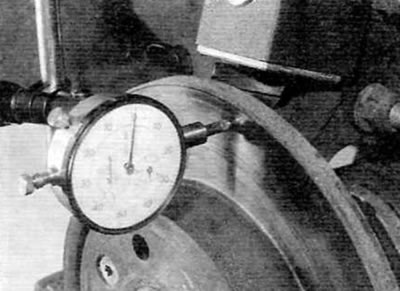
Figure 6.4. Checking the disc runout using a dial indicator

Figure 6.4. Checking the disc runout using a dial indicator


5. Check the disc for cracks (especially in the area of the holes for the wheel mounting bolts) and any other signs of wear or damage. Replace it if necessary.

Removal


6. Remove the brake pads as described in paragraph 4.

7. Remove the two bolts securing the brake caliper support bracket to the steering knuckle (figure 6.7). Remove the support bracket together with the caliper from the disc and steering knuckle and tie the assembly to the front spring to prevent deformation of the brake hose.
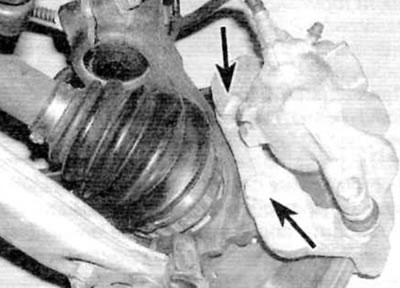


Figure 6.7. Front caliper support bracket mounting bolts (marked with arrows)

Figure 6.7. Front caliper support bracket mounting bolts (marked with arrows)


8. Use chalk or paint to mark the relative positions of the disc and hub. Then unscrew all the screws securing the disc to the hub and remove the disc (figure 6.8, a, b). If the disc does not come off, lightly tap the back of the disc with a plastic hammer to loosen it from the hub.
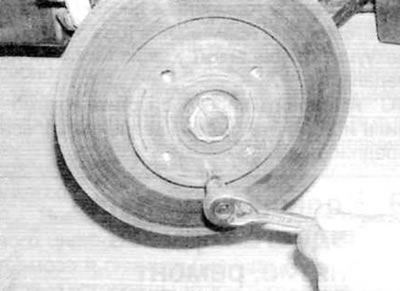
Figure 6.8, a. Remove two screws...
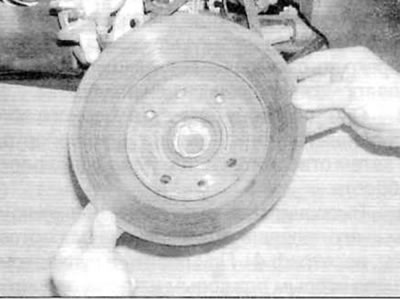
Figure 6.8, a. Remove two screws...


Figure 6.8, b....and remove the front brake disc

Figure 6.8, b....and remove the front brake disc


Installation


9. Installation is carried out in the reverse order of removal, taking into account the following points:
  • a) Make sure the mating surfaces of the disc and hub are clean and flat.
  • b) When installing the disc on the hub, align the marks made during removal and securely tighten the disc mounting screws.
  • c) If a new disc has been installed, remove the preservative coating from the disc using a suitable solvent before installing the caliper.
  • d) Apply a suitable thread locking compound to the threads of the caliper support bracket mounting bolts and tighten the bolts to the specified torque.
  • d) Install the wheel, lower the vehicle and tighten the wheel bolts to the specified torque. Finally, depress the brake pedal several times to restore normal (without vacuum amplification effect) pedal pressure.
This article is available at russian, bulgarian, belarusian, ukrainian, serbian, croatian, romanian, polish, slovak, hungarian
Article reviewed by editor: Nikonova Veronica
Share information:
Previous
Partner I: Brake system
Next

Rear brake pads — replacement
Front brake pads — replacement
Hydraulic lines and hoses — replacement
Hydraulic drive — air removal
General information about the braking system
Rear brake drum — inspection, removal and installation
Front Brake Caliper — removal, repair, and installation
Rear Brake Wheel Cylinder — removal, repair, and installation
Master cylinder — removal, repair and installation
Brake booster — inspection, removal and installation
See similar information for other Peugeot models

➨ Front brake pads — renewal (solid disc) Peugeot 106 (1991-2003)
➨ Removal and installation the front brake disc Peugeot 207 (2006-2014)
➨ Removal and installation front disc brake pads on models… Peugeot 305 (1977-1989)
➨ Front brake disc — removal, inspection and installation Peugeot 405 (1987-1997)
➨ Brake disc — removal Peugeot 605 (1989-2000)
Link to this article in different formats
Comments and feedback from visitors
No comments yet


Add two numbers 45 + 27


Partner I (1996-2008) 
  • General information
  • Introduction to the guide
  • Faults en route
  • Weekly checks
  • User manual
  • Maintenance (petrol)
  • Maintenance (diesel)
  • Power unit
  • Petrol engines
  • Diesel engines «XUD»
  • Diesel engines «DW»
  • Overhaul of petrol engines
  • Overhaul of diesel engines
  • Cooling and heating
  • Power and exhaust (petrol)
  • Power and exhaust (XUD diesels)
  • Power and exhaust (DW diesels)
  • Emission reduction
  • Starting and charging system
  • Transmission
  • Clutch
  • Mechanical gearbox
  • Drive shafts
  • Chassis, running gear
  • Brake system
  • Car suspension
  • Steering
  • Body and interior
  • Exterior (external elements)
  • Interior (internal elements)
  • Doors, locks and windows
  • Electrical equipment
  • Equipment and devices
  • Electrical circuits
Peugeot 807 (2002-2014) 
  • General information
  • Operating instructions
  • Maintenance
  • Troubleshooting
  • Power unit
  • Gasoline engines
  • Diesel engines
  • Cooling and heating
  • Fuel injection (petrol)
  • Fuel system (diesel)
  • Fuel system
  • Exhaust system
  • Ignition system
  • Transmission
  • Clutch
  • Manual gearbox
  • Automatic gearbox
  • Chassis, running gear
  • Brake system
  • Car suspension
  • Steering system
  • Body and interior
  • Exterior (external elements)
  • Interior (internal elements)
  • Electrical equipment
  • Power devices
  • Electrical circuits
Peugeot 806 (1994-2002) 
  • General information
  • User manual
  • Maintenance
  • Power unit
  • Petrol engines
  • Diesel engines
  • Lubrication system
  • Cooling system
  • Fuel injection (petrol)
  • Fuel system (diesel)
  • Ignition and exhaust systems
  • ECM Bosch Motronic MP 3.2
  • ECM Magneti-Marelli (MM)
  • Transmission
  • Clutch
  • Mechanical gearbox
  • Chassis, running gear
  • Brake system
  • Car suspension
  • Steering
  • Electrical equipment
  • Equipment and devices
  • Electrical circuits
Peugeot J5 (1981-1993) 
  • General information
  • Introduction to manual
  • Specifications
  • Gasoline engine
  • Engine repair
  • Lubrication system
  • Cooling system
  • Fuel system
  • Ignition system
  • Diesel engine
  • Engine repair (DB9)
  • Lubrication system (DB9)
  • Cooling system (DB9)
  • Fuel injection (DB9)
  • Engine repair (U25)
  • Lubrication system (U25)
  • Cooling system (U25)
  • Fuel injection (U25)
  • Transmission
  • Clutch
  • Gearbox
  • Drive shafts
  • Chassis, running gear
  • Steering system
  • Car suspension
  • Brake system
  • Electrical equipment
  • Power devices
  • Electrical circuits
PeugeotBook.ru © 2018–2026 | Mobile version | Sitemap: EN BG BY UA RS HR RO PL SK HU | Write message | Site search | Add to bookmarks | Peugeot owners
106 (1991-2003) | 206 (1998-2012) | 207 (2006-2014) | 305 (1977-1989) | 306 (1993-2002) | 307 (2001-2008) | 405 (1987-1997) | 406 (1995-2004) | 605 (1989-2000) | Partner-I (1996-2008) | Eurovans-807 (2002-2014) | Eurovans-806 (1994-2002) | J5 (1981-1993) |
Cookies are used to ensure the correct display of pages on the site.