



Table of contents: Draining coolant from the cooling…🠇 Flushing the cooling system 🠇 Filling the cooling system 🠇 Antifreeze 🠇
Draining coolant from the cooling system
Caution: Wait for the engine to cool before starting this procedure. Avoid contact of antifreeze with skin or vehicle paint. Splashes should be washed off immediately with plenty of water. Never leave antifreeze in an open container or in puddles on your driveway or garage floor. Its pleasant smell can attract children and pets, and swallowing antifreeze can be fatal.
1. On the 1.9L DW series engine, release the retaining clips on the right side and on the top surface of the engine cover, then remove the cover, being careful not to let the corresponding rubber mounts fall out (figure 4.6, a-c). On a 2.0L engine, release the locking tabs by turning them a quarter turn and remove the engine cover (figure 4.11, a, b).
2. Wait until the engine has cooled down completely and remove the expansion tank cap. Turn the cap counterclockwise to the first detent position. Wait until the residual pressure in the cooling system is released, then press the cap and turn it counterclockwise to the second locked position, and then remove it.
3. Place a suitable container under the left side of the radiator. On early models, loosen the drain plug (there is no need to unscrew it completely) and allow the coolant to drain into the container. Later models do not have a drain plug, so you will need to disconnect the lower radiator hose to drain the coolant.
4. To facilitate draining of the fluid, open the air bleed screws from the cooling system. They are located in the fitting of the outlet hose of the heater radiator (for easier access, the screw can be located in the extension hose), on the engine compartment bulkhead and on the thermostat housing (figure 25.4, a, b).
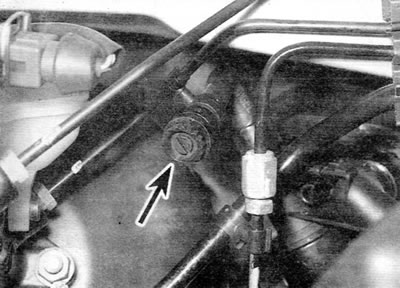
Figure 25.4, a. Air bleed screw on the heater hose (marked with an arrow)
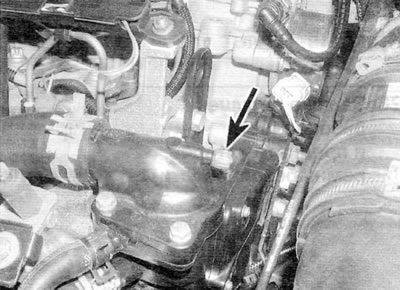
Figure 25.4, b. Air bleed screw on the thermostat housing (marked with an arrow)
5. When the coolant stops leaking, move the container under the cylinder block drain plug located on the rear of the block.
6. Remove the drain plug and allow the coolant to drain into a container.
7. If the coolant is drained for reasons other than replacement, then if it is clean and less than two years old, it can be reused, but this is not recommended.
8. Once draining is complete, replace the radiator and cylinder block drain plugs. Also connect the lower radiator hose (late models), if you do not plan to flush the system.
Flushing the cooling system
9. If coolant replacement has been neglected or the antifreeze concentration has dropped, the cooling system may gradually lose efficiency as the coolant passages become narrowed due to rust, scale, and other deposits. The efficiency of the cooling system can be restored by flushing the system.
10. To avoid additional contamination, the radiator should be flushed separately from the engine.
Radiator flushing
11. To flush the radiator, first tighten the drain plug and air bleed screw on it (if applicable).
12. Disconnect the upper and lower hoses and all other related hoses from the radiator (see chapter 3).
13. Insert a garden hose into the upper radiator inlet. Direct a stream of clean water into the radiator and continue flushing until clear water comes out of the lower outlet pipe.
14. If after a reasonable amount of time there is no clear water coming out of the lower hose, you can flush the radiator with a good commercial cooling system flush cleaner. Follow the product manufacturer's instructions carefully. If the contamination is very severe, remove the radiator, insert a hose into the lower radiator hose and backflush the radiator (countercurrent).
Engine flush
15. To flush the engine, first screw in the cylinder block drain plug and tighten the air bleed screws.
16. Remove the thermostat (see chapter 3) and temporarily install the thermostat cover.
17. With the upper and lower radiator hoses disconnected from the radiator, insert a garden hose into the upper radiator hose. Direct a stream of clean water through the engine and continue flushing until clear water comes out of the lower radiator hose.
18. After flushing, reinstall the thermostat and connect the hoses as described in chapter 3.
Filling the cooling system
19. Before filling the cooling system, make sure that all hoses and clamps are in good condition and that the clamps are tightly tightened. Please note that to prevent corrosion of engine components, antifreeze should be used year-round (see below). Also, make sure the drain plugs on the radiator and cylinder block are installed and tightened securely.
20. Remove the filler cap of the expansion tank.
21. Open all air bleed screws from the cooling system (see item 4).
22. Some of the cooling system hoses are located above the neck of the expansion tank. Therefore, when filling the cooling system, it is necessary to use a so-called pressure tank, which reduces the possibility of air penetration into the system. Although Peugeot/Citroen dealers use a special pressure container, the same effect can be achieved with a suitable plastic bottle, provided that a tight seal is ensured between it and the neck of the expansion tank.
Tip: To make a "pressure tank" for filling the cooling system, take an "old" antifreeze container and cut off the bottom. The seal at the location marked with the arrow must be absolutely airtight.
(Original publication on the website peugeotbook.ru)
23. Install the "pressure tank" on the expansion tank and slowly fill the system. Coolant will flow out of each bleed screw in turn, starting with the lowest screw. Once coolant without air bubbles appears from under the lowest screw, tighten that screw and begin monitoring the next air bleed screw. Repeat this procedure until coolant begins to flow out from under the topmost bleed screw. After this, tighten all air bleed screws securely.
24. Continue filling the cooling system until air bubbles stop appearing in the expansion tank. To help remove air from the system, squeeze the lower radiator hose several times.
25. When the bubbling stops, make sure the pressure tank is full (at least 0.5 l of coolant), and start the engine. Allow the engine to run at a higher idle speed (do not exceed 2000 rpm) until the cooling fan turns on and off. Turn off the engine.
Warning. The coolant will be very hot. Be extremely careful not to scald yourself.
26. Wait for the engine to cool down, and then remove the "pressure tank".
27. After the engine has cooled down, check the coolant level (see "Weekly checks"). If necessary, add fluid and install the cap on the expansion tank. Install the top cover onto the engine (if applicable).
Antifreeze
28. Antifreeze should be replaced at the prescribed intervals. This is necessary not only to preserve the properties of the antifreeze, but also to prevent corrosion that may occur due to a gradual decrease in the effectiveness of corrosion inhibitors.
29. Be sure to use the prescribed grade of ethylene glycol based antifreeze (see "Lubricants and operating fluids"), The amount of antifreeze and its protective properties are indicated in "Specifications".
30. Before adding coolant, the cooling system should be completely drained, preferably flushed, and the condition and secure fastening of all hoses should be checked.
31. After adding antifreeze, attach a tag to the expansion tank indicating the brand and concentration of the antifreeze used, as well as the date of filling. Any subsequent refilling should use the same brand and concentration of antifreeze.
32. Do not use antifreeze for the engine cooling system in the windscreen washer system/glass of the raised tailgate, as it can damage the paintwork of the vehicle. The glass washer additive should be added to the washer system in the quantities indicated on the bottle.