
English Русский
Български
Беларускі
Український
Српски
Hrvatski
Română
Polski
Slovenský
Magyar
Bookmark Articles Sitemap Contacts
Company Hyundai Company Opel Company Skoda Company Kia Company Mitsubishi Company LADA Company Audi
PeugeotBook.ru


Series 100   Series 200   Series 300   400-500   Series 600   Crossovers   Others
 
Partner I (1996-2008) Peugeot 807 (2002-2014) Peugeot 806 (1994-2002) Peugeot J5 (1981-1993)

Checking the steering and suspension (Peugeot Partner I)

  • Main
  • Пежо
  • Partner I (1996-2008)
  • General information
  • Maintenance (diesel)
  • Checking the steering and suspension
0
1. Fully apply the parking brake. Raise the front of the vehicle and support it securely (see "Lifting and installing the car on supports").

2. Visually inspect the ball joint dust boots and steering gear boots for cracks, cuts and abrasions. Any wear on these components results in loss of lubrication, dirt and water ingress, and ultimately rapid wear of the ball joints or steering gear.

3. On vehicles with power steering, check the power steering hoses for chafing or other damage, and the fittings of the lines and hoses for leaks. Also check for leaks of pressurized power steering fluid through the steering gear boots, which is a sign of failure of the steering gear seals.

4. Grasp the wheel from the top (at 12 o'clock) and bottom (at 6 o'clock) and try to rock it (figure 18.4). A very slight amount of play is acceptable, but if the movement is noticeable, further investigation is necessary to determine the cause. Continue rocking the wheel and ask your assistant to depress the brake pedal. If the large amount of play is now gone or has significantly decreased, the wheel bearings are probably faulty. If significant play remains when the brake pedal is depressed, this means that the suspension joints or supports are worn out.
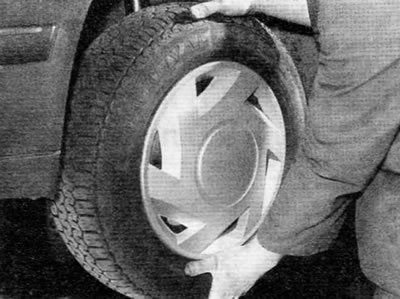
Figure 18.4. To check the hub bearings for wear, grasp the wheel from the top and bottom and try to…

Figure 18.4. To check the hub bearings for wear, grasp the wheel from the top and bottom and try to rock it


5. Now grab the wheel at the sides (9 o'clock and 3 o'clock) and try to rock it again. Any play currently perceived could also be caused by worn wheel bearings or tie rod ball joints. If the inner or outer ball joint is worn, movement will be visible.

6. Using a large screwdriver or pry bar, check the suspension support bushings for wear. To do this, use an improvised lever to pry up the corresponding suspension element relative to its attachment point. Some movement is acceptable as the bushings are made of rubber. Any increased wear will be evident. Also check the condition of all visible rubber bushings, looking for cuts, cracks or contamination.

7. Place the vehicle on its wheels and have an assistant turn the steering wheel back and forth approximately 45 degrees in each direction. There should be very little or no play in the steering wheel. If this is not the case, carefully inspect the hinges and supports described above. Also, check the steering column universal joints and steering gear for wear.

Suspension struts/shock absorbers


8. Check for leaks in the areas around the suspension struts/shock absorber housings or from under the rubber piston rod boot. If there are traces of any liquid, the suspension strut or shock absorber has an internal defect and requires replacement.

Note: Suspension struts/shock absorbers on the same axle should always be replaced in pairs.


9. The effectiveness of the suspension strut/shock absorber can be checked by pressing on each corner of the car. Usually, after pressing it, the body returns to its normal position and stops. If it rises and returns after being pressed, the suspension strut/shock absorber is likely faulty. Inspect the upper and lower suspension/shock absorber mounts for signs of wear.
This article is available at russian, bulgarian, belarusian, ukrainian, serbian, croatian, romanian, polish, slovak, hungarian
Article reviewed by editor: Nikonova Veronica
Share information:
Previous
Partner I: Maintenance (diesel)
Next

Checking the exhaust system
Checking and adjusting the parking brake
Checking the rear drum brake shoes
Checking the front disc brake pads
Checking and replacing the accessory drive belt — 2.0l engines
Replacing the fuel filter (1.8L and 1.9L XUD series engines)
Replacing the fuel filter (1.9L DW series engines)
Replacing the fuel filter (2.0L engines)
Replacing the air filter element
Checking the oil level in a manual transmission
See similar information for other Peugeot models

➨ Steering and suspension check Peugeot 106 (1991-2003)
➨ Removal and installation the front suspension steering knuckle Peugeot 207 (2006-2014)
➨ Checking the front suspension and steering Peugeot 307 (2001-2008)
➨ Checking the oil level in the power steering system Peugeot 405 (1987-1997)
➨ Suspension and steering specifications Peugeot 605 (1989-2000)
Link to this article in different formats
Comments and feedback from visitors
No comments yet


Add two numbers 29 + 12


Partner I (1996-2008) 
  • General information
  • Introduction to the guide
  • Faults en route
  • Weekly checks
  • User manual
  • Maintenance (petrol)
  • Maintenance (diesel)
  • Power unit
  • Petrol engines
  • Diesel engines «XUD»
  • Diesel engines «DW»
  • Overhaul of petrol engines
  • Overhaul of diesel engines
  • Cooling and heating
  • Power and exhaust (petrol)
  • Power and exhaust (XUD diesels)
  • Power and exhaust (DW diesels)
  • Emission reduction
  • Starting and charging system
  • Transmission
  • Clutch
  • Mechanical gearbox
  • Drive shafts
  • Chassis, running gear
  • Brake system
  • Car suspension
  • Steering
  • Body and interior
  • Exterior (external elements)
  • Interior (internal elements)
  • Doors, locks and windows
  • Electrical equipment
  • Equipment and devices
  • Electrical circuits
Peugeot 807 (2002-2014) 
  • General information
  • Operating instructions
  • Maintenance
  • Troubleshooting
  • Power unit
  • Gasoline engines
  • Diesel engines
  • Cooling and heating
  • Fuel injection (petrol)
  • Fuel system (diesel)
  • Fuel system
  • Exhaust system
  • Ignition system
  • Transmission
  • Clutch
  • Manual gearbox
  • Automatic gearbox
  • Chassis, running gear
  • Brake system
  • Car suspension
  • Steering system
  • Body and interior
  • Exterior (external elements)
  • Interior (internal elements)
  • Electrical equipment
  • Power devices
  • Electrical circuits
Peugeot 806 (1994-2002) 
  • General information
  • User manual
  • Maintenance
  • Power unit
  • Petrol engines
  • Diesel engines
  • Lubrication system
  • Cooling system
  • Fuel injection (petrol)
  • Fuel system (diesel)
  • Ignition and exhaust systems
  • ECM Bosch Motronic MP 3.2
  • ECM Magneti-Marelli (MM)
  • Transmission
  • Clutch
  • Mechanical gearbox
  • Chassis, running gear
  • Brake system
  • Car suspension
  • Steering
  • Electrical equipment
  • Equipment and devices
  • Electrical circuits
Peugeot J5 (1981-1993) 
  • General information
  • Introduction to manual
  • Specifications
  • Gasoline engine
  • Engine repair
  • Lubrication system
  • Cooling system
  • Fuel system
  • Ignition system
  • Diesel engine
  • Engine repair (DB9)
  • Lubrication system (DB9)
  • Cooling system (DB9)
  • Fuel injection (DB9)
  • Engine repair (U25)
  • Lubrication system (U25)
  • Cooling system (U25)
  • Fuel injection (U25)
  • Transmission
  • Clutch
  • Gearbox
  • Drive shafts
  • Chassis, running gear
  • Steering system
  • Car suspension
  • Brake system
  • Electrical equipment
  • Power devices
  • Electrical circuits
PeugeotBook.ru © 2018–2026 | Mobile version | Sitemap: EN BG BY UA RS HR RO PL SK HU | Write message | Site search | Add to bookmarks | Peugeot owners
106 (1991-2003) | 206 (1998-2012) | 207 (2006-2014) | 305 (1977-1989) | 306 (1993-2002) | 307 (2001-2008) | 405 (1987-1997) | 406 (1995-2004) | 605 (1989-2000) | Partner-I (1996-2008) | Eurovans-807 (2002-2014) | Eurovans-806 (1994-2002) | J5 (1981-1993) |
Cookies are used to ensure the correct display of pages on the site.