
English Русский
Български
Беларускі
Український
Српски
Hrvatski
Română
Polski
Slovenský
Magyar
Bookmark Articles Sitemap Contacts
Company Hyundai Company Opel Company Skoda Company Kia Company Mitsubishi Company LADA Company Audi
PeugeotBook.ru


Series 100   Series 200   Series 300   400-500   Series 600   Crossovers   Others
 
Peugeot 206 (1998-2012) Peugeot 207 (2006-2014)

Removal and installation the front suspension steering knuckle (Peugeot 207)

  • Main
  • 20X
  • Peugeot 207 (2006-2014)
  • Chassis, running gear
  • Car suspension
  • Removal and installation the front suspension steering knuckle
0
Table of contents: Removal 🠇 Installation 🠇

Removal


Raise and block the car, raising the front wheels. Remove the wheel.

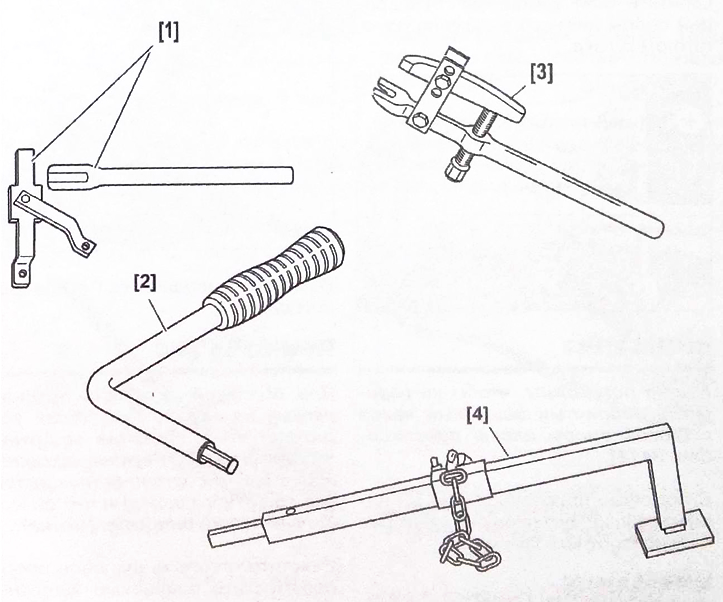
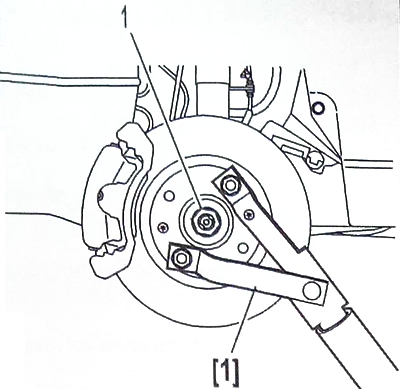
Using the tool [1], lock the hub to prevent it from rotating.

Loosen the drive shaft nut.

Caution: When loosening the drive shaft nut, do not use the brake - this may result in the brake disc mounting bolts being cut off.


Loosen and then remove the drive shaft nut (1).

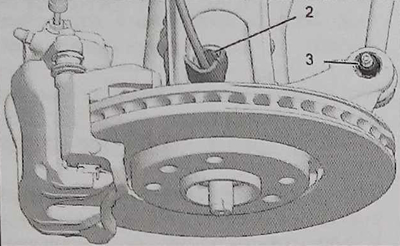
Remove the wheel speed sensor mount (2).

Loosen the tie rod end nut (3).

Remove the steering rod ball joint using tool [3].
Special devices:

Special devices:
1 - device for fixing the hub 6310-T;
2 - FACOM DS-12 steering knuckle release key;
3 - Ball joint puller 1892-T;
4 - lever for separating the ball joints of the steering knuckle 0622.

4 - lever for separating the ball joints of the steering knuckle 0622.


Source of the article is website peugeotbook.ru


Remove the front brake disc (see the corresponding operation).
Remove the front brake disc (see the corresponding operation).


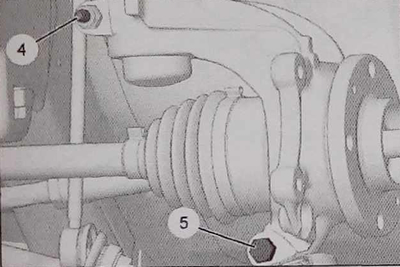
Unscrew the bolt (4).

Remove the mounting bolt (5) of the ball joint of the lower arm on the steering knuckle.
Remove the mounting bolt (5) of the ball joint of the lower arm on the steering knuckle.


Caution: Be careful not to tear the ribbed ball joint boot with the chain of the tool [4].


Using tool [4], remove the ball joint of the lower arm of the steering knuckle.

Caution: When removing the steering knuckle, hold the drive shaft in the differential housing.


Remove the steering knuckle from the drive shaft.

Insert the key [2] into the hole in the steering knuckle and turn it a quarter turn to open the clamp.

Remove the steering knuckle.
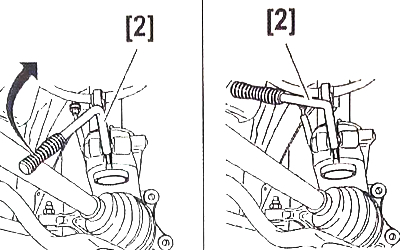
Remove the steering knuckle.


Installation


Insert the key [2] into the hole in the steering knuckle.

Install the steering knuckle in place.

Attention. Observe the correct position of the shock absorber in relation to the steering knuckle (mark in zone "a").
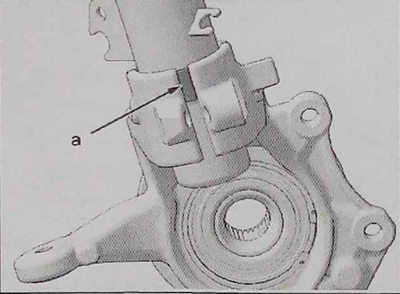

Attention. Observe the correct position of the shock absorber in relation to the steering knuckle…


Insert the drive shaft into the steering knuckle.

Note: When reinstalling the lower control arm onto the steering knuckle, make sure the ribbed boot on the steering knuckle is in good condition (no breaks in the protective cover) and that it is correctly positioned (label).


Clean the ball joint rod, move the rubber protective cap from top to bottom to check its elasticity, install the protective cap so that it is stretched as much as possible.

Insert the lower control arm ball joint into the steering knuckle.

Install and tighten:
  • bolt (4) torque 54 ±5.4 Nm;
  • bolt (5) with a torque of 40 ±4 Nm.

Install the parts in reverse order.
This article is available at russian, bulgarian, belarusian, ukrainian, serbian, croatian, romanian, polish, slovak, hungarian
Article reviewed by editor: Matveev Demid
Share information:
Previous
Peugeot 207: Car suspension
Next

General characteristics and tightening torques of the rear…
Front axle alignment angles
General characteristics and tightening torques of the front…
Geometry of bridges
Rear axle
Removal and installation the lower front arm
Removal and installation the ball joint of the front steering…
Lower Front Arm Repair
Front steering knuckle repair
Features of front suspension wheel bearings
See similar information for other Peugeot models

➨ Steering and suspension check Peugeot 106 (1991-2003)
➨ Checking the front suspension and steering Peugeot 307 (2001-2008)
➨ Front suspension anti-roll bar linkage Peugeot 406 (1995-2004)
➨ Suspension and steering specifications Peugeot 605 (1989-2000)
➨ Front hub bearings and steering knuckle — replacement Peugeot Partner I (1996-2008)
Link to this article in different formats
Comments and feedback from visitors
No comments yet


Add two numbers 22 + 40


Peugeot 207 (2006-2014) 
  • General information
  • Car care
  • Governing bodies
  • Driving and operation
  • Power unit
  • Engine characteristics
  • Engine repair
  • Cooling system
  • Lubrication system
  • Ignition system
  • Control system (gasoline)
  • Fuel system (gasoline)
  • Control system (diesel)
  • Transmission
  • Clutch
  • Mechanical gearbox
  • Automatic gearbox
  • Drive shafts
  • Chassis, running gear
  • Car suspension
  • Steering
  • Brake system
  • Body and interior
  • Exterior (external elements)
  • Interior (internal elements)
  • Heating and air conditioning
  • Electrical equipment
  • Equipment and devices
  • Headlights and lighting
  • Power devices
  • Electrical circuits
Peugeot 206 (1998-2012) 
  • General information
  • User manual
  • Maintenance
  • Power unit
  • Gasoline engines
  • Diesel engines
  • Diesel power system
  • Engine management system
  • Transmission
  • Clutch
  • Mechanical gearbox
  • Automatic gearbox
  • Drive shafts
  • Chassis, running gear
  • Front suspension
  • Rear suspension
  • Steering
  • Brake system
  • Body and interior
  • Body elements
  • Doors, locks and windows
  • Electrical equipment
  • Equipment and devices
  • Electrical circuits
PeugeotBook.ru © 2018–2026 | Mobile version | Sitemap: EN BG BY UA RS HR RO PL SK HU | Write message | Site search | Add to bookmarks | Peugeot owners
106 (1991-2003) | 206 (1998-2012) | 207 (2006-2014) | 305 (1977-1989) | 306 (1993-2002) | 307 (2001-2008) | 405 (1987-1997) | 406 (1995-2004) | 605 (1989-2000) | Partner-I (1996-2008) | Eurovans-807 (2002-2014) | Eurovans-806 (1994-2002) | J5 (1981-1993) |
Cookies are used to ensure the correct display of pages on the site.