



Location of brake pad adjustment elements
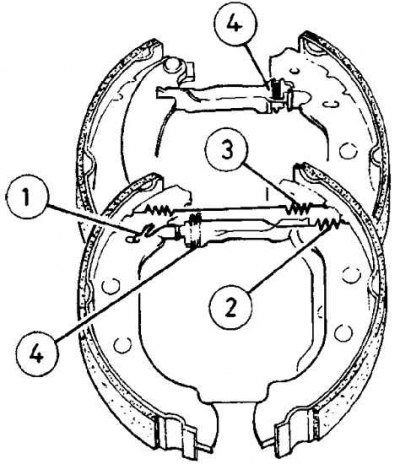
1. Regulator bolt retaining spring; 2. Regulator bar spring; 3. Upper return spring; 4. Adjusting element
Attention! Always replace all pads on one axle of the vehicle, even if one pad has reached the wear limit. If the pads are to be reinstalled, mark them before removing.
1. Remove the brake drum.
2. Using caution and safety precautions, clean all traces of brake dust from the brake drum, brake shield and shoes.
3. Measure the brake pad lining thickness at several points. If at least one pad is worn down to the minimum thickness at any point, replace all 4 brake pads.
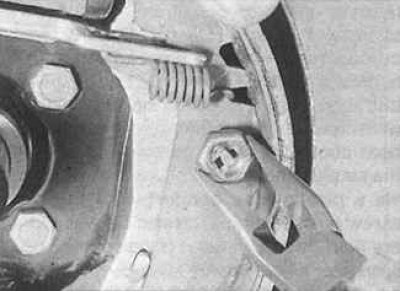
4. Mark the installation position of all rear brake components. Using pliers, remove the shoe retaining spring plate by pressing the plate and turning it 90°. Remove the springs and remove the retainer pins.
5. Remove one brake shoe from the lower shoe support and disconnect the lower return spring.
6. Press both pads away from the wheel brake cylinder and remove them. Be careful not to damage the dust boots. Disconnect the handbrake cable from the brake shoe. To prevent the pistons from falling out of the working brake cylinder, secure the pistons with a suitable rubber band or wire.
7. Mark the location of the brake shoe adjuster components, remove the handbrake actuator lever and disconnect the adjuster bolt retaining spring from the front (by location) brake shoe. Disconnect the upper return spring, separate the front brake shoe and return spring from the rear brake shoe. Disconnect the spring securing the adjuster to the rear brake shoe (see figure Location of brake pad adjustment elements).
8. Replace all return springs regardless of their condition.
9. Unscrew the bolt that secures the regulator to the adjusting bar and check their condition. Pay special attention to the threads of the regulator bolt and the edges of the adjusting wheel. Note that the left and right adjusting bars are not interchangeable. The bolts of the adjuster of the right and left wheels are also not interchangeable. The bolt of the adjuster of the left wheel has a left-hand thread, and the bolt of the adjuster of the right wheel has a right-hand thread.
10. Check that all parts on the end of the adjuster bar are correctly positioned, then apply a small amount of high-temperature grease to the threads of the adjuster bolt. Screw the adjuster wheel onto the adjuster bolt until there is a small gap between the wheel and the head of the bolt. Insert the adjuster bolt into the adjuster bar.
11. Install the return spring on the rear (by location) brake shoe so that the shorter end of the spring engages the shoe. Install the adjusting bar to the end of the spring. Insert the adjusting bar into the groove in the rear brake shoe.
12. Install the upper return spring on the rear brake shoe. Install the other end of the spring on the front brake shoe and, moving it, position the front shoe so that the head of the adjusting bolt is located in the groove. Then insert the hook of the locking spring into the groove on the front brake shoe.
13. Lift up the rubber protective boots of the brake cylinder and check the wheel cylinder for brake fluid leaks.
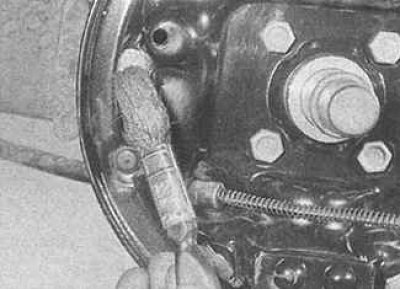
14. Clean the rear brake components. Apply high melting point lubricant to the contact areas of the pads with the brake shield.
15. Check that the handbrake lever is positioned against the edge of the rear brake shoe and remove the rubber band securing the pistons in the brake cylinder.
16. Stretch the brake shoes and install their upper ends on the piston of the working brake cylinder. Connect the handbrake cable to the handbrake lever located on the rear brake shoe. Install the lower return spring on both brake shoes, install the lower part of the brake shoes on the shoe support.
17. When moving the brake shoes, center them in relation to the brake shield. Install the shoe retainer pins, springs and spring mounting plate.
18. Using a screwdriver, turn the adjuster bar wheel to spread the brake shoes until they touch the brake drum.
19. Install the brake drum.
20. Replace the brake pads on the second rear wheel.
21. After replacing the brake pads, adjust the gap between them and the brake drum by pressing the brake pedal several times. When pressing the pedal, if the adjusting bar is working normally, clicks should be heard from the adjusting bar.
22. Check and, if necessary, adjust the handbrake.
23. Check the brake fluid level in the system.