



Attention! Be sure to replace all the pads on one axle of the car, even if one pad has reached the wear limit. If the pads are to be reinstalled, they must be marked before removal.
Warning! When brake pads are in operation, brake dust is generated, which contains asbestos, which is harmful to health. Therefore, when cleaning brake pads, do not use compressed air and do not inhale the dust.
1. Raise the front of the car and secure it on stands. Remove the front wheels.
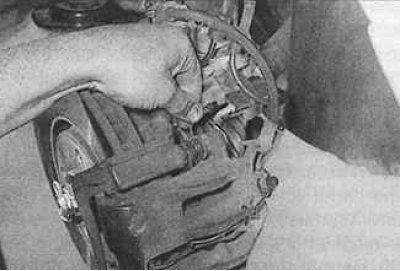
2. Disconnect the electrical connector located on the wire that goes to the brake pad wear sensor.
3. Press the piston into the caliper, moving the caliper in the direction opposite to the piston position.
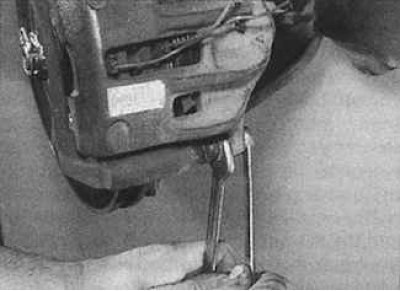
4. Unscrew the bolt securing the lower guide pin. At the same time, use a thin spanner to keep the guide finger from turning. Use only a new bolt to secure the guide pin.
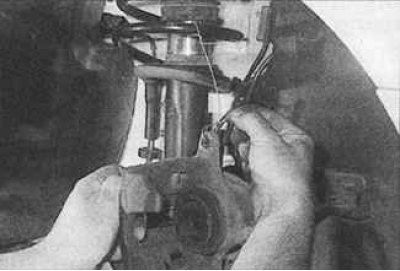
5. Turn the caliper up on the top guide pin and tie it to the stand with soft wire.
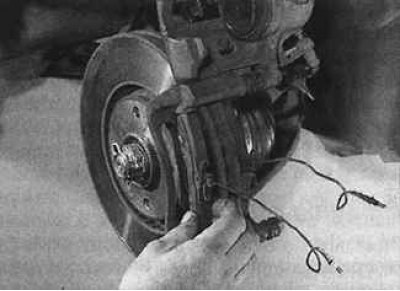
6. Remove the two brake pads from the caliper holder.
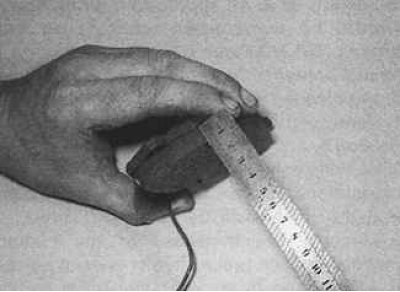
7. Measure the lining thickness of each brake shoe.
8. If the brake shoe linings are in good condition for continued use, clean them using a clean wire brush and rag.
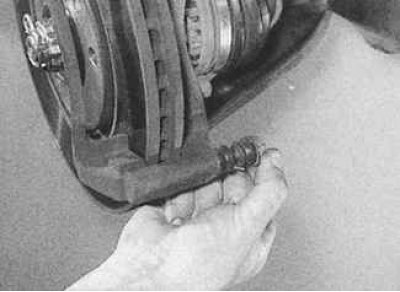
9. Before installing the pads, check that the guide pins move freely in the caliper holder and make sure that the rubber protective boots of the guide pin are not damaged.
10. Clean dust and dirt from the caliper and piston. Check the condition of the dust seal around the piston.
11. If new brake pads are to be installed, press the piston into the caliper. This can be done with a wooden rod or a hammer handle. In this case, be especially careful that the piston is not warped and that the surfaces of the piston and dust boot are not damaged. When the piston is pushed in, the brake fluid is forced out of the brake cylinder into the expansion tank. Therefore, constantly monitor the fluid level in the tank and pump it out if necessary. When installing old brake pads, put them back in their original places.
12. Insert the outer and inner brake pads into the caliper holder.
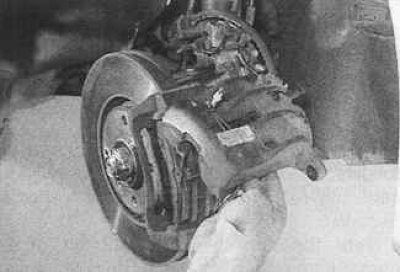
13. Lower the caliper onto the brake pads, passing the wire from the brake pad wear sensor through the window in the caliper. Lubricate the threads of the guide pin mounting bolt with anti-loosening agent (Peugeot recommends Loctite Frenetanch).
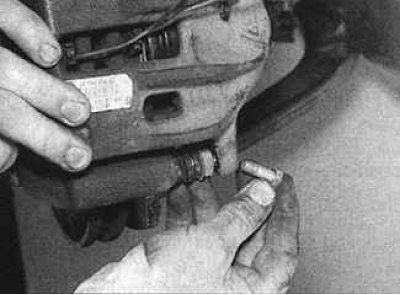
14. Press the caliper into position, then tighten the guide pin mounting bolt to the specified torque.
15. Connect the brake pad wear sensor electrical connector.
16. Check the brake fluid level in the reservoir. It should not exceed the "max" mark. Press the brake pedal several times to press the pads against the disc, and recheck the brake fluid level in the reservoir.
17. Perform the above steps on the second front wheel.
(Original published on the portal: peugeotbook.ru)
18. Install the wheels and lower the vehicle.
19. Recheck the brake fluid level.