



Attention! Be sure to replace all the pads on one axle of the vehicle, even if one pad has reached the wear limit.
1. Raise the rear of the car and secure it on stands. Remove the rear wheels.
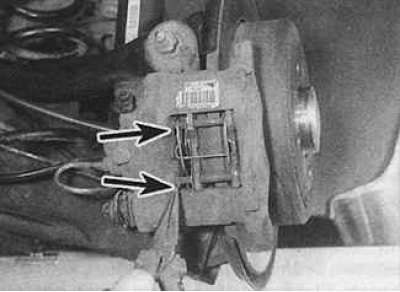
2. Remove the spring clips (indicated by arrows), the fastening pins that hold the brake pads in place.
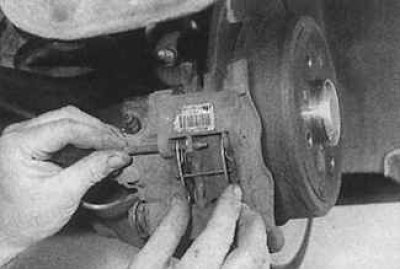
3. Remove the spring that prevents the pads from vibrating.
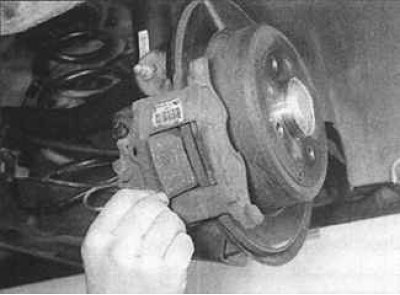
4. Using pliers, remove the inner and outer brake pads from the caliper.
5. Measure the lining thickness of each brake shoe.
6. If the pads are fit for further use, clean them using a wire brush and rag.
7. Before installing the pads, check that the guide bushings move freely in the caliper and that the rubber protective boots are not damaged.
8. If new brake pads are to be installed, press the piston into the caliper with a wooden rod or hammer handle. Make sure that the piston is not warped and that the piston and dust boot surfaces are not damaged. When the piston is pushed in, the brake fluid is forced out of the brake cylinder into the expansion tank, so constantly monitor the fluid level in the tank and, if necessary, pump out a small amount of it from the tank.
9. Install the brake pads into the caliper.
(Source of the article is posted at Peugeotbook.ru)
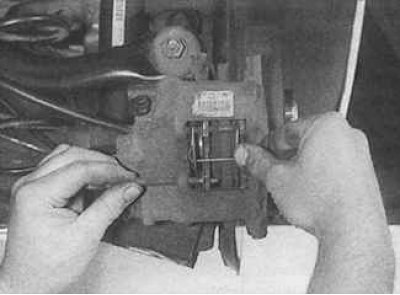
10. Install the anti-vibration spring. Install the pad retaining pins by passing them through the hole in the caliper, brake pad and the center of the anti-vibration spring. Secure the pins with spring clips.
11. Press the brake pedal several times to press the brake pads against the brake disc. Check the brake fluid level in the reservoir. Check that the inner lip of the pad is correctly aligned with one of the grooves of the caliper piston.
12. Repeat the above steps on the second wheel.
13. Install the wheels and lower the vehicle.
14. Check the brake fluid level.