



- loosen the rear wheel mounting bolts, then raise the rear of the car and secure it on stands. Unscrew the mounting bolts and remove the wheel;
- remove the cap from the brake fluid expansion tank;
- use a syringe to partially pump out the brake fluid from the reservoir;
- install the cap on the brake fluid expansion tank;
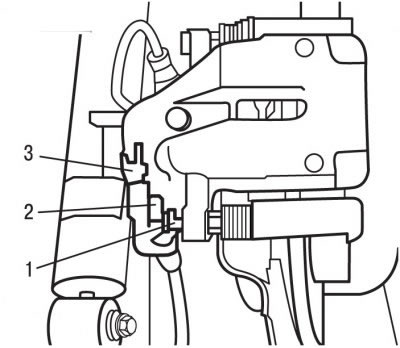
Figure 8.12. Parking brake cable fastening: 1 - bolt for fastening the lower guide pin of the caliper; 2 - parking brake cable; 3 - lever
- disconnect the parking brake cable 2 from the lever 3 (figure 8.12);
- unscrew bolt 1 (see Figure 8.12) lower guide pin fastenings;
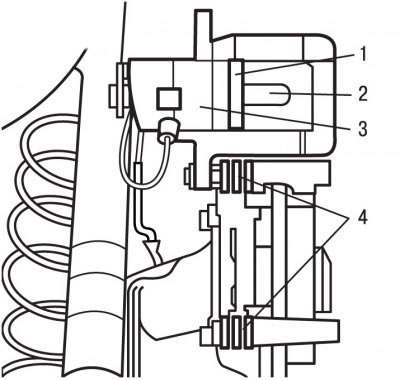
Figure 8.13. LUCAS front brake caliper: 1 - cuff; 2 - piston; 3 - support; 4 - protective corrugated caps
- turn the caliper 3 on the upper guide pin (figure 8.13) up;
- remove the brake pads from the caliper holder;
- clean off dust and dirt from the caliper and rust from the edge of the brake disc. If the pads are fit for further use, clean them with a wire brush and rag. Clean the brake disc with a solvent such as HENKEL;
- check for brake fluid leaks from under piston 2;
- check the condition and proper fit of the cuff 1 and protective corrugated caps 4;
- check the brake disc for cracks, especially around the wheel bolt holes, as well as for wear or mechanical damage, and replace both discs if necessary;
- measure the thickness of the brake disc;
- make sure the caliper guide pins slide freely;
- replace faulty parts if necessary;
Caution! Do not press the brake pedal when the brake pads are removed.
- press the piston into the caliper using the special tool DF 6.1 (you can also press the piston into the caliper using a wooden rod or a hammer handle). In this case, make sure that the piston is not warped and that the surfaces of the piston and cuff are not damaged. When the piston is pressed, brake fluid is forced out of the brake cylinder into the expansion tank, so constantly monitor the fluid level in the tank and, if necessary, pump out a small amount from the tank.
To install rear brake pads:
- install the brake pads into the rear brake caliper holder;
- lower the caliper down;
Caution: Lower the caliper carefully to avoid pinching the upper guide pin.
- apply to the thread of bolt 1 (see Figure 8.12) apply a locking compound to the guide pin fastenings to prevent it from loosening, screw in the bolt and tighten it to a torque of 38 Nm;
- install the parking brake cable 2 and secure it to the lever 3;
- replace the brake pads on the second rear wheel in the same way;
- check the brake fluid level in the reservoir and top up if necessary;
- start the engine and press the brake pedal several times, calmly and with increasing force, until the brake pads are pressed against the brake disc.
Caution! After installing new brake pads, avoid sudden braking for the first 200 km of driving.