



- loosen the wheel mounting bolts, lift the corresponding part of the car and secure it on stands;
- remove the wheel;
- remove the brake pads;
- slowly rotate the brake disc so that it can be viewed from both sides. Brake disc wear from the pads must be within acceptable limits. If the wear exceeds the permissible limit or there are cracks on the disc, the disc must be replaced;
- if necessary, clean the perimeter of the disc from rust and brake dust;
- check the runout of the brake disc with a dial indicator. Attach the dial indicator to any convenient location and, by rotating the disk, determine its runout at several points from its center. If the disc runout exceeds the permissible limits, the disc must be replaced. However, the cause of disc beating may be a failure of the hub bearing. To check the runout of the inside of the brake disc, remove the brake disc from the hub, turn it 180°, re-fasten it to the hub and measure its runout with a dial indicator;
- check the brake disc for cracks, especially around the wheel bolt holes;
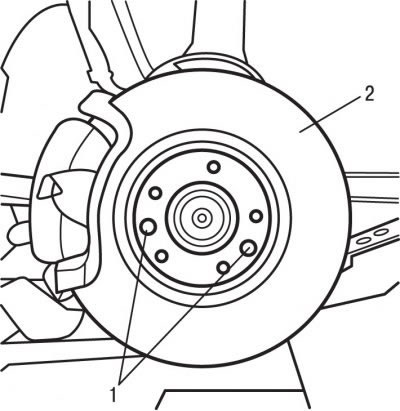
Figure 8.15. Location of bolts (1) for fastening the front brake disc (2)
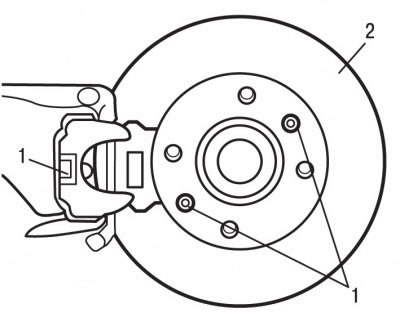
Figure 8.16. Location of brake pads and bolts (1) for fastening the rear brake disc (2)
- unscrew bolts 1 and remove brake disc 2 (figure 8.15, 8.16).
To install the brake disc:
- check the condition and measure the thickness of the brake disc;
- if a brake disc needs to be replaced, both must be replaced to ensure uniform braking. When replacing brake discs, you must also replace the brake pads;
- check and, if necessary, clean the mating surfaces of the brake disc and hub. When installing a new brake disc, remove the protective coating from its surface;
- install the brake disc on the wheel hub and secure it with bolts, tightening them to a torque of 10 Nm;
- install brake pads;
- install the wheel and lower the car to the ground;
- press the brake pedal hard several times to press the brake pads against the brake disc.