



Table of contents: Examination 🠇 Removal 🠇
Caution: On petrol models with air conditioning and on diesel models, the "Bitron" temperature sensor controls the coolant temperature gauge.
Examination
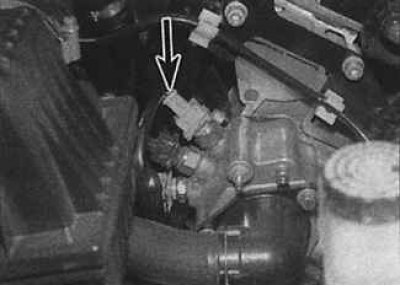
1. Temperature sensor "Bitron" (indicated by the arrow) screwed into the left side of the cylinder head. The sensor can be identified by the blue color of the electrical connector. On 1.8 and 2.0 liter 16-valve models, the sensors are screwed into the thermostat housing.
2. The coolant temperature gauge is supplied with DC voltage from the instrument panel (through the ignition switch and fuse). The "Bitron" sensor is installed in the ground circuit of the temperature gauge. The sensor contains a thermistor - an electronic component whose electrical resistance decreases according to a certain law as its temperature increases. When the coolant is cold, the resistance of the sensor is high, and as a result, the electric current through the temperature gauge is insignificant and the pointer points to the blue (cold) section of the scale. As the coolant temperature increases and the resistance of the sensor decreases, i.e. the electric current increases, the pointer moves to the top of the scale. If the sensor is faulty, it must be replaced.
3. On models with a temperature warning light, the light is powered by the instrument cluster and controlled by a momentary switch that is installed in the circuit of the wire that connects the light to ground. If the temperature warning light is installed in addition to the temperature gauge, they are connected to the vehicle ground by two separate wires through sensors.
4. If the temperature indicator shows an excess temperature, and the light does not light, then it is necessary to check the voltage supply to it and the operability of the sensor. The fault may be in the printed circuit board conductor. The fault can be determined as follows.
5. If the temperature gauge needle is in the cold zone of the scale when the engine is hot, remove the wire from the sensor and connect it to the cylinder head. If the needle deflects when the ignition is turned on, the sensor is faulty and must be replaced. If the needle does not deflect, remove the instrument panel and check the integrity of the wire between the sensor and the temperature gauge. If the wire is intact and the defect is present, the temperature gauge is faulty and must be replaced.
6. If the temperature gauge needle points to the hot end of the scale when the engine is cold, remove the wire from the sensor. If the needle returns to the cold end of the scale when the ignition is on, the sensor is faulty and must be replaced. If the needle still remains in place, check the electrical circuit as described earlier.
(Source of the article is website: «Peugeotbook.ru»)
7. The operation of the temperature warning lamp is checked in a similar manner.
Removal
The removal procedure is similar to removing the radiator fan temperature sensor.