



The steering wheel is fixed to the steering column and transmits force to the rack and pinion through the shaft.
The steering gear is attached to the subframe with two studs. The steering gear rack is connected to the transverse steering rod on both sides with ball joints.
The rack-and-pinion steering mechanism has a smooth stroke and no play when turning the steering wheel from lock to lock.
The steering mechanism requires virtually no maintenance, but the condition of the ball joint protective boots of the tie rods should be checked regularly.
Peugeot 605 cars are equipped with a power steering mechanism (see illustration 12.0).
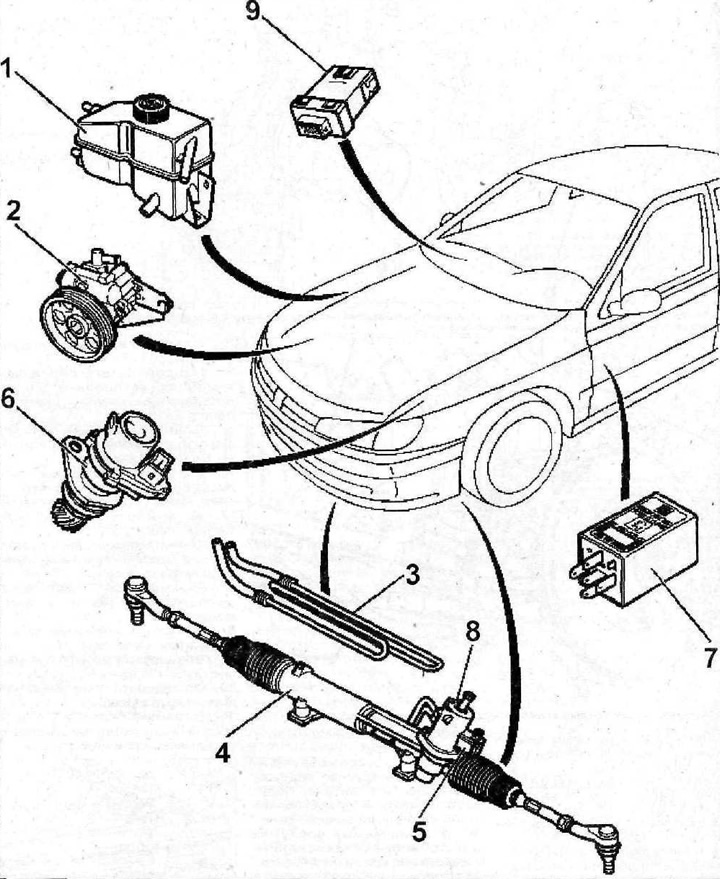
12.0 Power steering components
1 - hydraulic fluid reservoir
2 - Power steering pump
3 - hydraulic fluid cooling radiator
4 - steering rack
5 - sensor
6 - speedometer sensor
7 - power steering control unit
8 - discharge valve
The power steering consists of a pump, expansion tank and hydraulic fluid circulation hoses. The pump is driven by the engine via the accessory drive belt. The pump sucks hydraulic fluid from the expansion tank and forces it to the valve stem, which directs the hydraulic fluid to the appropriate part of the working cylinder. There, the fluid presses on the piston of the toothed rack and thus supports the driver's effort applied to the steering wheel.
The steering wheel may be equipped with an inflatable driver airbag. The airbag is a folded bag that instantly fills with air during a frontal collision, thereby protecting the driver's torso and head from hitting the steering wheel.
Source of the article is website: www.PeugeotBook.ru