



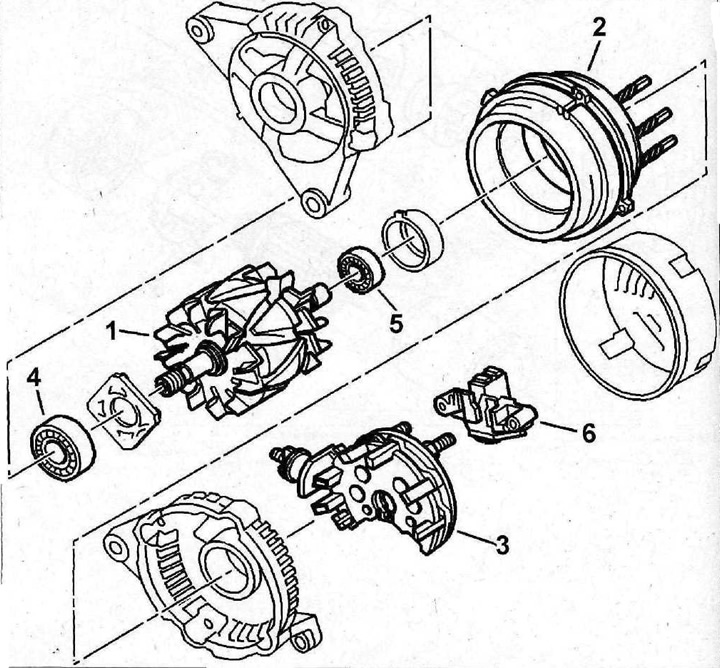
4.0 Bosch Generator
1 - rotor
2 - stator
3 - diode board
4 - front bearing
5 - rear bearing
6 - voltage regulator
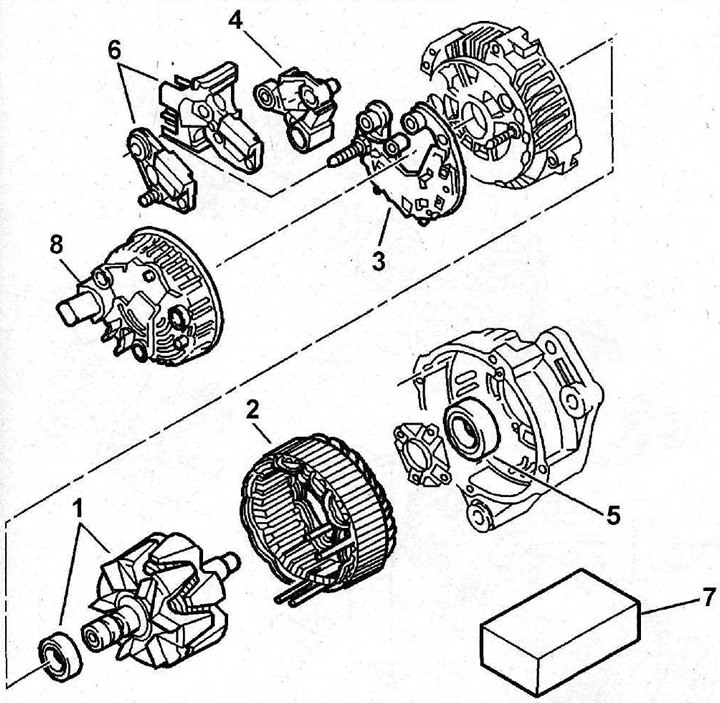
4.0a Valeo Generator
1 - rotor
2 - stator
3 - diode board
4 - voltage regulator
5 - bearing
6 - brush holder
7 - repair kit
8 - back cover
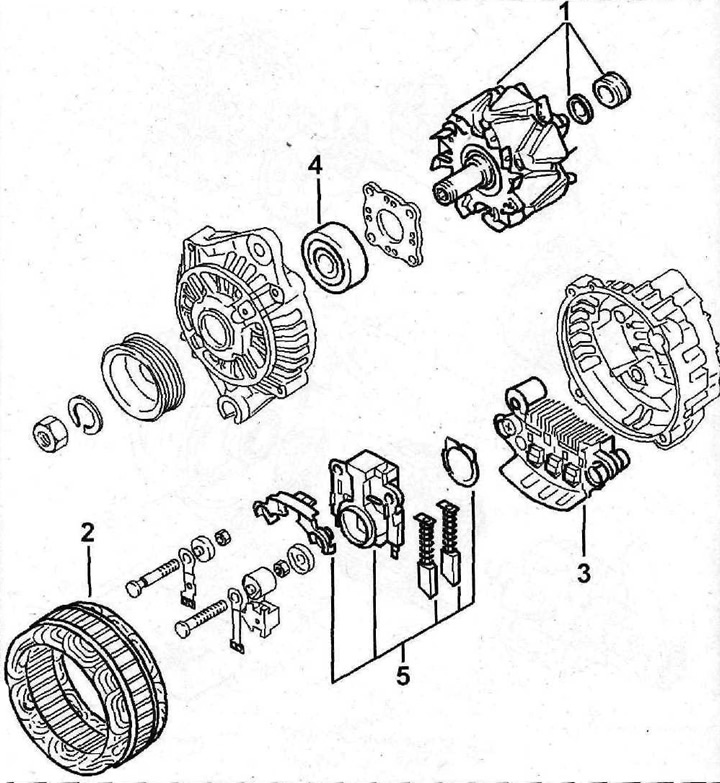
4.0b Mitsubishi Generator
1 - rotor
2 - stator
3 - diode board
4 - bearing
5 - voltage regulator and brushes
The alternator, despite its small size, produces a fairly large amount of electricity. Already at idle speed, approximately 25 A is supplied from the generator to the on-board network, and at an engine speed of 2400 rpm, the generator's performance is almost maximum. The service life of the generator's carbon brushes is over 100,000 km.
[Information posted on the website PEUGEOTBOOK.ru]
The generator, as its name suggests, can only produce alternating current. However, the on-board network requires direct current, because the battery is a source of direct current. Therefore, the generator has a built-in diode rectifier unit that converts alternating current into direct current. Rectifier diodes are very sensitive to voltage clicks.
In order to ensure that the generator's performance is sufficient even at low engine speeds, the generator's rotation speed is greater than that of the crankshaft. This is achieved by installing a belt pulley on the generator shaft that is smaller in diameter than the generator drive belt pulley on the crankshaft shaft. The voltage regulator is mounted on the rear side of the generator.
When working on a generator, certain precautions must be taken:
- Do not disconnect the battery or voltage regulator while the engine is running. This will cause voltage spikes that can damage electronic devices.
- Do not short the generator excitation winding terminal or the wire from this terminal to ground (-).
- Do not reverse the polarity of the voltage regulator wires.
- Do not turn on the voltage regulator if it is shorted to ground (-). In this case, it will be damaged.
- Do not remove the alternator without first disconnecting the battery completely or at least the negative (-) terminal. Otherwise, irreparable damage will inevitably occur.
- Do not use a test light connected to a 110 or 220 V network. A 12 V test light may be used.
- Disconnect the wires from the battery when charging it with a charger without removing it from the car. Instead, connect the wires of the charger, observing the polarity. Failure to observe the polarity will damage the rectifier, voltage regulator, and electronic devices.