



- a) ignition interruptions;
- b) knocks in a cylinder or in several cylinders;
- c) engine overheating;
- d) reduction of the effective engine power;
- d) the appearance of excessively black smoke from the exhaust pipe;
- g) increased fuel consumption;
- c) the appearance of blue smoke from the exhaust pipe when starting a cold engine.
A faulty injector can be identified by loosening the high-pressure fuel line nuts on each injector one by one. The engine must be idling. If, after loosening the fuel line nut on the next injector, the engine continues to run with the same noise or knocking, then this particular injector is faulty.
Checking the injectors for leaks and repairing them should be entrusted to a workshop. These works cannot be done by yourself, because they require special equipment. In addition, there is a risk of injury due to unprofessional performance of these works.
Depending on the engine type and fuel system, different types of injectors are installed. XUD9 engines are equipped with injectors of the same shape, regardless of the manufacturer. These injectors have corresponding marks painted on them (see illustration 3.0).
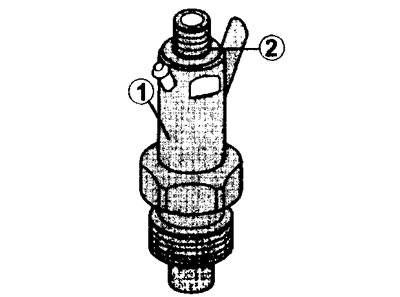
3.0 Fuel injector. At points 1 and 2, the corresponding marks are applied with paint. On injectors manufactured by Bosch, color marking is applied only to the body, at point 1
XUDl I engines can be equipped with different types of injectors.
The injector housings for cylinders 13 are identical. The injector installed on cylinder 4 has a needle stroke sensor designed to detect the start of fuel injection. The signal from this sensor is sent to the electronic control unit of the injection system. Cylinder No. 4 and the corresponding injector are located on the toothed belt side.
Access to the injectors is difficult and therefore, to remove them, it is necessary to dismantle some parts. The injectors are located next to the glow plugs and protrude from the mount on the cylinder head (see illustration 3.0a)
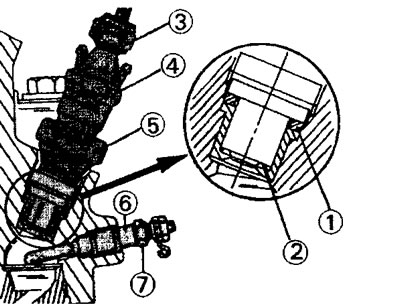
3.0a Fastening the injector to the engine.
1 - copper ring
2 - heat-protective gasket
3 - union nut
4 - nozzle
5 - 27mm hex nut
6 - glow plug
7 - glow plug hex nut
1. Disconnect the negative (-) battery terminal.
2. Unscrew the union nut of the high-pressure fuel line of the corresponding injector and move the fuel line to the side. To loosen the union nuts, you can use a regular wrench, but do not allow the wrench to slip on the nut.
3. Disconnect the return fuel lines.
4. Unscrew the injector using a 27 mm socket wrench. Remove the copper injector sealing ring and heat shield (see illustration).
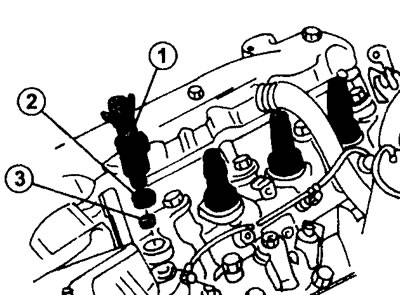
3.4 Unscrew the injector 1 using a 27 mm socket wrench. Remove the copper sealing ring 2 from the injector and the heat-protective gasket 3
5. Replace the copper sealing ring and heat shield. The sequence of installation of the injector is the reverse of removal.
6. Install a new sealing ring, heat shield and screw in the injector (see illustration).
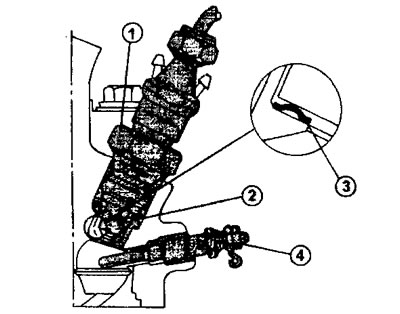
3.6 When installing the injector, the heat-protective gasket must be placed with the convex side facing up.
1 - nozzle
2 - copper sealing ring
3 - heat-protective gasket
4 - glow plug
7. Tighten the injector to a torque of 90 Nm. The union nuts of the fuel lines are tightened to a torque of 20 Nm. When tightening the union nuts, be careful not to damage the hexagon of the nut.
Information copied from the resource (www.PEUGEOTBOOK.ru)