



2. Turn the box over and remove the bolts with special washers securing the tray. If you haven't already, you'll first need to unscrew and remove the nuts that secure the exhaust pipe bracket to the transmission. When removing the bolts, note that 3 of them are longer than the others, and note their position on the gearbox housing.
3. Unscrew and remove the three bolts securing the mesh filter, paying attention to the rubber seal between the filter and the gearbox housing.
4. Remove the 4 bolts securing the oil seal support washer on the final drive (clutch side). Mark the washer and the crankcase so that it can be installed correctly later, and carefully remove the washer, being careful not to lose the adjusting shims. Remove all adjusting washers and put them in one place. The sealing ring located between the lock washer and the crankcase, and the final drive oil seal located in the washer must be replaced during assembly.
5. Remove the 4 large and 4 small bolts securing the differential case to the gearbox housing and remove the differential case. If it doesn't go well, you can tap it with a soft-faced hammer. The differential can be removed from its housing, but be sure to set aside the tapered roller bearing outer races along with their shells. We are not considering differential rebuild here. If it is faulty or badly worn, it should be replaced as a whole or taken to a specialist for repair.
6. Remove the nut and lock screw securing the speedometer drive. Remove the drive.
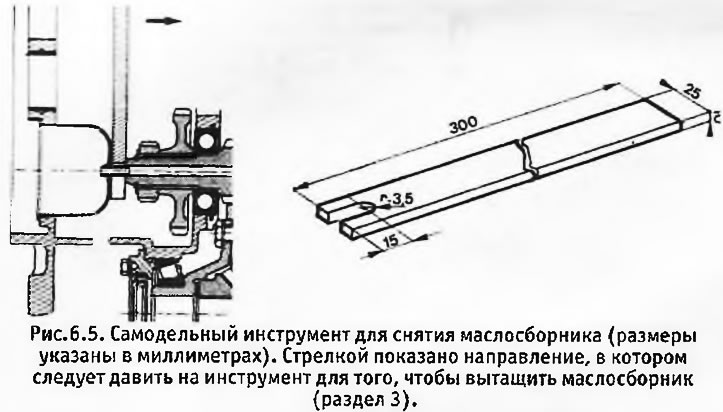
7. An oil collector is installed in the gearbox housing on the clutch side, from which a short tube extends to the secondary shaft. Its function is to direct oil into the shaft to lubricate the driven gear of 1st gear through special bores. To remove the oil pan, you need a special tool, which you can make yourself according to B/Figure 6.5. This figure also shows how to use the tool.
8. Engage reverse gear and carefully push out the cylindrical pin securing the reverse fork to its rod. While keeping the reverse idler gear engaged, engage first gear. This will lock the drive, input, and output shafts, allowing you to loosen the nut on the end of the output shaft (this nut must be replaced during assembly). Immediately install a new nut on the end of the shaft and tighten it to a low torque (approximately 5 kg m). This will allow you to check the axial movement and clearances before removing the secondary shaft.
9. Loosen and remove the 3 bolts securing the triangular plate that holds the input shaft ball bearing.
10. There is a groove on the outer ring of the ball bearing for installing a special puller. If you do not have a special puller, you can remove the ball bearing in the following way. Remove the retaining ring and the disc washer behind it from the end of the input shaft. Note that the outer rim of the Belleville washer contacts the inner bearing race and the inner rim contacts the retaining ring. Carefully drive the drive shaft inward towards the gear blocks. In this case, the ball bearing located at the opposite end of the input shaft will protrude slightly. While holding the bearing in the extended position with screwdrivers pressed into the groove on its outer race, have an assistant carefully hammer the input shaft back into the crankcase. Repeat this procedure until you can remove the ball bearing. Be careful not to apply too much force to the bearing. Each time the bearing should be pushed outwards very slightly.
11. After removing the bearing, disengage the reverse intermediate gear. Remove the 2 bolts securing the primary shaft middle bearing cover and remove the cover. If the cylindrical pins fall out during removal, they must be installed back into the crankcase.
12. Compress the retaining ring at the junction of the drive and input shafts and separate the shafts. Please note that there is a rubber washer in the hole in the primary shaft, against which the end of the drive shaft should rest. This washer must be replaced during assembly. Remove both shafts from the crankcase and move the gear rods to neutral position.
13. Now it is necessary to check the axial movement and clearances of the secondary shaft in order to determine which of its parts need to be replaced.
14. Axial displacement. The easiest way to determine the axial displacement is with a dial gauge mounted on the crankcase so that its button rests on the end of the secondary shaft and the shaft is parallel to the shaft axis. Move the secondary shaft until it stops in each direction along its axis and measure the axial movement of the shaft. Alternatively, you can use a depth gauge, but since the maximum permissible axial movement is only 0.5 mm, a very accurate depth gauge is required so that its readings can be used to assess the condition of the secondary shaft ball bearing, which determines its axial movement. If the axial movement is too large, the bearing and its retaining ring must be replaced and the axial movement must be checked again. If it again exceeds the permissible limits, the gearbox housing must be replaced or (depending on the condition of the box)the entire box assembled.
15. Clearances of driven gears. Each of the secondary shaft gears has a working clearance that allows it to rotate on the sleeve when it is not locked by the synchronizer to rotate the shaft. First, you should check that the inner ring of the needle roller bearing (see B/Figure 6.6), located at the same end of the shaft as the nut, touched the 4th gear sleeve, and the lock nut touched the inner ring of the needle bearing. Using feeler gauges, measure the clearances J1, J2, J3, and J4; they should be 0.2-0.35 mm. If the measured values exceed these limits, the driven gear bushings must be replaced.

16. After this, the centralization of the synchronizers should be checked, but this check is meaningless if the axial movement of the secondary shaft and the clearances of the driven gears do not go beyond the specified limits. However, if the transmission housing or secondary shaft, shift forks, piston rods or locking plungers are to be replaced, this check should be performed after the transmission has been assembled.
17. When the gear forks are in neutral position, the synchronizer rings must be centered in relation to the synchronizer cones. To check this, measure the distances D1, D2, D3 and D4 shown in Figure 6.7. These distances should be equal to each other when the corresponding parts are fully opened. A Peugeot tool is provided to check these distances, but instead you can use a homemade 9 mm wide tool that fits into the corresponding gaps.
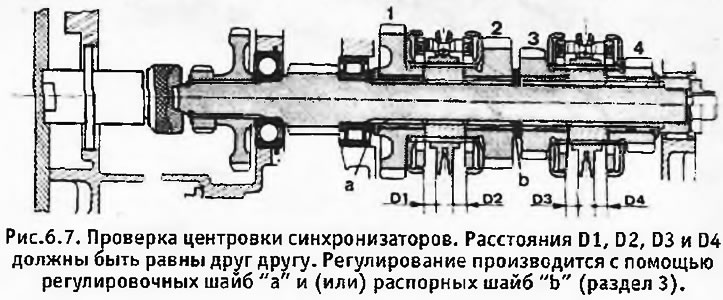
18. Before carrying out the check, lightly load the secondary shaft towards the end nut. There is a special Peugeot tool for this purpose, shown in the attached picture, but instead of it you can use a wooden block with a wedge. In order to properly load the shaft, a special tool is tightened manually (shown in the picture). Check that all forks and rods are in neutral position (checked by the position of the locking plungers).
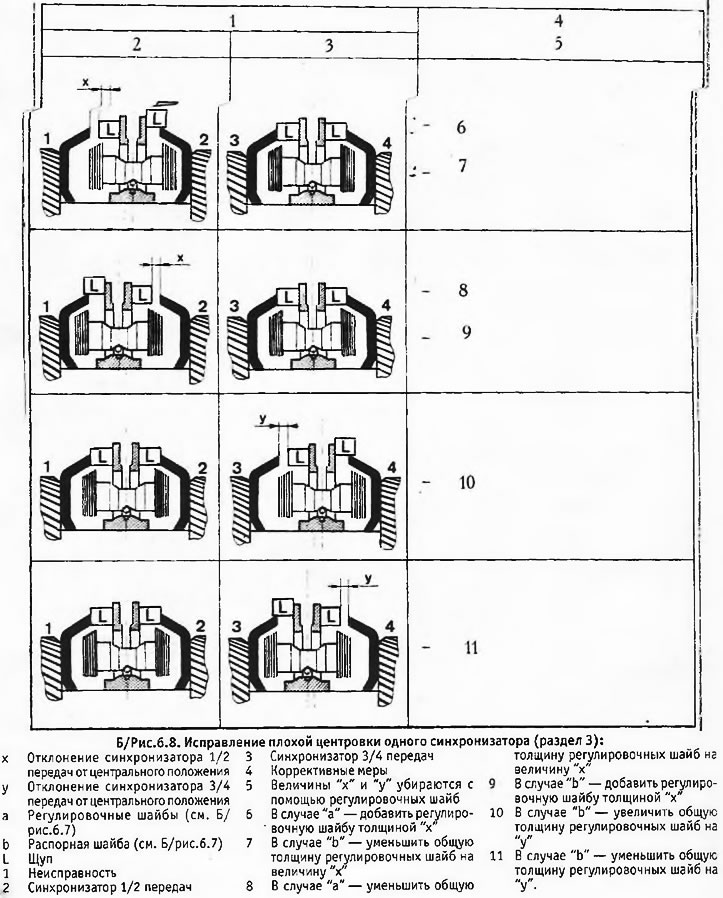
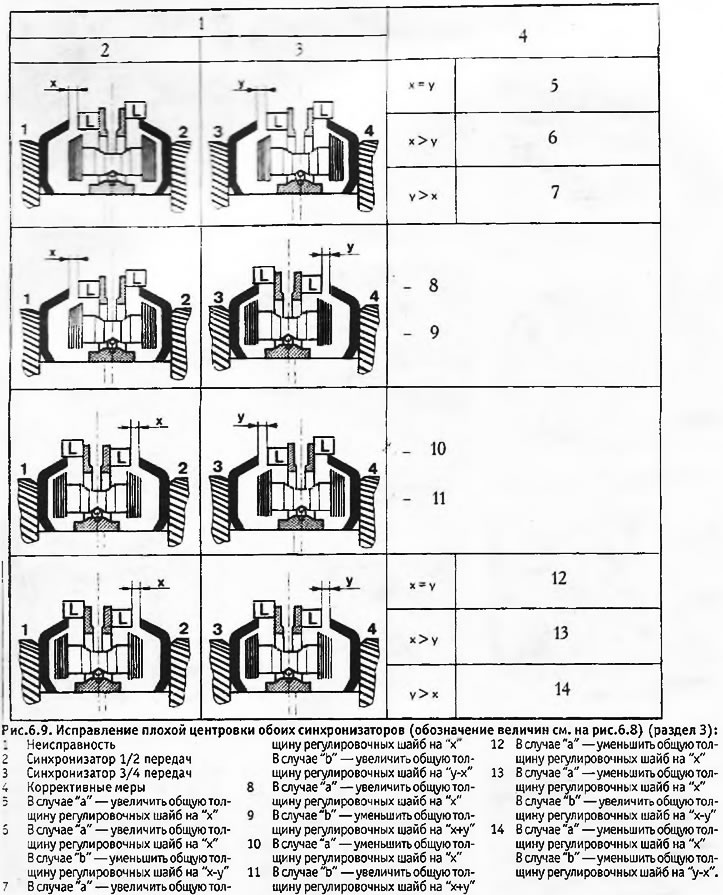
19. Insert the feeler gauge alternately between each of the synchronizer cones and the adjacent surface of the synchronizer hub, being careful not to apply force. Ideally the feeler gauge should fit between the cone and the hub in all four cases, but if this does not happen, refer to B/Figures 6.8 and 6.9, which show the 8 possible cases and the necessary corrective actions. Adjustment is made using adjusting washers "a" and spacer washer "b", shown in the same figures. When disassembling the gearbox, it is enough to simply remember the required thickness of the adjustment parts in order to select them correctly during assembly. After this, you will have to check the gaps again to make sure everything is OK.
20. Remove the wooden block with the wedge used to load the secondary shaft and engage 4th gear. Carefully knock the cylindrical pins out of the fork on the 3/4 gear rod and the reverse intermediate gear shaft. Remove the axle and idler gear from the gearbox and return the piston rods to neutral.
21. Loosen the banjo bolts where the outer oil line attaches to the gearbox and remove the line and bolts with washers. Remove the 4 bolts securing the gearshift cover to the gearbox housing and carefully remove the cover, being careful not to lose the balls and retainer springs. Remove the balls and springs from the crankcase. Remove the old cover gasket (must be replaced with a new one during assembly).
22. Engage the reverse gear lock and carefully turn the rod upward. During this process, the retainer ball should pop out. Grab it so it doesn't get lost and remove the spring. Knock out the roll pin securing the retainer to the reverse gear rod and remove the retainer and rod.
23. Engage 2nd gear and knock out the cylindrical pin securing the 3/4 gear lock to its rod. Knock out the roll pin that secures the 1/2 gear fork to the rod, but leave the punch in the hole for the rod and set the fork to the neutral position. Turn the 3/4 gear rod up 1/4 turn to prevent the locking pin from falling out.
24. Remove both piston rods, 3/4 gear lock, both forks and locking plungers.
25. Remove the nut from the end of the secondary shaft (from the side of the timing mechanism housing). From the other end of the shaft (clutch side) remove the snap ring, disc washer, speedometer drive worm, adjusting washer and reverse driven gear.
26. Working through the hole in which the differential was located, loosen the retaining ring that secures the outer ring of the secondary shaft middle roller bearing and, using a soft-faced hammer, push the shaft outward (towards the clutch). Remove the shaft. Pull the synchronizer and gear assembly out of the crankcase and note the position of the spacer and adjusting washers. Do not remove the synchronizers from their hubs - unless they are to be replaced, they should be installed in their original order.
27. At this point, the disassembly of the box can be considered complete. Further disassembly (removing the secondary shaft ball bearing or drive shaft bushing) may be required only if the relevant parts are in poor condition. If they are in order, it is better not to disassemble the box further. Please note that replacing the drive shaft bushing must be performed by a professional, as alignment of the bushing with the other two bearings is critical.