



The outer and inner shells of the corrugated CV joint boots are made of different materials. The component parts of the drive shafts are shown in Figure 7.0.
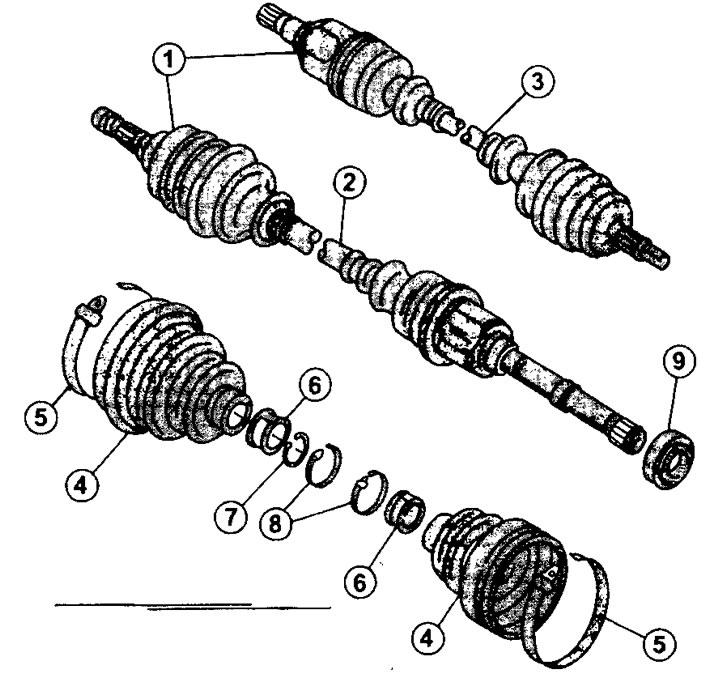
7.0 Components of both drive shafts
1 - external constant velocity joints
2 - right drive shaft
3 - left drive shaft
4 - protective covers for outer and inner CV joints
5 - clamp for fastening the cover on a large diameter
6 - cover bushing
7 - retaining ring
8 - clamp for fastening the cover on a small diameter
9 - thrust bearing
The CV joint components are adjusted to each other and cannot be replaced by installing them on other CV joints.
After removing the protective cover, all parts inside the cover must be cleaned of grease. The use of solvents for these purposes is not permitted.
The thrust bearing, if installed, can be replaced with a new one. However, to remove the old bearing, you need a puller of sufficient length to allow the bearing to be removed from the shaft. Therefore, we recommend entrusting this work to a workshop if there is a need to replace a bearing
34. Clamp the removed drive shaft in a vice, placing soft metal pads on the vice jaws.
35. Remove the clamps that secure the CV joint protective boots.
36. Use needle-nose pliers to bend back the compressed seat belt of the hinge cup. Be careful not to damage the surface of the shaft where the cup fits. Knock the cup off the inner hinge.
37. Remove grease with a clean cloth.
38. Mark the position of the CV joint coupling on the shaft with paint so that you can return it to its original position during assembly.
39. Remove the separator with cylindrical grooves, the separator support cup, the spring and the retaining ring holding the hinge sleeve (see illustration).
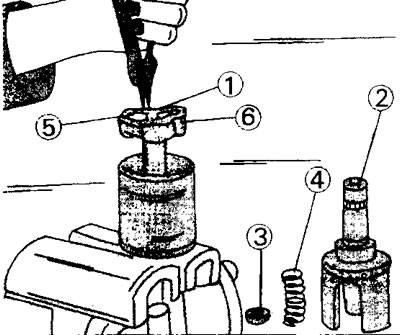
7.39 Disassembling the inner CV joint.
1 - marks of the position of the joint coupling on the shaft
2 - separator with cylindrical grooves
3 - separator support cup
4 - spring
5 - retaining ring
6 - rollers of the hinge coupling. It is recommended to wrap them with an elastic band so that they do not fall out
After removal, the retaining ring must be replaced with a new one.
40. Wrap the ball joint rollers with a rubber band to prevent them from falling out.
Secure the joint sleeve so that the shaft can be pressed out of the sleeve. When pressing out, do not allow the shaft to fall.
42. Remove the protective cover and the rubber ring of the inner hinge.
43. Remove the protective cover of the joint from the shaft and the cover from the second joint.
44. Clean all parts, check their condition and make sure they are not worn out.
The hinge is assembled in the reverse order of disassembly.
45. Lubricate the sealing ring and install it.
In order to secure the cup to the joint separator, you need to bend the edge of the cup seating belt along the entire diameter of the contact with the shaft surface. Use a wooden drift for this.
46. Remove any excess grease.
47. Install the joint coupling onto the shaft, making sure it is not tilted. The marks applied before removing the coupling must match.
49. Drive the joint coupling onto the shaft, placing a socket head of the appropriate diameter and a piece of pipe on it (see illustration).
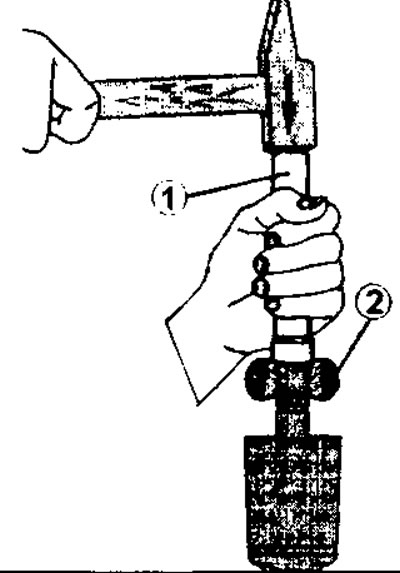
7.49 Drive the coupling of the hinge 2 onto the shaft, placing on its end head 1 of the corresponding diameter and a piece of pipe
50. Secure the joint sleeve to the shaft with a retaining ring (see illustration). The rounded side of the thrust ring must face the coupling.
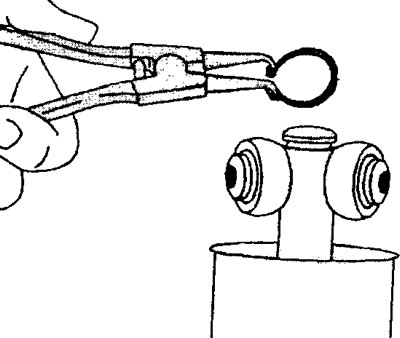
7.50 Secure the joint sleeve to the shaft with a retaining ring
51. Fill the joint with the grease included in the repair kit and put on the protective cover together with the fastening clamp along the large diameter of the cover.
52. Remove air by pulling the protective boot seat belt away from the shaft or by inserting a screwdriver between the boot and the shaft. In this case, you should act carefully so that the screwdriver does not slip and damage the hinge.
53. Install the protective boot on the outer hinge, having first filled the hinge with grease and removed the air from the boot.
54. Remove any excess grease to prevent road dust from accumulating on the drive shaft components and to help the protective boots last longer.
Cars with ABS
Note: To replace the thermoplastic boot installed on the outer CV joint, there is no need to remove the boot from the inner joint. To perform the work, you will need a hammer puller and an adapter with the appropriate thread to screw the puller onto the shaft for subsequent removal of the joint. If such devices are not available, the dismantled drive shaft can be brought to a workshop to replace the boot or boots of both CV joints.
55. Remove both clamps securing the protective boot to the outer hinge and secure the drive shaft in a vice.
56. Remove the protective cover as shown in the illustration. This same illustration shows the procedure for removing the outer joint from the shaft using a hammer puller. If you don't have such a puller, you can knock off the joint with a rubber hammer.
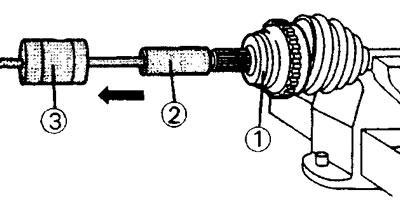
7.56 Remove the protective cover and the hinge itself using a hammer puller 2 and adapter 1
57. Using a screwdriver or pliers, remove the retaining ring from the groove at the end of the drive shaft.
58. Remove both clamps securing the protective boot to the inner joint and secure the shaft in a vice, placing it vertically with the joint facing upwards.
59. Remove the separator, spring and separator support cup (see illustration 7.39). Wrap the hinge sleeve with a rubber band to prevent the rollers from falling out.
60. Install the joint coupling so that the shaft can be knocked out of it. Take care to prevent the shaft from falling when disconnecting from the coupling.
61. Remove the remaining protective CV joint boot from the shaft. If the work is being performed on the right drive shaft and the support bearing needs to be replaced, the shaft can now be taken to a repair shop.
The installation of the protective cover is carried out as follows.
62. Place it on the shaft from the outer joint side and leave it on the shaft.
63. Install the retaining ring into the groove on the shaft. To make installation of the ring easier, you can use a hose clamp and, placing it on the retaining ring, press it into the groove (see illustration).
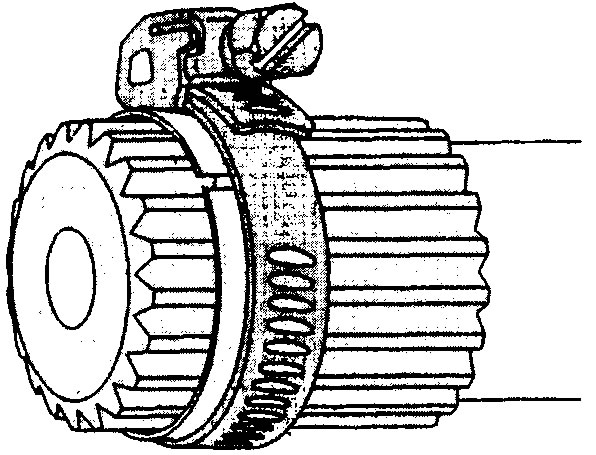
7.63 Install the retaining ring into the groove on the shaft. To make installation of the ring easier, you can use a hose clamp and, placing it on the retaining ring, press it into the groove
64. Install the hinge housing onto the shaft and tap it with a rubber or plastic hammer. The clamp that holds the retaining ring will shift and can be removed.
65. Fill the hinge protective boot with approximately 160 g of grease.
66. Place the protective cover over the hinge and secure it with both clamps. Usually, special pliers are used to tighten clamps.
67. Tap the joint sleeve onto the shaft using a rubber mallet and socket head (see illustration 7.49) and fill the protective cover and the coupling with approximately 160 g of grease from the repair kit.
68. Install the separator support cup, separator and spring (see illustration 7.39).
69. Secure the protective boot to the CV joint. Make sure the thick part of the boot fits snugly into the groove on the CV joint housing
70. Tighten the clamps securing the protective cover to the CV joint.